



Sargocentron diadema (Lacepède, 1802)
Crown squirrelfish
Ajouter votre observation dans Fish Watcher
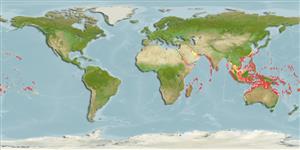
| Native range | All suitable habitat | Point map | Year 2050 |
|
| This map was computer-generated and has not yet been reviewed. |
| Sargocentron diadema AquaMaps Data sources: GBIF OBIS |
Envoyez vos Photos et vidéos
Images | vidéos | Images Google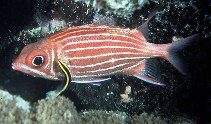 Sargocentron diadema
Photo de Randall, J.E.
Images | vidéos | Images Google
Photo de Randall, J.E.
Classification / Noms Noms communs | Synonymes | Catalog of Fishes(Genre, Espèce) | ITIS | CoL | WoRMS | Cloffa
> Holocentriformes (Squirrelfishes, soldierfishes) > Holocentridae (Squirrelfishes, soldierfishes) > Holocentrinae
Etymology: Sargocentron: Greek, sargos = sargus + Greek, kentron = sting (Ref. 45335).
More on author: Lacepède.
Etymology: Sargocentron: Greek, sargos = sargus + Greek, kentron = sting (Ref. 45335).
More on author: Lacepède.
Environnement : milieu / zone climatique / profondeur / gamme de distribution Écologie
marin récifal; profondeur 1 - 60 m (Ref. 27370), usually 2 - 30 m (Ref. 30573). Tropical; 30°N - 33°S, 27°E - 128°W
Distribution Territoires | Zones FAO | Écosystèmes | Occurrences | Carte par point | Introductions | Faunafri
Indo-Pacific: Red Sea and East Africa to the Hawaiian and Pitcairn islands, north to the Ryukyu and Ogasawara islands, south to northern Australia and Lord Howe Island. Throughout Micronesia (Ref. 1602).
Taille / Poids / Âge
Description synthétique Clés d'identification | Morphologie | Morphométrie
Épines dorsales (Total) : 11; Rayons mous dorsaux (Total) : 12 - 14; Épines anales: 4; Rayons mous anaux: 8 - 9. Body with alternating broad red and narrower silvery white stripes (Ref. 4201); red head with 2 vertical white streaks on the opercle, one on its edge and an oblique one below the eye; distinctive reddish-black to black dorsal fin with two white streaks. Five or 6 oblique rows of scales on cheek. Maxilla nearly reaching or extending slightly beyond a vertical at anterior edge of the pupil; upper jaw length 2.75-2.95 in head length. Body depth 2.75-3.25 in SL; head length 2.7-3.15 in SL; snout length 4.0-4.4 in head length; interorbital width 4.4-4.9 in head length; premaxillary groove extending slightly posterior to a vertical at anterior edge of orbit; anterior end of nasal bone rounded; medial margin of nasal bone without spinule; nasal fossa without spinules on its edge; upper edge of suborbital bones below anterior half of eye spineless; small preopercular spine, its length 2-3 times in orbit diameter, 2.85-3.5 in head length; longest 4th dorsal spines, 1.7-2.25 in head length; third anal spine 1.2-1.35 in head length (Ref. 27370).
Body shape (shape guide): fusiform / normal; Cross section: compressed.
Body shape (shape guide): fusiform / normal; Cross section: compressed.
A common species that inhabits shallow coral reefs (Ref. 58534) and lagoon and seaward reefs to depths of 30 m or more. Benthopelagic (Ref. 58302). Occurs under ledges or in crevices during the day and feeds on isopods; at night it roams over open sand and low-profile reef areas to feed on polychaetes and small crabs. Stomach contents listed gastropods (e.g. Atys sp.), polychaetes, small clams, solenogastrid, isopods, brachyuran crabs, and other crustaceans (Ref. 27370). Tends to occur in aggregations (Ref. 30573). Venomous spine on its preopercle. Size rarely exceeds 13 cm. Minimum depth reported taken from Ref. 30874.
Cycle de vie et comportement reproducteur Maturité | Reproduction | Frai | Œufs | Fécondité | Larves
Référence principale
Téléchargez vos références | Références | Coordinateur : Randall, John E. | Collaborateurs
Randall, J.E., 1998. Revision of the Indo-Pacific squirrelfishes (Beryciformes: Holocentridae: Holocentrinae) of the genus Sargocentron, with descriptions of four new species. Indo-Pac. Fish. (27):105 p. (Ref. 27370)
Statut dans la liste rouge de l'IUCN (Ref. 130435: Version 2025-2 (Global))
Préoccupation mineure (LC) ; Date assessed: 04 March 2015
CITES
Not Evaluated
Menace pour l'homme
Venomous (Ref. 2334)
Utilisations par l'homme
Pêcheries: intérêt commercial mineur; Aquarium: Commercial
FAO - Publication: search | FishSource | Sea Around Us
Plus d'informations
Écologie trophique
Aliments (proies)
Composition du régime alimentaire
Consommation alimentaire
Rations alimentaires
Prédateurs
Aliments (proies)
Composition du régime alimentaire
Consommation alimentaire
Rations alimentaires
Prédateurs
Dynamique des populations
Paramètres de croissance
Âges / tailles maximales
Longueur-poids rel.
Rel. longueur-longueur.
Fréquences de longueurs
Conversion de masse
Recrutement
Abondance
Paramètres de croissance
Âges / tailles maximales
Longueur-poids rel.
Rel. longueur-longueur.
Fréquences de longueurs
Conversion de masse
Recrutement
Abondance
Cycle de vie
Reproduction
Maturité
Maturité/épines rel.
Fécondité
Frai
Agrégats de frai
Œufs
Développement de l'œuf
Larves
Dynamique des populations larvaires
Reproduction
Maturité
Maturité/épines rel.
Fécondité
Frai
Agrégats de frai
Œufs
Développement de l'œuf
Larves
Dynamique des populations larvaires
Physiologie
Composition corporelle
Nutriments
Consommation d'oxygène
Type de natation
Vitesse de nage
Pigments visuels
Son de poisson
Maladies et parasites
Toxicité (CL50)
Composition corporelle
Nutriments
Consommation d'oxygène
Type de natation
Vitesse de nage
Pigments visuels
Son de poisson
Maladies et parasites
Toxicité (CL50)
Génétique
génôme
Génétique
Hétérozygotie
Héritabilité
Diversité génétique
génôme
Génétique
Hétérozygotie
Héritabilité
Diversité génétique
Liées à l'homme
Systèmes d'aquaculture
Profils d'aquaculture
Souches
Cas de ciguatera
Timbres, pièces de monnaie, divers
Systèmes d'aquaculture
Profils d'aquaculture
Souches
Cas de ciguatera
Timbres, pièces de monnaie, divers
Outils
Quiz bio | E-book | Guide de terrain | Clés d'identification | Générateur de fréquences de longueur | Outil de dynamique de population | Carte par point |
Capture-MSY |
Articles particuliers
Télécharger en XML
Sources Internet
AFORO (otoliths) | Aquatic Commons | BHL | Cloffa | Websites from users | FishWatcher | CISTI | Catalog of Fishes: Genre, Espèce | DiscoverLife | ECOTOX | FAO - Publication: search | Faunafri | Fishipedia | Fishtrace | GloBI | Google Books | Google Scholar | Google | IGFA World Record | Bases de données nationales | OneZoom | Open Tree of Life | Otolith Atlas of Taiwan Fishes | Aquariums publics | PubMed | Reef Life Survey | Socotra Atlas | TreeBase | Arbre de Vie | Wikipedia: aller à, chercher | World Records Freshwater Fishing | Zoological Record
Estimations basées sur des modèles
Température préférée (Réf. 123201): 24.7 - 29, mean 27.7 °C (based on 1144 cells).
Indice de diversité phylogénétique (Réf. 82804): PD50 = 0.5000 [Uniqueness, from 0.5 = low to 2.0 = high].
Bayesian length-weight: a=0.01660 (0.01092 - 0.02523), b=2.98 (2.86 - 3.10), in cm total length, based on LWR estimates for this species & Genus-body shape (Ref. 93245).
Niveau trophique (Réf. 69278): 3.4 ±0.2 se; based on diet studies.
Generation time: 1.0 ( na - na) years. Estimated as median ln(3)/K based on 2 growth studies.
Résilience (Réf. 120179): Haut, temps minimum de doublement de population inférieur à 15 mois (K=1.13).
Nutriments (Ref. 124155): Calcium = 84.8 [33.5, 355.9] mg/100g; Iron = 0.696 [0.281, 2.192] mg/100g; Protein = 18.5 [17.3, 19.7] %; Omega3 = 0.157 [0.066, 0.371] g/100g; Selenium = 42.2 [22.9, 82.5] μg/100g; VitaminA = 54.4 [19.7, 155.9] μg/100g; Zinc = 2.32 [0.96, 4.43] mg/100g (wet weight);