



Pseudorasbora parva (Temminck & Schlegel, 1846)
Stone moroko
Hochladen Photos und videos
Bilder | Google Bild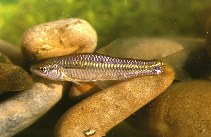 Pseudorasbora parva
Photo von Lorenzoni, M.
Bilder | Google Bild
Photo von Lorenzoni, M.
Klassifizierung / Names Namen | Synonyme | Catalog of Fishes(Gattung, Arten) | ITIS | CoL | WoRMS | Cloffa
> Cypriniformes (Carps) > Gobionidae (Gudgeons)
Etymology: Pseudorasbora: Greek, pseudes = false + Rasbora, an Indian word for a fish, also used in Malay peninsula.
More on authors: Temminck & Schlegel.
Etymology: Pseudorasbora: Greek, pseudes = false + Rasbora, an Indian word for a fish, also used in Malay peninsula.
More on authors: Temminck & Schlegel.
Umwelt: Milieu / Klimazone / Tiefenbereich / Verbreitungsgebiet Ökologie
; süßwasser; brackwasser benthopelagisch; pH range: ? - 7.0; dH range: ? - 15. Temperate; 5°C - 22°C (Ref. 2060); 54°N - 22°N, 110°E - 141°E
Verbreitung Territorien | FAO Gebiete | Ökosysteme | Vorkommen | Punkt Karte | Einführungen | Faunafri
Asia: Amur to Zhujiang [Pearl River] drainages in Siberia, Korea and China (Ref. 59043). Introduced to various areas in Europe and Asia. Several countries report adverse ecological impact after introduction (Ref. 1739).
Länge bei der ersten Reifung / Größe / Gewicht / Alter
Geschlechtsreife: Lm 3.0 range ? - ? cm
Max length : 12.5 cm TL Männchen/unbestimmt; (Ref. 88166); common length : 8.0 cm TL Männchen/unbestimmt; (Ref. 1441); max. veröff. Alter: 5 Jahre (Ref. 56557)
Max length : 12.5 cm TL Männchen/unbestimmt; (Ref. 88166); common length : 8.0 cm TL Männchen/unbestimmt; (Ref. 1441); max. veröff. Alter: 5 Jahre (Ref. 56557)
Kurzbeschreibung Bestimmungsschlüssel | Morphologie | Morphometrie
Rückenflossenstacheln (insgesamt) : 3; Rückenflossenweichstrahlen (insgesamt) : 7; Afterflossenstacheln: 3; Afterflossenweichstrahlen: 6. Mouth superior and transverse; 6 branched anal rays; barbels absent; distal margin of dorsal convex; large adults with sexually dimorphic coloration (Ref. 43281).
Body shape (shape guide): fusiform / normal.
Body shape (shape guide): fusiform / normal.
Found in a wide variety of habitats, most abundantly in well vegetated small channels, ponds and small lakes (Ref. 59043). Adults occur in cool running water. Feed on small insects, fish and fish eggs (Ref. 30578), and plant material (Ref. 59043). Usually breed in habitats with still or very slow-flowing water (Ref. 59043). Females spawn 3-4 times in a season (Ref. 59043). Males clear the surface of the spawning site and guard the eggs until they hatch (Ref. 59043). Regarded as pest which competes with the fry of other species due to its high reproductive rate (Ref. 1739).
Lebenszyklus und Paarungsverhalten Geschlechtsreife | Fortpflanzung | Ablaichen | Eier | Fruchtbarkeit | Larven
Nests under stones and the male cleans the cavity with its pearl organs. Eggs adhere to the ceiling of the cavity. The male leaves the nest before the eggs hatch. Females spawn 3-4 times during a season (Ref. 59043).
Hauptreferenz
Laden Sie Ihre Referenzen hoch | Referenzen | Koordinator | Partner
Kottelat, M. and J. Freyhof, 2007. Handbook of European freshwater fishes. Publications Kottelat, Cornol and Freyhof, Berlin. 646 pp. (Ref. 59043)
IUCN Rote Liste Status (Ref. 130435: Version 2025-2 (Global))
nicht bedroht (LC) ; Date assessed: 14 April 2020
CITES
Not Evaluated
Bedrohung für Menschen
Potential pest
Nutzung durch Menschen
Fischereien: nicht kommerziell; Aquarium: Kommerziell
FAO - Publication: search | FishSource |
Mehr Information
Trophische Ökologie
Lebensmittel (Beutetiere)
Nahrungszusammensetzung
Nahrungsaufnahme
Lebensmittelrationen
Räuber
Lebensmittel (Beutetiere)
Nahrungszusammensetzung
Nahrungsaufnahme
Lebensmittelrationen
Räuber
Populationsdynamik
Wachstumsparameter
Max. Alter/Größen
Länge-Gewicht-Rel.
Länge-Länge-Verhältnis.
Längenhäufigkeiten
Massenkonvertierung
Rekrutierung
Dichte
Wachstumsparameter
Max. Alter/Größen
Länge-Gewicht-Rel.
Länge-Länge-Verhältnis.
Längenhäufigkeiten
Massenkonvertierung
Rekrutierung
Dichte
Lebenszyklus
Fortpflanzung
Geschlechtsreife
Reifung/Kiemen rel.
Fruchtbarkeit
Ablaichen
Laichaggregationen
Eier
Eientwicklung
Larven
Larven Pop.Dyn.
Fortpflanzung
Geschlechtsreife
Reifung/Kiemen rel.
Fruchtbarkeit
Ablaichen
Laichaggregationen
Eier
Eientwicklung
Larven
Larven Pop.Dyn.
Anatomie
Kiemenoberfläche
Gehirn
Otolith
Kiemenoberfläche
Gehirn
Otolith
Physiologie
Körperliche Zusammensetzung
Nährstoffe
Sauerstoffverbrauch
Schwimmart
Schwimmgeschwindigkeit
Visuelle Pigmente
Fischgeräusche
Krankheiten und Parasiten
Toxizität (LC50s)
Körperliche Zusammensetzung
Nährstoffe
Sauerstoffverbrauch
Schwimmart
Schwimmgeschwindigkeit
Visuelle Pigmente
Fischgeräusche
Krankheiten und Parasiten
Toxizität (LC50s)
Menschenbezogen
Aquakultur-Systeme
Aquakultur Profile
Zuchtlinien
Ciguatera-Fälle
Briefmarken, Münzen, Verschiedenes.
Aquakultur-Systeme
Aquakultur Profile
Zuchtlinien
Ciguatera-Fälle
Briefmarken, Münzen, Verschiedenes.
Tools
Bio-Quiz | E-Book | Feldführer | Bestimmungsschlüssel | Längenhäufigkeits Tool | Lebensdaten Tool | Punkt Karte |
Catch-MSY |
Zusatzinformationen
Download XML
Zusammenfassung | Punktdaten | Namen | Photos
Internet Quellen
AFORO (otoliths) | Alien/Invasive Species database | Aquatic Commons | BHL | Cloffa | Websites from users | FishWatcher Einträge suchen | CISTI | Catalog of Fishes: Gattung, Arten | DiscoverLife | ECOTOX | FAO - Publication: search | Faunafri | Fishipedia | Fishtrace | GloBI | Google Books | Google Scholar | Google | IGFA World Record | Nationale Datenbanken | OneZoom | Open Tree of Life | Otolith Atlas of Taiwan Fishes | Öffentliche Aquarien | PubMed | Reef Life Survey | Socotra Atlas | TreeBase | Tree of Life | Wikipedia: Gehe zu, Suchen | World Records Freshwater Fishing | Zoologischer Rekord
Schätzungen auf der Grundlage von Modellen
Phylogenetischer Diversitätsindex (Ref. 82804): PD50 = 0.5312 [Uniqueness, from 0.5 = low to 2.0 = high].
Bayesian length-weight: a=0.00776 (0.00666 - 0.00905), b=3.13 (3.09 - 3.17), in cm total length, based on LWR estimates for this species (Ref. 93245).
Trophische Ebene (Ref. 69278): 3.1 ±0.1 se; based on diet studies.
Generation time: 4.5 ( na - na) years. Estimated as median ln(3)/K based on 2 growth studies.
Widerstandsfähigkeit (Ref. 120179): mittel, Verdopplung der Population dauert 1,4 - 4,4 Jahre. (tm=1; tmax=5; K=0.24; Fec=1,000).