



Tigrigobius digueti (Pellegrin, 1901)
Banded cleaner goby
Carregue seu(sua) Fotos e vídeos
Fotos | Imagem do Google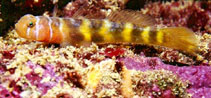 Tigrigobius digueti
Foto de Robertson, R.
Fotos | Imagem do Google
Foto de Robertson, R.
Classificação / Nomes Nomes comuns | Sinônimos | Catalog of Fishes(Gênero, Espécies) | ITIS | CoL | WoRMS | Cloffa
> Gobiiformes (Gobies) > Gobiidae (Gobies) > Gobiinae
Eponymy: Léon Diguet (1859–1926) was a French chemical engineer and geologist who was employed at a copper mine at Santa Rosalia, Baja California (1889–1892). [...] (Ref. 128868), visit book page.
More on author: Pellegrin.
Eponymy: Léon Diguet (1859–1926) was a French chemical engineer and geologist who was employed at a copper mine at Santa Rosalia, Baja California (1889–1892). [...] (Ref. 128868), visit book page.
More on author: Pellegrin.
Taxonomic Remarks
Junior synonym Tigrigobius inornatus (Bussing, 1990) is considered a valid species by some authors (see van Tassell 2011, Ref. 89468 for other works; Parenti etal,, 2024: Ref. 129193:281). Please send references or more studies are needed.
Meio ambiente: milieu / Zona climática / intervalo de profundidade / faixa de distribuição Ecologia
marinhas associadas(os) a recifes; intervalo de profundidade ? - 21 m (Ref. 87125), usually ? - 15 m (Ref. 87125). Tropical
Distribuição Territórios | Áreas da FAO | Ecossistemas | Ocorrências | Mapa de pontos | Introduções | Faunafri
Eastern Pacific: from Cabo San Lucas in southern Baja California north to the central Gulf of California, and south to central Mexico.
Tamanho / Peso / Idade
Descrição suscinta Chaves de identificação | Morfologia | Morfometria
Espinhos dorsais (total) : 6 - 7; Raios dorsais (total) : 9 - 11; Espinhos anais: 1; Raios anais : 8 - 10. Distinguished by the following characters: head plump, more or less rounded, dorsoventrally compressed; mouth slightly oblique, forming an angle of about 20° to 25° with body axis; maxilla extending under middle to rear margin of eye, occasionally only to front of pupil; profile of snout steeply rounded in lateral view; interorbital narrow equal to or less than one-half eye length; gill-rakers on outer face of first arch short and slender; those on second and following arches shorter; mandibular frenum without lobes; anterior nostril a short tube, posterior nostril with a raised rim; most males with first, rarely second, first dorsal-fin spines filamentous, the first reaching to last first dorsal-fin spine base to second ray base of second dorsal fin, and occasionally to the ninth dorsal-fin ray base; scales absent (Ref. 87125).
Body shape (shape guide): elongated.
Body shape (shape guide): elongated.
Inhabits coral and rocky reefs (Ref. 11482). Mobile-invertebrate feeder (Ref. 57615). Picks ectoparasites from other fishes.
Ciclo de vida ou comportamento de acasalamento Maturidade | Reprodução | Desova | Ovos | Fecundidade | Larvas
Referência principal
Carregar suas referências | Referências | Coordenador | Colaboradores
Allen, G.R. and D.R. Robertson, 1994. Fishes of the tropical eastern Pacific. University of Hawaii Press, Honolulu. 332 p. (Ref. 11482)
Status na Lista Vermelha da UICN (Ref. 130435: Version 2025-2 (Global))
Segura ou pouco preocupante (LC) ; Date assessed: 15 February 2024
CITES
Not Evaluated
Ameaça para os humanos
Harmless
Uso pelos humanos
FAO - Publication: search | FishSource |
Mais informação
Ecologia Trófica
Itens alimentares (presas)
Composição da dieta
Consumo alimentar
Rações alimentares
Predadores
Itens alimentares (presas)
Composição da dieta
Consumo alimentar
Rações alimentares
Predadores
Ecologia
Ecologia
Ecologia
Dinâmica populacional
Parâmetros de crescimento
Idade máxima / tamanhos
Relação comprimento-peso.
Relação comprimento-comprimento.
Frequências de comprimento
Conversão de massa
Recrutamento
Abundância
Parâmetros de crescimento
Idade máxima / tamanhos
Relação comprimento-peso.
Relação comprimento-comprimento.
Frequências de comprimento
Conversão de massa
Recrutamento
Abundância
Ciclo de vida
Reprodução
Maturidade
Maturidade/Rel. das guelras
Fecundidade
Desova
Agregações de desova
Ovos
Desenvolvimento dos ovos
Larvas
Dinâmica larval
Reprodução
Maturidade
Maturidade/Rel. das guelras
Fecundidade
Desova
Agregações de desova
Ovos
Desenvolvimento dos ovos
Larvas
Dinâmica larval
Anatomia
Área branquial
Cérebro
Otólito
Área branquial
Cérebro
Otólito
Fisiologia
Composição corporal
Nutrientes
Consumo de oxigênio
Tipo de natação
Velocidade de natação
Pigmentos visuais
Som de peixe
Doenças e Parasitas
Toxicidade (LC50s)
Composição corporal
Nutrientes
Consumo de oxigênio
Tipo de natação
Velocidade de natação
Pigmentos visuais
Som de peixe
Doenças e Parasitas
Toxicidade (LC50s)
Genética
genoma
Genética
Heterozigosidade
Hereditariedade
Diversidade genética
genoma
Genética
Heterozigosidade
Hereditariedade
Diversidade genética
Relacionado a humanos
Sistemas de aquicultura
Perfis para aquacultura
Estirpes
Casos de Ciguatera
Selos, moedas, diversos.
Sistemas de aquicultura
Perfis para aquacultura
Estirpes
Casos de Ciguatera
Selos, moedas, diversos.
Ferramentas
Livro eletrônico | Guia de campo | Ferramenta auxiliar de frequências de comprimento | Ferramenta sobre a história de vida | Mapa de pontos |
Catch-MSY |
Relatórios especiais
Checar Manutenção em Aquário | Checar Planilhas de Fatos sobre as Espécies | Checar Planilhas de Fatos sobre Aquicultura
Baixar XML
Fontes da internet
AFORO (otoliths) | Aquatic Commons | BHL | Cloffa | Websites from users | Checar Observador de Peixes (FishWatcher) | CISTI | Catalog of Fishes: Gênero, Espécies | DiscoverLife | ECOTOX | FAO - Publication: search | Faunafri | Fishipedia | Fishtrace | GloBI | Google Books | Google Scholar | Google | IGFA World Record | OneZoom | Open Tree of Life | Otolith Atlas of Taiwan Fishes | PubMed | Reef Life Survey | Socotra Atlas | TreeBase | Árvore da vida | Wikipedia: Ir para, procura | World Records Freshwater Fishing | Registro zoológico
Estimativas baseadas em modelos
Índice de diversidade filogenética (Ref. 82804): PD50 = 0.5000 [Uniqueness, from 0.5 = low to 2.0 = high].
Bayesian length-weight: a=0.00933 (0.00505 - 0.01724), b=3.15 (2.99 - 3.31), in cm total length, based on LWR estimates for this species & (Sub)family-body (Ref. 93245).
Nível Trófico (Ref. 69278): 3.1 ±0.3 se; based on size and trophs of closest relatives
Resiliência (Ref. 120179): Elevada, tempo mínimo de duplicação da população menor que 15 meses (Preliminary K or Fecundity.).