



Australoheros facetus (Jenyns, 1842)
Chameleon cichlid
Hochladen Photos und videos
Bilder | Google Bild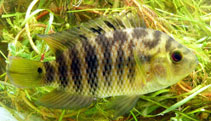 Australoheros facetus
Photo von Loureiro, M.
Bilder | Google Bild
Photo von Loureiro, M.
Klassifizierung / Names Namen | Synonyme | Catalog of Fishes(Gattung, Arten) | ITIS | CoL | WoRMS | Cloffa
> Cichliformes (Cichlids, convict blennies) > Cichlidae (Cichlids) > Cichlinae
Etymology: Australoheros: From the Latin word 'australis' meaning southern, and the name Heros, after the nominotypic genus of the Heroini tribe. Tribe.
More on author: Jenyns.
Etymology: Australoheros: From the Latin word 'australis' meaning southern, and the name Heros, after the nominotypic genus of the Heroini tribe. Tribe.
More on author: Jenyns.
Umwelt: Milieu / Klimazone / Tiefenbereich / Verbreitungsgebiet Ökologie
; süßwasser benthopelagisch; pH range: 6.5 - 7.0; dH range: 5 - 12. Subtropical; 25°C - 30°C (Ref. 1672)
Verbreitung Territorien | FAO Gebiete | Ökosysteme | Vorkommen | Punkt Karte | Einführungen | Faunafri
South America: Coastal drainages of Uruguay and Rio Grande do Sul, Brazil; Paraná River basin, lower part of Paraná River in Argentina.
Größe / Gewicht / Alter
Geschlechtsreife: Lm ? range ? - ? cm
Max length : 19.3 cm SL Männchen/unbestimmt; (Ref. 56003); common length : 18.0 cm TL Männchen/unbestimmt; (Ref. 36377); max. veröff. Alter: 10 Jahre (Ref. 40602)
Max length : 19.3 cm SL Männchen/unbestimmt; (Ref. 56003); common length : 18.0 cm TL Männchen/unbestimmt; (Ref. 36377); max. veröff. Alter: 10 Jahre (Ref. 40602)
Kurzbeschreibung Bestimmungsschlüssel | Morphologie | Morphometrie
Rückenflossenstacheln (insgesamt) : 15 - 17; Rückenflossenweichstrahlen (insgesamt) : 9 - 11; Afterflossenstacheln: 5 - 7; Afterflossenweichstrahlen: 7 - 9. This species differs from its congeners in having a lower jaw longer than upper and mouth pointing upwards; has the shortest dorsal scale cover and the least scaled dorsal and anal fins among (together with A. tembe); with four abdominal bars (present in more than 80% of individuals as compared to 50% or less in all other species (Ref. 74689).
Body shape (shape guide): short and / or deep.
Body shape (shape guide): short and / or deep.
An opportunistic diurnal feeder, eating detritus and plant material, preying on small aquatic animals, including small fish. Very resistant to low temperatures. (Ref. 59043). Common in creeks, rivers, swamps and lakes (Ref. 74689). This species is an easy open spawner that lays its eggs on a stone or piece of wood (Ref. 12251). Both parents care for the eggs and fry (Ref. 12251). Consumed locally. Reported to reach 25.0 cm SL (Ref. 59043).
Lebenszyklus und Paarungsverhalten Geschlechtsreife | Fortpflanzung | Ablaichen | Eier | Fruchtbarkeit | Larven
This species is an easy open spawner that lays its eggs on a stone or piece of wood. Both parents care for the eggs and fry (Ref. 12251). In Europe where it has invaded native drainages, spawns when temperature rises above 28-30°C. Forms pairs during spawning and both sexes are territorial. Females deposits eggs on exposed hard surfaces such as stones or wood. Both parent guard larvae and juveniles for 1-3 weeks (Ref. 59043).
Hauptreferenz
Laden Sie Ihre Referenzen hoch | Referenzen | Koordinator : Kullander, Sven O. | Partner
Říčan, O. and S.O. Kullander, 2008. The Australoheros (Teleostei: Cichlidae) species of Uruguay and Paraná River drainages. Zootaxa 1724:1-51. (Ref. 74689)
IUCN Rote Liste Status (Ref. 130435: Version 2025-2 (Global))
nicht bedroht (LC) ; Date assessed: 18 February 2021
CITES
Not Evaluated
Bedrohung für Menschen
Harmless
Nutzung durch Menschen
Fischereien: nicht kommerziell; Aquarium: Kommerziell
FAO - Publication: search | FishSource |
Mehr Information
Trophische Ökologie
Lebensmittel (Beutetiere)
Nahrungszusammensetzung
Nahrungsaufnahme
Lebensmittelrationen
Räuber
Lebensmittel (Beutetiere)
Nahrungszusammensetzung
Nahrungsaufnahme
Lebensmittelrationen
Räuber
Populationsdynamik
Wachstumsparameter
Max. Alter/Größen
Länge-Gewicht-Rel.
Länge-Länge-Verhältnis.
Längenhäufigkeiten
Massenkonvertierung
Rekrutierung
Dichte
Wachstumsparameter
Max. Alter/Größen
Länge-Gewicht-Rel.
Länge-Länge-Verhältnis.
Längenhäufigkeiten
Massenkonvertierung
Rekrutierung
Dichte
Lebenszyklus
Fortpflanzung
Geschlechtsreife
Reifung/Kiemen rel.
Fruchtbarkeit
Ablaichen
Laichaggregationen
Eier
Eientwicklung
Larven
Larven Pop.Dyn.
Fortpflanzung
Geschlechtsreife
Reifung/Kiemen rel.
Fruchtbarkeit
Ablaichen
Laichaggregationen
Eier
Eientwicklung
Larven
Larven Pop.Dyn.
Anatomie
Kiemenoberfläche
Gehirn
Otolith
Kiemenoberfläche
Gehirn
Otolith
Physiologie
Körperliche Zusammensetzung
Nährstoffe
Sauerstoffverbrauch
Schwimmart
Schwimmgeschwindigkeit
Visuelle Pigmente
Fischgeräusche
Krankheiten und Parasiten
Toxizität (LC50s)
Körperliche Zusammensetzung
Nährstoffe
Sauerstoffverbrauch
Schwimmart
Schwimmgeschwindigkeit
Visuelle Pigmente
Fischgeräusche
Krankheiten und Parasiten
Toxizität (LC50s)
Menschenbezogen
Aquakultur-Systeme
Aquakultur Profile
Zuchtlinien
Ciguatera-Fälle
Briefmarken, Münzen, Verschiedenes.
Aquakultur-Systeme
Aquakultur Profile
Zuchtlinien
Ciguatera-Fälle
Briefmarken, Münzen, Verschiedenes.
Tools
Bio-Quiz | E-Book | Feldführer | Längenhäufigkeits Tool | Lebensdaten Tool | Punkt Karte |
Catch-MSY |
Zusatzinformationen
Download XML
Zusammenfassung | Punktdaten | Namen | Photos
Internet Quellen
AFORO (otoliths) | Alien/Invasive Species database | Aquatic Commons | BHL | Cloffa | Websites from users | FishWatcher Einträge suchen | CISTI | Catalog of Fishes: Gattung, Arten | DiscoverLife | ECOTOX | FAO - Publication: search | Faunafri | Fishipedia | Fishtrace | GloBI | Google Books | Google Scholar | Google | IGFA World Record | Nationale Datenbanken | OneZoom | Open Tree of Life | Otolith Atlas of Taiwan Fishes | PubMed | Reef Life Survey | Socotra Atlas | TreeBase | Tree of Life | Wikipedia: Gehe zu, Suchen | World Records Freshwater Fishing | Zoologischer Rekord
Schätzungen auf der Grundlage von Modellen
Phylogenetischer Diversitätsindex (Ref. 82804): PD50 = 0.5000 [Uniqueness, from 0.5 = low to 2.0 = high].
Bayesian length-weight: a=0.02512 (0.01600 - 0.03945), b=3.04 (2.91 - 3.17), in cm total length, based on LWR estimates for this species & (Sub)family-body (Ref. 93245).
Trophische Ebene (Ref. 69278): 3.3 ±0.48 se; based on food items.
Widerstandsfähigkeit (Ref. 120179): mittel, Verdopplung der Population dauert 1,4 - 4,4 Jahre. (tmax=10; Fec=300-1,000).