This website uses cookies to enhance your browsing experience and ensure the functionality of our site. For more detailed information about the types of cookies we use and how we protect your privacy, please visit our Privacy Information page.
×
Cookie Settings
This website uses different types of cookies to enhance your experience. Please select your preferences below:
> Blenniiformes (Blennies) > Blenniidae (Combtooth blennies) > Blenniinae
Etymology: Meiacanthus:Greek, meion = less = lessen + Greek, akantha = thorn (Ref. 45335); limbatus:Specific epithet means 'bordered' referring to the dark stripe at the base of the anal fin.
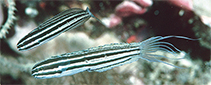
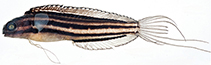
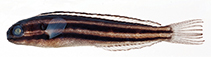
เงี่ยงครีบหลัง (รวม) : 4 - 5; ก้านครีบอ่อนที่หาง (รวม) : 24 - 27; เงี่ยงครีบก้น: 2; ก้านครีบอ่อนที่ก้น: 16 - 18. This species is distinguished by the following characters: a major portion of dentary gland dorsally positioned and held in place laterally by a dorsolateral flange of dentary; D IV-V,24-27 (usually IV,26-27); A II,16-18; pectoral-fin rays 13-15, usually 14; in adult males, inner caudal-fin rays produced as filaments. Colouration: a dark mid-lateral stripe that does not extend onto dorsal part of pectoral fin base and only very slightly onto caudal-fin base; a lower dark stripe extending from upper lip through lower half of pectoral fin to base of caudal fin; anal fin of adults with dark basal stripe (best developed in males); pelvic fin sexually dimorphic in adults, depressed fin extends to or beyond anal fin origin in males and about 25-30% of distance to anal-fin origin in females; median supratemporal pores 1 or 2 but surprisingly variable (Ref. 123060). Cross section: oval.
Adults are found in coral reefs, usually in sheltered inshore reefs (Ref. 41819); described as a gregarious species, with schools as large as 40-50 individuals, some retreating into crevices when disturbed (Ref. 123060), Also in steep outer reef slope (Ref. 90102); typically found in 25-55 m near vertical walls or caves (Ref. 123060). Oviparous. Eggs are demersal and adhesive (Ref. 205), and are attached to the substrate via a filamentous, adhesive pad or pedestal (Ref. 94114). Larvae are planktonic, often found in shallow, coastal waters (Ref. 94114).
Smith-Vaniz, W.F. and G.R. Allen, 2019. Meiacanthus solomon, a new fangblenny (Teleostei: Blenniidae) from the Solomon Islands, with a redescription and new records of M. limbatus. J. Ocean Sci. Found. 33:44-52. (Ref. 123060)
สถานะบัญชีแดงของ IUCN (Ref. 130435: Version 2025-2 (Global))
อุณหภูมิที่ต้องการ (อ้างอิง 123201): 24.2 - 29.1, mean 28.4 °C (based on 8 cells).
ดัชนีความหลากหลายทางวิวัฒนาการ (อ้างอิง 82804): PD50 = 0.5000 [Uniqueness, from 0.5 = low to 2.0 = high].
Bayesian length-weight: a=0.00575 (0.00255 - 0.01297), b=3.06 (2.87 - 3.25), in cm total length, based on LWR estimates for this (Sub)family-body shape (Ref. 93245).
ระดับชั้นอาหาร (อ้างอิง 69278): 3.2 ±0.4 se; based on size and trophs of closest relatives
ความสามารถในการกลับคืนสู่ปกติ (อ้างอิง 120179): ความสูง, เวลาต่ำสุดที่จะทำให้ประชากรเพิ่มขึ้นเป็น 2 เท่าใช้เวลาน้อยกว่า 15 เดือน (Preliminary K or Fecundity.).
ความเสี่ยงต่อการตกปลา (Ref. 59153): Low vulnerability (10 of 100). 🛈