



Beobachtung melden im Fish Watcher
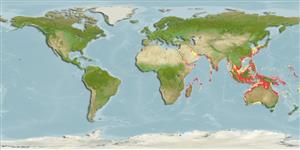
| Native range | All suitable habitat | Point map | Year 2050 |
|
| This map was computer-generated and has not yet been reviewed. |
| Pegasus volitans AquaMaps Data sources: GBIF OBIS |
Hochladen Photos und videos
Bilder | Google Bild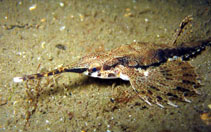 Pegasus volitans
Photo von Maddern, M.
Bilder | Google Bild
Photo von Maddern, M.
Klassifizierung / Names Namen | Synonyme | Catalog of Fishes(Gattung, Arten) | ITIS | CoL | WoRMS | Cloffa
> Dactylopteriformes (Flying gurnards) > Pegasidae (Seamoths)
Etymology: Pegasus: Named after the winged horse sprung from the blood of Medusa (Ref. 1418); volitans: From the Latin word 'volitans' meaning to fly.
More on author: Linnaeus.
Etymology: Pegasus: Named after the winged horse sprung from the blood of Medusa (Ref. 1418); volitans: From the Latin word 'volitans' meaning to fly.
More on author: Linnaeus.
Umwelt: Milieu / Klimazone / Tiefenbereich / Verbreitungsgebiet Ökologie
seewasser; brackwasser demersal; tiefenbereich 1 - 73 m (Ref. 11441), usually 9 - 27 m (Ref. 1418). Tropical; 36°N - 37°S
Verbreitung Territorien | FAO Gebiete | Ökosysteme | Vorkommen | Punkt Karte | Einführungen | Faunafri
Indo-West Pacific: Delagoa Bay, Mozambique to Saudi Arabia (Persian Gulf) and throughout Gulf of Manaar to Bay of Bengal; along the east coast of Myanmar; north to Japan, south to tropical Australia (Ref. 1418) and Papua New Guinea (Ref. 6192).
Größe / Gewicht / Alter
Kurzbeschreibung Bestimmungsschlüssel | Morphologie | Morphometrie
Rückenflossenstacheln (insgesamt) : 0; Rückenflossenweichstrahlen (insgesamt) : 5; Afterflossenstacheln: 0; Afterflossenweichstrahlen: 5; Wirbelzahl: 21. Body light brown or olive to dark brown-black dorsally and laterally, lighter ventrally. Tubercles absent on surface of carapace; no scales on orbit; distal margin of dorsal and anal fins perpendicular to horizontal axis of body. 4 pairs of dorsolateral body plates; 5 pairs of ventrolateral body plates; tail rings 12, anteriormost 9 mobile, last 3 fused; a lateral pair of posteriorly directed spines on terminal tail rings; suborbital shelf convex obscuring eye from ventral view; deep pits absent. Rostrum monomorphic and spatulate.
Body shape (shape guide): other; Cross section: flattened.
Body shape (shape guide): other; Cross section: flattened.
A rare species (Ref. 4264) collected from muddy and sandy bottoms of estuaries and bays. Known to 'walk' over the bottom using its tentacular pelvic fins. Juveniles expatriate to tropical regions; adults mainly found in muddy estuaries where they pair. Sometimes they are seen partly buried but also feed during the day. Sometimes found floating on the surface (Ref. 48635). Sometimes occurs in seagrass areas (Ref 90102). Feeds on small benthic organisms (Ref. 68964).
Lebenszyklus und Paarungsverhalten Geschlechtsreife | Fortpflanzung | Ablaichen | Eier | Fruchtbarkeit | Larven
Hauptreferenz
Laden Sie Ihre Referenzen hoch | Referenzen | Koordinator | Partner
Palsson, W.A. and T.W. Pietsch, 1989. Revision of the Acanthopterygian fish Family Pegasidae (Order Gasterosteiformes). Indo-Pac. Fish. (18):38 p. (Ref. 1418)
IUCN Rote Liste Status (Ref. 130435: Version 2025-2 (Global))
Daten mangelhaft (DD) ; Date assessed: 12 July 2016
CITES
Not Evaluated
Bedrohung für Menschen
Harmless
Nutzung durch Menschen
Fischereien: kommerziell
FAO - Publication: search | FishSource |
Mehr Information
Trophische Ökologie
Lebensmittel (Beutetiere)
Nahrungszusammensetzung
Nahrungsaufnahme
Lebensmittelrationen
Räuber
Lebensmittel (Beutetiere)
Nahrungszusammensetzung
Nahrungsaufnahme
Lebensmittelrationen
Räuber
Populationsdynamik
Wachstumsparameter
Max. Alter/Größen
Länge-Gewicht-Rel.
Länge-Länge-Verhältnis.
Längenhäufigkeiten
Massenkonvertierung
Rekrutierung
Dichte
Wachstumsparameter
Max. Alter/Größen
Länge-Gewicht-Rel.
Länge-Länge-Verhältnis.
Längenhäufigkeiten
Massenkonvertierung
Rekrutierung
Dichte
Lebenszyklus
Fortpflanzung
Geschlechtsreife
Reifung/Kiemen rel.
Fruchtbarkeit
Ablaichen
Laichaggregationen
Eier
Eientwicklung
Larven
Larven Pop.Dyn.
Fortpflanzung
Geschlechtsreife
Reifung/Kiemen rel.
Fruchtbarkeit
Ablaichen
Laichaggregationen
Eier
Eientwicklung
Larven
Larven Pop.Dyn.
Physiologie
Körperliche Zusammensetzung
Nährstoffe
Sauerstoffverbrauch
Schwimmart
Schwimmgeschwindigkeit
Visuelle Pigmente
Fischgeräusche
Krankheiten und Parasiten
Toxizität (LC50s)
Körperliche Zusammensetzung
Nährstoffe
Sauerstoffverbrauch
Schwimmart
Schwimmgeschwindigkeit
Visuelle Pigmente
Fischgeräusche
Krankheiten und Parasiten
Toxizität (LC50s)
Genetik
Genom
Genetik
Heterozygotie
Vererbbarkeit
Genetische Vielfalt
Genom
Genetik
Heterozygotie
Vererbbarkeit
Genetische Vielfalt
Menschenbezogen
Aquakultur-Systeme
Aquakultur Profile
Zuchtlinien
Ciguatera-Fälle
Briefmarken, Münzen, Verschiedenes.
Aquakultur-Systeme
Aquakultur Profile
Zuchtlinien
Ciguatera-Fälle
Briefmarken, Münzen, Verschiedenes.
Tools
Bio-Quiz | E-Book | Feldführer | Längenhäufigkeits Tool | Lebensdaten Tool | Punkt Karte |
Catch-MSY |
Zusatzinformationen
Download XML
Zusammenfassung | Punktdaten | Namen | Photos
Internet Quellen
AFORO (otoliths) | Aquatic Commons | BHL | Cloffa | Websites from users | FishWatcher Einträge suchen | CISTI | Catalog of Fishes: Gattung, Arten | DiscoverLife | ECOTOX | FAO - Publication: search | Faunafri | Fishipedia | Fishtrace | GloBI | Google Books | Google Scholar | Google | IGFA World Record | Nationale Datenbanken | OneZoom | Open Tree of Life | Otolith Atlas of Taiwan Fishes | PubMed | Reef Life Survey | Socotra Atlas | TreeBase | Tree of Life | Wikipedia: Gehe zu, Suchen | World Records Freshwater Fishing | Zoobank | Zoologischer Rekord
Schätzungen auf der Grundlage von Modellen
Bevorzugte Temperatur (Ref. 123201): 23.8 - 29.1, mean 28.1 °C (based on 1202 cells).
Phylogenetischer Diversitätsindex (Ref. 82804): PD50 = 0.5391 [Uniqueness, from 0.5 = low to 2.0 = high].
Bayesian length-weight: a=0.01000 (0.00244 - 0.04107), b=3.04 (2.81 - 3.27), in cm total length, based on all LWR estimates for this body shape (Ref. 93245).
Trophische Ebene (Ref. 69278): 3.5 ±0.37 se; based on food items.