



Neoceratias spinifer Pappenheim, 1914
Spiny seadevil
Beobachtung melden im Fish Watcher
| Native range | All suitable habitat | Point map | Year 2050 |

|
| This map was computer-generated and has not yet been reviewed. |
| Neoceratias spinifer AquaMaps Data sources: GBIF OBIS |
Hochladen Photos und videos
Google Bild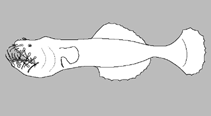 No image available for this species;
drawing shows typical species in Neoceratiidae.
Google Bild
drawing shows typical species in Neoceratiidae.
Klassifizierung / Names Namen | Synonyme | Catalog of Fishes(Gattung, Arten) | ITIS | CoL | WoRMS | Cloffa
> Lophiiformes (Anglerfishes) > Neoceratiidae (Toothed seadevils)
Etymology: Neoceratias: Named by Pappenheim (1914:198) to signify a new kind of ceratiid-like anglerfish, at the time expressing uncertainty of its position within the suborder but finding great similarity with the Ceratiidae. (Ref. 86949).
Etymology: Neoceratias: Named by Pappenheim (1914:198) to signify a new kind of ceratiid-like anglerfish, at the time expressing uncertainty of its position within the suborder but finding great similarity with the Ceratiidae. (Ref. 86949).
Umwelt: Milieu / Klimazone / Tiefenbereich / Verbreitungsgebiet Ökologie
seewasser demersal; tiefenbereich 0 - 1200 m (Ref. 58302). Deep-water
Verbreitung Territorien | FAO Gebiete | Ökosysteme | Vorkommen | Punkt Karte | Einführungen | Faunafri
Western Central Pacific.
Größe / Gewicht / Alter
Kurzbeschreibung Bestimmungsschlüssel | Morphologie | Morphometrie
Rückenflossenweichstrahlen (insgesamt) : 10 - 13; Afterflossenweichstrahlen: 10 - 13. Metamorphosed females distinguished by the following characteristics: lacks illicium and second cephalic spine, as well as cranial trough, within which pterygiophore of illicium lies in all other female ceratioids; broad and roughly rectangular shaped frontals; absence of metapterygoid and mesopterygoid; usually short and nearly straight preopercle; usually thick and well developed premaxillae and dentaries, with rounded edges; presence of a pair of prominent nasal papillae on snout; inner margin of jaws bearing single inner row of small immobile teeth; outer margin bears 2-3 series of long hinged teeth, each with tiny distal hook; dorsal and anal fins mounted on prominent bases; presence of supraethmoid; frontals without ventromedial extensions, meet on midline; presence of parietals; conical shaped sphenotics, without distal spine; presence of pterosphenoid; hyomandibula with single head; 2 hypohyals and 6 (2+4), rarely 5 (1+4), branchiostegal rays; bifuctaed and very much reduced opercle; reduced subopercle, long and narrow, as long as or slightly longer than lower fork of opercle, without posterior notch; ventral part without spine or projection on anterior margin; quadrate, articular, angular and preopercular spines absent; jaws subequal, lower extending anteriorly beyond upper; lower jaw lacking symphisial spine; absence postmaxillary process of premaxilla and anterior-maximandibular ligament; absence of first, second and fourth pharyngobranchial, third is well developed and toothed; single ossified hypobranchial; absence of ossified basibranchials; absence of epibranchial and ceratobranchial; epurals absent; deeply notched posterior margin of hypural plate; pterygiophore of illicium fully embedded in skin of head; esca absent; coracoid lacking posteroventral process; 3 pectoral radials; small and cylindrical pelvic bones, without distal expansion; dorsal fin rays 10-13; anal fin rays 10-13; pectoral fin rays 12-15; pelvic fins absent (Ref. 86949).
Meso- (Ref 58302) and bathypelagic (Ref. 7300, 75154). Females with long movable teeth outside jaws. Mature males parasitic on females.
Lebenszyklus und Paarungsverhalten Geschlechtsreife | Fortpflanzung | Ablaichen | Eier | Fruchtbarkeit | Larven
Hauptreferenz
Laden Sie Ihre Referenzen hoch | Referenzen | Koordinator | Partner
Nelson, J.S., 1984. Fishes of the world. 2nd edition. John Wiley & Sons, Inc., New York. 523 p. (Ref. 245)
IUCN Rote Liste Status (Ref. 130435: Version 2025-2 (Global))
nicht bedroht (LC) ; Date assessed: 16 July 2014
CITES
Not Evaluated
Bedrohung für Menschen
Harmless
Nutzung durch Menschen
Fischereien: nicht kommerziell
FAO - Publication: search | FishSource |
Mehr Information
Trophische Ökologie
Lebensmittel (Beutetiere)
Nahrungszusammensetzung
Nahrungsaufnahme
Lebensmittelrationen
Räuber
Lebensmittel (Beutetiere)
Nahrungszusammensetzung
Nahrungsaufnahme
Lebensmittelrationen
Räuber
Ökologie
Ökologie
Ökologie
Populationsdynamik
Wachstumsparameter
Max. Alter/Größen
Länge-Gewicht-Rel.
Länge-Länge-Verhältnis.
Längenhäufigkeiten
Massenkonvertierung
Rekrutierung
Dichte
Wachstumsparameter
Max. Alter/Größen
Länge-Gewicht-Rel.
Länge-Länge-Verhältnis.
Längenhäufigkeiten
Massenkonvertierung
Rekrutierung
Dichte
Lebenszyklus
Fortpflanzung
Geschlechtsreife
Reifung/Kiemen rel.
Fruchtbarkeit
Ablaichen
Laichaggregationen
Eier
Eientwicklung
Larven
Larven Pop.Dyn.
Fortpflanzung
Geschlechtsreife
Reifung/Kiemen rel.
Fruchtbarkeit
Ablaichen
Laichaggregationen
Eier
Eientwicklung
Larven
Larven Pop.Dyn.
Anatomie
Kiemenoberfläche
Gehirn
Otolith
Kiemenoberfläche
Gehirn
Otolith
Physiologie
Körperliche Zusammensetzung
Nährstoffe
Sauerstoffverbrauch
Schwimmart
Schwimmgeschwindigkeit
Visuelle Pigmente
Fischgeräusche
Krankheiten und Parasiten
Toxizität (LC50s)
Körperliche Zusammensetzung
Nährstoffe
Sauerstoffverbrauch
Schwimmart
Schwimmgeschwindigkeit
Visuelle Pigmente
Fischgeräusche
Krankheiten und Parasiten
Toxizität (LC50s)
Genetik
Genom
Genetik
Heterozygotie
Vererbbarkeit
Genetische Vielfalt
Genom
Genetik
Heterozygotie
Vererbbarkeit
Genetische Vielfalt
Menschenbezogen
Aquakultur-Systeme
Aquakultur Profile
Zuchtlinien
Ciguatera-Fälle
Briefmarken, Münzen, Verschiedenes.
Aquakultur-Systeme
Aquakultur Profile
Zuchtlinien
Ciguatera-Fälle
Briefmarken, Münzen, Verschiedenes.
Tools
Zusatzinformationen
Download XML
Zusammenfassung | Punktdaten | Namen | Photos
Internet Quellen
AFORO (otoliths) | Aquatic Commons | BHL | Cloffa | Websites from users | FishWatcher Einträge suchen | CISTI | Catalog of Fishes: Gattung, Arten | DiscoverLife | ECOTOX | FAO - Publication: search | Faunafri | Fishipedia | Fishtrace | GloBI | Google Books | Google Scholar | Google | IGFA World Record | Nationale Datenbanken | OneZoom | Open Tree of Life | Otolith Atlas of Taiwan Fishes | PubMed | Reef Life Survey | Socotra Atlas | TreeBase | Tree of Life | Wikipedia: Gehe zu, Suchen | World Records Freshwater Fishing | Zoobank | Zoologischer Rekord
Schätzungen auf der Grundlage von Modellen
Bevorzugte Temperatur (Ref. 123201): 8.3 - 20.1, mean 13 °C (based on 250 cells).
Phylogenetischer Diversitätsindex (Ref. 82804): PD50 = 1.5000 [Uniqueness, from 0.5 = low to 2.0 = high].
Bayesian length-weight: a=0.00389 (0.00180 - 0.00842), b=3.12 (2.94 - 3.30), in cm total length, based on all LWR estimates for this body shape (Ref. 93245).
Trophische Ebene (Ref. 69278): 3.5 ±0.5 se; based on size and trophs of closest relatives
Nährstoffe (Ref. 124155): Calcium = 77.4 [30.7, 210.4] mg/100g; Iron = 0.678 [0.288, 1.403] mg/100g; Protein = 17.6 [15.0, 20.7] %; Omega3 = 0.571 [0.185, 1.583] g/100g; Selenium = 10.5 [3.4, 27.0] μg/100g; VitaminA = 69.1 [14.1, 370.3] μg/100g; Zinc = 0.611 [0.352, 1.033] mg/100g (wet weight);