This website uses cookies to enhance your browsing experience and ensure the functionality of our site. For more detailed information about the types of cookies we use and how we protect your privacy, please visit our Privacy Information page.
×
Cookie Settings
This website uses different types of cookies to enhance your experience. Please select your preferences below:
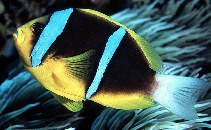
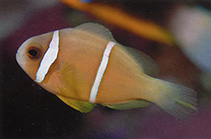
Espinas dorsales (total) : 10 - 11; Radios blandos dorsales (total) : 15 - 17; Espinas anales: 2; Radios blandos anales: 13 - 14. Body shape (shape guide): short and / or deep; Cross section: compressed.
Adults inhabit passages and outer reef slopes. Known to occur at 25°C. Feed chiefly on planktonic copepods, algae, echiuroid and sipunculoid worms, and pelagic tunicates. Oviparous, distinct pairing during breeding (Ref. 205). Eggs are demersal and adhere to the substrate (Ref. 205). Males guard and aerate the eggs (Ref. 205). Associated with the anemones: Entacmaea quadricolor, Heteractis aurora, Heteractis crispa, Heteractis magnifica, Stichodactyla haddoni, and Stichodactyla mertensii (Ref. 5911). Minimum depth reported taken from Ref. 128797.
Oviparous, distinct pairing during breeding (Ref. 205). Eggs are demersal and adhere to the substrate (Ref. 205). Males guard and aerate the eggs (Ref. 205). Spawning pairs can be found throughout the year. The total annual egg production is estimated at 3,000 - 5,000 eggs (Ref. 237). Fecundity ranges from 128 - 632 (Ref. 237). Also Ref. 7471, 240.
Fautin, D.G. and G.R. Allen, 1992. Field guide to anemonefishes and their host sea anemones. Western Australian Museum, Francis Street, Perth. (Ref. 5911)
Situación en la Lista Roja de la UICN (Ref. 130435: Version 2025-2 (Global))
Fisiología Composición corporal Nutrientes Consumo del oxígeno Tipo de natación Velocidad de natación Pigmentos visuales Sonido de peces Enfermedades y parásitos Toxicidad (CL50)
Temperatura preferida (Referencia 123201): 27.2 - 29, mean 28 °C (based on 146 cells).
Índice de diversidad filogenética (Referencia 82804): PD50 = 0.5000 [Uniqueness, from 0.5 = low to 2.0 = high].
Bayesian length-weight: a=0.02344 (0.01149 - 0.04783), b=2.98 (2.80 - 3.16), in cm total length, based on LWR estimates for this (Sub)family-body shape (Ref. 93245).
Nivel trófico (Referencia 69278): 2.2 ±0.0 se; based on diet studies.
Generation time: 1.4 ( na - na) years. Estimated as median ln(3)/K based on 1 growth studies.
Resiliencia (Referencia 120179): Alto, población duplicada en un tiempo mínimo inferior a 15 meses (tm<1; Fec=128-632).
Vulnerabilidad pesquera (Ref. 59153): Low vulnerability (16 of 100). 🛈