



Beobachtung melden im Fish Watcher
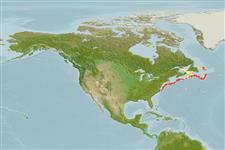
| Native range | All suitable habitat | Point map | Year 2050 |
|
| This map was computer-generated and has not yet been reviewed. |
| Lipogenys gillii AquaMaps Data sources: GBIF OBIS |
Hochladen Photos und videos
Bilder | Google Bild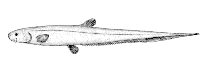 Lipogenys gillii
Photo von Canadian Museum of Nature, Ottawa, Canada
Bilder | Google Bild
Photo von Canadian Museum of Nature, Ottawa, Canada
Klassifizierung / Names Namen | Synonyme | Catalog of Fishes(Gattung, Arten) | ITIS | CoL | WoRMS | Cloffa
> Notacanthiformes (Halosaurs and deep-sea spiny eels) > Notacanthidae (Deep-sea spiny eels)
Etymology: Lipogenys: Greek, lipos = fat + Greek, geny, -yos = face, jaw (Ref. 45335).
Eponymy: Professor Theodore Nicholas Gill (1837–1914) was an American ichthyologist, malacologist, mammologist and librarian, a zoologist at George Washington University and associated with the Smithsonian Institution for more than half a century. [...] (Ref. 128868), visit book page.
More on authors: Goode & Bean.
Etymology: Lipogenys: Greek, lipos = fat + Greek, geny, -yos = face, jaw (Ref. 45335).
Eponymy: Professor Theodore Nicholas Gill (1837–1914) was an American ichthyologist, malacologist, mammologist and librarian, a zoologist at George Washington University and associated with the Smithsonian Institution for more than half a century. [...] (Ref. 128868), visit book page.
More on authors: Goode & Bean.
Umwelt: Milieu / Klimazone / Tiefenbereich / Verbreitungsgebiet Ökologie
seewasser bathydemersal; tiefenbereich 400 - 2000 m (Ref. 50674). Deep-water; 50°N - 35°N, 76°W - 48°W
Verbreitung Territorien | FAO Gebiete | Ökosysteme | Vorkommen | Punkt Karte | Einführungen | Faunafri
Northwest Atlantic: Nova Scotia and Hudson Canyon (Ref. 37108). Southwest Pacific: Australia (Ref. 75154).
Größe / Gewicht / Alter
Kurzbeschreibung Bestimmungsschlüssel | Morphologie | Morphometrie
Rückenflossenstacheln (insgesamt) : 6 - 8; Rückenflossenweichstrahlen (insgesamt) : 4 - 5; Afterflossenstacheln: 44 - 58; Afterflossenweichstrahlen: 67 - 88; Wirbelzahl: 228 - 234. Tail slender and tapering to a point. Mouth inferior, small and sucker-like; upper lip with thick, pleated folds; posterior end of maxilla bent sharply downward, forming a flap-like structure; fleshy papillae on snout bordering upper lip. Teeth absent. Dorsal fin short-based, located above anus, the first 4-6 rays hard and spinous, increasing in length from front to back, the remainder soft and segmented, membrane connecting all rays except for first I-III spines. Anal fin long, extending from just behind anus to tip of tail, anterior rays spinous, posterior rays segmented, the transition gradual. Caudal fin absent (Ref. 11041). Light brown, lining of gill chamber and rim of opercular branchiostegal flap dark brown, mouth and lining of buccal cavity light yellowish tan (Ref. 37108).
Body shape (shape guide): elongated; Cross section: circular.
Body shape (shape guide): elongated; Cross section: circular.
Feed mostly on organic material contained in bottom sediment drawn up by the sucker-like mouth [RF doubts this is a detritus feeder; the elaborate mouth without teeth looks like a specialization for extracting soft-bodied benthic invertebrates out of the ground; also, there are no gill rakers to filter detritus (Ref. 50674)]. No obvious sexual dimorphism; a female of 37.5 cm SL was still immature (Ref. 50674).
Lebenszyklus und Paarungsverhalten Geschlechtsreife | Fortpflanzung | Ablaichen | Eier | Fruchtbarkeit | Larven
Sexes can be separated by testis and ovaries; there is no indication of internal fertilization.
Hauptreferenz
Laden Sie Ihre Referenzen hoch | Referenzen | Koordinator | Partner
Smith, D.G., 1997. Lipogenyidae. Spiny sucker eels. p. 1629. In K.E. Carpenter and V.H. Niem (eds.) FAO species identification guide for fishery purposes. The living marine resources of the WCP. Vol. 3. Batoid fishes, chimaeras and bony fishes part 1 (Elopidae to Linophrynidae). FAO, Rome. (Ref. 11041)
CITES
Not Evaluated
Bedrohung für Menschen
Harmless
Nutzung durch Menschen
Fischereien: nicht kommerziell
FAO - Publication: search | FishSource |
Mehr Information
Trophische Ökologie
Lebensmittel (Beutetiere)
Nahrungszusammensetzung
Nahrungsaufnahme
Lebensmittelrationen
Räuber
Lebensmittel (Beutetiere)
Nahrungszusammensetzung
Nahrungsaufnahme
Lebensmittelrationen
Räuber
Populationsdynamik
Wachstumsparameter
Max. Alter/Größen
Länge-Gewicht-Rel.
Länge-Länge-Verhältnis.
Längenhäufigkeiten
Massenkonvertierung
Rekrutierung
Dichte
Wachstumsparameter
Max. Alter/Größen
Länge-Gewicht-Rel.
Länge-Länge-Verhältnis.
Längenhäufigkeiten
Massenkonvertierung
Rekrutierung
Dichte
Lebenszyklus
Fortpflanzung
Geschlechtsreife
Reifung/Kiemen rel.
Fruchtbarkeit
Ablaichen
Laichaggregationen
Eier
Eientwicklung
Larven
Larven Pop.Dyn.
Fortpflanzung
Geschlechtsreife
Reifung/Kiemen rel.
Fruchtbarkeit
Ablaichen
Laichaggregationen
Eier
Eientwicklung
Larven
Larven Pop.Dyn.
Anatomie
Kiemenoberfläche
Gehirn
Otolith
Kiemenoberfläche
Gehirn
Otolith
Physiologie
Körperliche Zusammensetzung
Nährstoffe
Sauerstoffverbrauch
Schwimmart
Schwimmgeschwindigkeit
Visuelle Pigmente
Fischgeräusche
Krankheiten und Parasiten
Toxizität (LC50s)
Körperliche Zusammensetzung
Nährstoffe
Sauerstoffverbrauch
Schwimmart
Schwimmgeschwindigkeit
Visuelle Pigmente
Fischgeräusche
Krankheiten und Parasiten
Toxizität (LC50s)
Genetik
Genom
Genetik
Heterozygotie
Vererbbarkeit
Genetische Vielfalt
Genom
Genetik
Heterozygotie
Vererbbarkeit
Genetische Vielfalt
Menschenbezogen
Aquakultur-Systeme
Aquakultur Profile
Zuchtlinien
Ciguatera-Fälle
Briefmarken, Münzen, Verschiedenes.
Aquakultur-Systeme
Aquakultur Profile
Zuchtlinien
Ciguatera-Fälle
Briefmarken, Münzen, Verschiedenes.
Tools
Zusatzinformationen
Download XML
Zusammenfassung | Punktdaten | Namen | Photos
Internet Quellen
AFORO (otoliths) | Aquatic Commons | BHL | Cloffa | Websites from users | FishWatcher Einträge suchen | CISTI | Catalog of Fishes: Gattung, Arten | DiscoverLife | ECOTOX | FAO - Publication: search | Faunafri | Fishipedia | Fishtrace | GloBI | Google Books | Google Scholar | Google | IGFA World Record | OneZoom | Open Tree of Life | Otolith Atlas of Taiwan Fishes | PubMed | Reef Life Survey | Socotra Atlas | TreeBase | Tree of Life | Wikipedia: Gehe zu, Suchen | World Records Freshwater Fishing | Zoobank | Zoologischer Rekord
Schätzungen auf der Grundlage von Modellen
Bevorzugte Temperatur (Ref. 123201): 3.4 - 5.3, mean 3.9 °C (based on 17 cells).
Phylogenetischer Diversitätsindex (Ref. 82804): PD50 = 0.7501 [Uniqueness, from 0.5 = low to 2.0 = high].
Bayesian length-weight: a=0.00257 (0.00104 - 0.00637), b=3.09 (2.88 - 3.30), in cm total length, based on LWR estimates for this (Sub)family-body shape (Ref. 93245).
Trophische Ebene (Ref. 69278): 3.5 ±0.37 se; based on food items.
Widerstandsfähigkeit (Ref. 120179): niedrig, Verdopplung der Population dauert 4,5 - 14 Jahre. (Assuming tm >=5).