



Luciocephalus pulcher (Gray, 1830)
Pikehead
Envoyez vos Photos et vidéos
Images | Images Google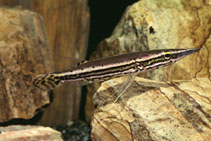 Luciocephalus pulcher
Photo de Hippocampus-Bildarchiv
Images | Images Google
Photo de Hippocampus-Bildarchiv
Classification / Noms Noms communs | Synonymes | Catalog of Fishes(Genre, Espèce) | ITIS | CoL | WoRMS | Cloffa
> Anabantiformes (Gouramies, snakeheads) > Osphronemidae (Gouramies) > Luciocephalinae
Etymology: Luciocephalus: Latin, lucius, Greek, lykos = wolf = pike, by its predatory habits + Greek,kepahle = head (Ref. 45335).
More on author: Gray.
Etymology: Luciocephalus: Latin, lucius, Greek, lykos = wolf = pike, by its predatory habits + Greek,kepahle = head (Ref. 45335).
More on author: Gray.
Environnement : milieu / zone climatique / profondeur / gamme de distribution Écologie
; eau douce benthopélagique; pH range: 6.0 - 7.5; dH range: ? - 15. Tropical; 22°C - 26°C (Ref. 1672)
Distribution Territoires | Zones FAO | Écosystèmes | Occurrences | Carte par point | Introductions | Faunafri
Asia: Peninsular Thailand, Malaysia, Brunei Darussalam and Indonesia (Ref. 56386) and Singapore (Ref. 85309).
Taille / Poids / Âge
Description synthétique Clés d'identification | Morphologie | Morphométrie
Rayons mous dorsaux (Total) : 10 - 12; Épines anales: 0 - 1; Rayons mous anaux: 19 - 21; Vertèbres: 38 - 40. Distinguished from Luciocephalus aura in the following characters: absence of numerous iridescent green spots on central stripe when live (vs. presence); presence of black irregular pattern on area below preorbital to central stripe (vs. absence); area just above anal-fin base with 3-4 dark brown blotches, which appear circular when body is viewed ventrally (vs. absence of such markings); yellowish caudal fin with 3-5 broad vertical black bars (vs. brownish caudal fin with 3-7 narrow iridescent vertical gold bars); presence of markings on anal and pelvic (vs. absence); shorter caudal-fin length (total length 120.0-125.6% SL vs. 123.7-127.1); shorter postdorsal length (10.4-12.4% SL vs. 12.0-13.2); greater head length (44.1-48.6% SL vs. 43.3-45.9); smaller caudal peduncle depth (8.9-10.6% SL vs 10.7-11.2); and relatively shorter anal-fin base length (19.3-23.4% SL vs. 23.6-24.5) (Ref. 56386).
Body shape (shape guide): elongated.
Body shape (shape guide): elongated.
Facultative air-breathing (Ref. 126274); Occurs in streams and flooded forest among dense vegetation (Ref. 56749). Found in primary peats swamps. Mouth brooder (Ref. 57235). Highly protrusible jaws. The premaxillae can extend about 1/3 of the head length. Prey is captured by the fish making a rapid lunge and surrounding the prey with the open mouth.
Cycle de vie et comportement reproducteur Maturité | Reproduction | Frai | Œufs | Fécondité | Larves
Males are mouthbrooding for about 30 days.
Référence principale
Téléchargez vos références | Références | Coordinateur | Collaborateurs
Nelson, J.S., 1984. Fishes of the world. 2nd edition. John Wiley & Sons, Inc., New York. 523 p. (Ref. 245)
Statut dans la liste rouge de l'IUCN (Ref. 130435: Version 2025-2 (Global))
Préoccupation mineure (LC) ; Date assessed: 18 January 2019
CITES
Not Evaluated
Menace pour l'homme
Harmless
Utilisations par l'homme
Pêcheries: commercial; Aquarium: Commercial
FAO - Publication: search | FishSource |
Plus d'informations
Écologie trophique
Aliments (proies)
Composition du régime alimentaire
Consommation alimentaire
Rations alimentaires
Prédateurs
Aliments (proies)
Composition du régime alimentaire
Consommation alimentaire
Rations alimentaires
Prédateurs
Écologie
Écologie
Écologie
Dynamique des populations
Paramètres de croissance
Âges / tailles maximales
Longueur-poids rel.
Rel. longueur-longueur.
Fréquences de longueurs
Conversion de masse
Recrutement
Abondance
Paramètres de croissance
Âges / tailles maximales
Longueur-poids rel.
Rel. longueur-longueur.
Fréquences de longueurs
Conversion de masse
Recrutement
Abondance
Cycle de vie
Reproduction
Maturité
Maturité/épines rel.
Fécondité
Frai
Agrégats de frai
Œufs
Développement de l'œuf
Larves
Dynamique des populations larvaires
Reproduction
Maturité
Maturité/épines rel.
Fécondité
Frai
Agrégats de frai
Œufs
Développement de l'œuf
Larves
Dynamique des populations larvaires
Anatomie
Surface branchiale
Cerveau
Otolithe
Surface branchiale
Cerveau
Otolithe
Physiologie
Composition corporelle
Nutriments
Consommation d'oxygène
Type de natation
Vitesse de nage
Pigments visuels
Son de poisson
Maladies et parasites
Toxicité (CL50)
Composition corporelle
Nutriments
Consommation d'oxygène
Type de natation
Vitesse de nage
Pigments visuels
Son de poisson
Maladies et parasites
Toxicité (CL50)
Génétique
génôme
Génétique
Hétérozygotie
Héritabilité
Diversité génétique
génôme
Génétique
Hétérozygotie
Héritabilité
Diversité génétique
Liées à l'homme
Systèmes d'aquaculture
Profils d'aquaculture
Souches
Cas de ciguatera
Timbres, pièces de monnaie, divers
Systèmes d'aquaculture
Profils d'aquaculture
Souches
Cas de ciguatera
Timbres, pièces de monnaie, divers
Outils
E-book | Guide de terrain | Générateur de fréquences de longueur | Outil de dynamique de population | Carte par point |
Capture-MSY |
Articles particuliers
Télécharger en XML
Sources Internet
AFORO (otoliths) | Aquatic Commons | BHL | Cloffa | Websites from users | FishWatcher | CISTI | Catalog of Fishes: Genre, Espèce | DiscoverLife | ECOTOX | FAO - Publication: search | Faunafri | Fishipedia | Fishtrace | GloBI | Google Books | Google Scholar | Google | IGFA World Record | OneZoom | Open Tree of Life | Otolith Atlas of Taiwan Fishes | PubMed | Reef Life Survey | Socotra Atlas | TreeBase | Arbre de Vie | Wikipedia: aller à, chercher | World Records Freshwater Fishing | Zoological Record
Estimations basées sur des modèles
Indice de diversité phylogénétique (Réf. 82804): PD50 = 0.7500 [Uniqueness, from 0.5 = low to 2.0 = high].
Bayesian length-weight: a=0.00389 (0.00180 - 0.00842), b=3.12 (2.94 - 3.30), in cm total length, based on all LWR estimates for this body shape (Ref. 93245).
Niveau trophique (Réf. 69278): 3.4 ±0.4 se; based on size and trophs of closest relatives
Résilience (Réf. 120179): Haut, temps minimum de doublement de population inférieur à 15 mois (Preliminary K or Fecundity.).