This website uses cookies to enhance your browsing experience and ensure the functionality of our site. For more detailed information about the types of cookies we use and how we protect your privacy, please visit our Privacy Information page.
×
Cookie Settings
This website uses different types of cookies to enhance your experience. Please select your preferences below:
> Characiformes (Characins) > Alestidae (African tetras)
Etymology: Hydrocynus:Greek, hydr = water + Greek, kyon = dog (Ref. 45335). Eponymy: Dr Peter Forsskål (1732–1763) was a Swedish explorer, orientalist, naturalist and a student of Linnaeus. [...] (Ref. 128868), visit book page. More on author: Cuvier.
Taxonomic Remarks Affinities: H. vittatus (Ref. 2880, 80290).
Umwelt: Milieu / Klimazone / Tiefenbereich / Verbreitungsgebiet Ökologie
Africa: Cross, Wouri and Sanaga basin in Lower Guinea ichthyofaunal province (Ref. 80290). Also in Chad, Niger, Ogun, Ouémé, Mono, Volta, Comoé, Bandama, Sassandra, Nipoué, St. Paul, Mano, Little Scarcies, Gambia and Senegal basins in West Africa (Ref. 2880, 80290, 81279); Nile River, including Lake Albert (Ref. 4903, 5331); Lake Turkana and Omo River (Ref. 2880, 5331, 80290); and Congo River basin (Ref. 2880, 80290).
Länge bei der ersten Reifung / Größe / Gewicht / Alter
Geschlechtsreife: Lm20.0, range 21 - ? cm Max length : 78.0 cm SL Männchen/unbestimmt; (Ref. 2880); max. veröff. Gewicht: 15.5 kg (Ref. 13337); max. veröff. Alter: 4 Jahre (Ref. 2757)
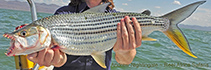
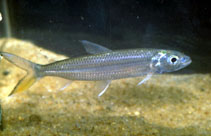
Diagnosis: 2 scale rows between lateral line and scaly process at pelvic-fin bases; eye <70% of interorbital space (Ref. 2880, 81279). Dorsal-fin uniformly greyish and its origin in front of pelvic fins; adipose fin greyish; caudal fin without black edge (Ref. 80290, 81279).
Body shape (shape guide): elongated.
Forms shoals; an open water predator often found near the water surface; feeds on fishes, preferring long bodied fish as they are easier to swallow and also takes insects, grass and snails; cannibalistic; preyed upon by fish eagle Haliaeetus vocifer; breeding migrations have been reported up several tributaries of Lake Kariba during the rains (Ref. 13337).
Paugy, D. and S.A. Schaefer, 2007. Alestidae. p. 347-411. In M.L.J. Stiassny, G.G. Teugels and C.D. Hopkins (eds.) Poissons d'eaux douces et saumâtres de basse Guinée, ouest de l'Afrique centrale/The fresh and brackish water fishes of Lower Guinea, west-central Africa. Vol. 1. Coll. Faune et Flore tropicales 42. Istitut de recherche pour le développement, Paris, France, Muséum nationale d'histoire naturelle, Paris, France and Musée royale de l'Afrique centrale, Tervuren, Belgique. 800 p. (Ref. 80290)
IUCN Rote Liste Status (Ref. 130435: Version 2025-2 (Global))