



Astyanax bimaculatus (Linnaeus, 1758)
Twospot astyanax
Hochladen Photos und videos
Bilder | Google Bild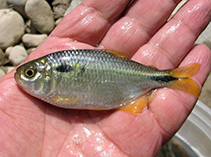 Astyanax bimaculatus
Photo von Eakins, R.
Bilder | Google Bild
Photo von Eakins, R.
Klassifizierung / Names Namen | Synonyme | Catalog of Fishes(Gattung, Arten) | ITIS | CoL | WoRMS | Cloffa
> Characiformes (Characins) > Acestrorhamphidae (American tetras) > Acestrorhamphinae
Etymology: Astyanax: The name of Astyanax, Hector´s son in the Greek mythology (Ref. 45335).
Eponymy: Astyanax was the son of Hector in Greek mythology. See Homer’s Iliad for details. The reasoning for its use for a genus of characins is not explained. (Ref. 128868), visit book page.
More on author: Linnaeus.
Etymology: Astyanax: The name of Astyanax, Hector´s son in the Greek mythology (Ref. 45335).
Eponymy: Astyanax was the son of Hector in Greek mythology. See Homer’s Iliad for details. The reasoning for its use for a genus of characins is not explained. (Ref. 128868), visit book page.
More on author: Linnaeus.
Taxonomic Remarks
Moenkhausia vittata (Castelnau, 1855) is valid, the species page will be created.
Umwelt: Milieu / Klimazone / Tiefenbereich / Verbreitungsgebiet Ökologie
; süßwasser benthopelagisch; pH range: 5.5 - 7.5; dH range: ? - 25; potamodrom (Ref. 51243). Subtropical; 20°C - 28°C (Ref. 1672)
Verbreitung Territorien | FAO Gebiete | Ökosysteme | Vorkommen | Punkt Karte | Einführungen | Faunafri
South America: Panama to the Amazon basin.
Größe / Gewicht / Alter
Geschlechtsreife: Lm ? range ? - ? cm
Max length : 17.5 cm TL Männchen/unbestimmt; (Ref. 79585); max. veröff. Gewicht: 91.60 g (Ref. 79585); max. veröff. Alter: 18 Jahre (Ref. 72479)
Max length : 17.5 cm TL Männchen/unbestimmt; (Ref. 79585); max. veröff. Gewicht: 91.60 g (Ref. 79585); max. veröff. Alter: 18 Jahre (Ref. 72479)
Kurzbeschreibung Bestimmungsschlüssel | Morphologie | Morphometrie
Body shape (shape guide): short and / or deep.
Inhabits large free flowing clear rivers, small streams, drainage ditches and artificial ponds and impoundments (Ref. 11225). Feeds on zooplankton, detritus, higher plants and sometimes on the scales of fish. Gametogenesis takes place during the dry season in time for reproduction to begin during the rainy season (Ref. 12225). Reproduction could be carried out in captivity (Ref. 27188).
Lebenszyklus und Paarungsverhalten Geschlechtsreife | Fortpflanzung | Ablaichen | Eier | Fruchtbarkeit | Larven
Hauptreferenz
Laden Sie Ihre Referenzen hoch | Referenzen | Koordinator | Partner
Planquette, P., P. Keith and P.-Y. Le Bail, 1996. Atlas des poissons d'eau douce de Guyane. Tome 1. Collection du Patrimoine Naturel Volume 22, MNHN, Paris & INRA, Paris. 429 p. (Ref. 12225)
IUCN Rote Liste Status (Ref. 130435: Version 2025-2 (Global))
nicht bedroht (LC) ; Date assessed: 04 March 2021
CITES
Not Evaluated
Bedrohung für Menschen
Harmless
Nutzung durch Menschen
Fischereien: nicht kommerziell; Aquarium: Kommerziell
FAO - Publication: search | FishSource |
Mehr Information
Trophische Ökologie
Lebensmittel (Beutetiere)
Nahrungszusammensetzung
Nahrungsaufnahme
Lebensmittelrationen
Räuber
Lebensmittel (Beutetiere)
Nahrungszusammensetzung
Nahrungsaufnahme
Lebensmittelrationen
Räuber
Populationsdynamik
Wachstumsparameter
Max. Alter/Größen
Länge-Gewicht-Rel.
Länge-Länge-Verhältnis.
Längenhäufigkeiten
Massenkonvertierung
Rekrutierung
Dichte
Wachstumsparameter
Max. Alter/Größen
Länge-Gewicht-Rel.
Länge-Länge-Verhältnis.
Längenhäufigkeiten
Massenkonvertierung
Rekrutierung
Dichte
Lebenszyklus
Fortpflanzung
Geschlechtsreife
Reifung/Kiemen rel.
Fruchtbarkeit
Ablaichen
Laichaggregationen
Eier
Eientwicklung
Larven
Larven Pop.Dyn.
Fortpflanzung
Geschlechtsreife
Reifung/Kiemen rel.
Fruchtbarkeit
Ablaichen
Laichaggregationen
Eier
Eientwicklung
Larven
Larven Pop.Dyn.
Anatomie
Kiemenoberfläche
Gehirn
Otolith
Kiemenoberfläche
Gehirn
Otolith
Physiologie
Körperliche Zusammensetzung
Nährstoffe
Sauerstoffverbrauch
Schwimmart
Schwimmgeschwindigkeit
Visuelle Pigmente
Fischgeräusche
Krankheiten und Parasiten
Toxizität (LC50s)
Körperliche Zusammensetzung
Nährstoffe
Sauerstoffverbrauch
Schwimmart
Schwimmgeschwindigkeit
Visuelle Pigmente
Fischgeräusche
Krankheiten und Parasiten
Toxizität (LC50s)
Menschenbezogen
Aquakultur-Systeme
Aquakultur Profile
Zuchtlinien
Ciguatera-Fälle
Briefmarken, Münzen, Verschiedenes.
Aquakultur-Systeme
Aquakultur Profile
Zuchtlinien
Ciguatera-Fälle
Briefmarken, Münzen, Verschiedenes.