Gymnocephalus cernua, Ruffe : fisheries, gamefish, bait

Gymnocephalus cernua (Linnaeus, 1758)

Ruffe
Envoyez vos Photos et vidéos
Images | vidéos | Images Google

Classification / Noms Noms communs | Synonymes | Catalog of Fishes(Genre, Espèce) | ITIS | CoL | WoRMS | Cloffa

> Perciformes/Percoidei (Perchs) > Percidae (Perches) > Percinae
Etymology: Gymnocephalus: Greek, gymnos = naked + Greek, kephale = head (Ref. 45335).
More on author: Linnaeus.

Environnement : milieu / zone climatique / profondeur / gamme de distribution Écologie

; eau douce; saumâtre benthopélagique; pH range: 7.0 - 7.5; dH range: 8 - 12; potamodrome (Ref. 51243); profondeur 2 - 85 m (Ref. 121625). Temperate; 10°C - 20°C (Ref. 13371); 74°N - 43°N, 6°W - 169°E

Distribution Territoires | Zones FAO | Écosystèmes | Occurrences | Carte par point | Introductions | Faunafri

Europe: Caspian, Black, Baltic and North Sea basins; Great Britain; north to about 69° N in Scandinavia. Asia: Aral Sea basin, Arctic Ocean basin eastward to Kolyma drainage. Several countries report adverse ecological impact after introduction.

Longueur à la première maturité / Taille / Poids / Âge

Maturité: Lm 10.5  range ? - ? cm
Max length : 25.0 cm TL mâle / non sexé; (Ref. 556); common length : 12.0 cm TL mâle / non sexé; (Ref. 556); poids max. publié: 400.00 g (Ref. 556); âge max. reporté: 10 années (Ref. 59043)

Description synthétique Clés d'identification | Morphologie | Morphométrie

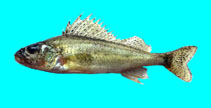
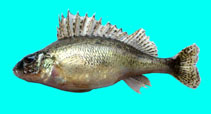
Épines dorsales (Total) : 11 - 19; Rayons mous dorsaux (Total) : 11 - 16; Épines anales: 2; Rayons mous anaux: 5 - 6; Vertèbres: 35 - 36. Distinguished uniquely from its congeners by its body depth 24-27% SL. Differs further from other members of the genus by the combination of having a flank yellowish with numerous, small, irregular, dark blotches and having 11-16 dorsal spines (Ref. 59043). Caudal fin with 16 to 17 rays (Ref. 40476). Dorsal fins are fused. Color brownish with dark spots (Ref. 35388).
Body shape (shape guide): fusiform / normal.

Biologie     Glossaire (ex. epibenthic)

Inhabits eutrophic lakes, lowland and piedmont rivers. Most abundant in estuaries of large rivers, brackish lakes with salinities up to 10-12 ppt and reservoirs. In general, its abundance increases with increased eutrophication (Ref. 59043). Reported to prefer still or slow-flowing water with soft bottom and without vegetation (Ref. 59043) and deep water with deposits of sand and gravel (Ref. 9696). Can tolerate some degradation of the environment (Ref. 30578). Can co-exist in deep lakes with Perca fluviatilis. Both species partly occur at different depths with Gymnocephalus cernua being more abundant in deeper layers (Ref. 59043). The membranous external walls of the head canals of this species provide high directional sensitivity; can feed at night in the dark using the lateral line system; feeds on zooplankton, chironomids, oligochaetes and amphipods (Ref. 10999). Pelagic in coastal lakes and tidal estuaries, preying on zooplankton and fish. Spawns on a variety of substrates at depths of about 3 m or less (Ref. 59043). White to yellow eggs in sticky strands are found on rocks and weed in shallow water (Ref. 41678). Used as bait for pike (Ref. 6258). Females live up to 10 year while males up to 7 years (Ref. 59043).

Cycle de vie et comportement reproducteur Maturité | Reproduction | Frai | Œufs | Fécondité | Larves

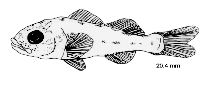
Eggs turn adhesive on contact with water and stick to stones or plants. Females lay eggs in two or more portions, usually separated by about 30 days in summer. First portion of eggs is larger the second portion. Larvae without or with only a brief, pelagic larval stage, switching early to benthic life, secretive and solitary, not forming schools. Larval survival is poor below 10°C and above 20°C (Ref. 59043).

Référence principale Téléchargez vos références | Références | Coordinateur | Collaborateurs

Kottelat, M. and J. Freyhof, 2007. Handbook of European freshwater fishes. Publications Kottelat, Cornol and Freyhof, Berlin. 646 pp. (Ref. 59043)

Statut dans la liste rouge de l'IUCN (Ref. 130435: Version 2025-2 (Global))

  Préoccupation mineure (LC) ; Date assessed: 28 May 2022

CITES

Not Evaluated

CMS (Ref. 116361)

Not Evaluated

Menace pour l'homme

  Potential pest


Utilisations par l'homme

Pêcheries: intérêt commercial mineur; pêche sportive: oui; appât: usually
FAO - pêcheries: débarquements; Publication: search | FishSource | Sea Around Us

Plus d'informations

Écologie trophique
Aliments (proies)
Composition du régime alimentaire
Consommation alimentaire
Rations alimentaires
Prédateurs
Écologie
Écologie
Dynamique des populations
Paramètres de croissance
Âges / tailles maximales
Longueur-poids rel.
Rel. longueur-longueur.
Fréquences de longueurs
Conversion de masse
Recrutement
Abondance
Cycle de vie
Reproduction
Maturité
Maturité/épines rel.
Fécondité
Frai
Agrégats de frai
Œufs
Développement de l'œuf
Larves
Dynamique des populations larvaires
Anatomie
Surface branchiale
Cerveau
Otolithe
Physiologie
Composition corporelle
Nutriments
Consommation d'oxygène
Type de natation
Vitesse de nage
Pigments visuels
Son de poisson
Maladies et parasites
Toxicité (CL50)
Génétique
génôme
Génétique
Hétérozygotie
Héritabilité
Diversité génétique
Liées à l'homme
Systèmes d'aquaculture
Profils d'aquaculture
Souches
Cas de ciguatera
Timbres, pièces de monnaie, divers
Sensibilisation
Collaborateurs
Références
Références

Outils

Articles particuliers

Télécharger en XML

Sources Internet

AFORO (otoliths) | Alien/Invasive Species database | Aquatic Commons | BHL | Cloffa | Websites from users | FishWatcher | CISTI | Catalog of Fishes: Genre, Espèce | DiscoverLife | DORIS | ECOTOX | FAO - pêcheries: débarquements; Publication: search | Faunafri | Fishipedia | Fishtrace | GloBI | Google Books | Google Scholar | Google | IGFA World Record | Bases de données nationales | OneZoom | Open Tree of Life | Otolith Atlas of Taiwan Fishes | Aquariums publics | PubMed | Reef Life Survey | Socotra Atlas | TreeBase | Arbre de Vie | Wikipedia: aller à, chercher | World Records Freshwater Fishing | Zoological Record

Estimations basées sur des modèles

Indice de diversité phylogénétique (Réf. 82804):  PD50 = 0.5312   [Uniqueness, from 0.5 = low to 2.0 = high].
Bayesian length-weight: a=0.00955 (0.00872 - 0.01046), b=3.00 (2.97 - 3.03), in cm total length, based on LWR estimates for this species (Ref. 93245).
Niveau trophique (Réf. 69278):  3.3   ±0.57 se; based on food items.
Generation time: 3.8 (2.3 - 5.1) years. Estimated as median ln(3)/K based on 21 growth studies.
Résilience (Réf. 120179):  Milieu, temps minimum de doublement de population : 1,4 à 4,4 années (K=0.1-0.48; tm=1-2).
Vulnérabilité de la pêche (Ref. 59153):  High vulnerability (58 of 100). 🛈
Catégorie de prix (Ref. 80766):   Unknown.
Nutriments (Ref. 124155):  Calcium = 32.8 [15.0, 75.3] mg/100g; Iron = 0.229 [0.115, 0.452] mg/100g; Protein = 17.3 [15.8, 18.8] %; Omega3 = 0.554 [0.198, 1.215] g/100g; Selenium = 9.99 [4.40, 21.18] μg/100g; VitaminA = 37.9 [12.2, 116.1] μg/100g; Zinc = 0.977 [0.660, 1.466] mg/100g (wet weight);