This website uses cookies to enhance your browsing experience and ensure the functionality of our site. For more detailed information about the types of cookies we use and how we protect your privacy, please visit our Privacy Information page.
×
Cookie Settings
This website uses different types of cookies to enhance your experience. Please select your preferences below:
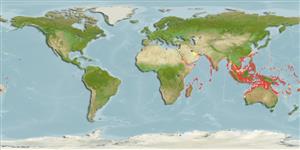
Indo-Pacific: Red Sea and East Africa to Samoa and the Phoenix Islands, north to Japan, south to Australia. Unknown from the Persian Gulf, Hawaii, and French Polynesia. Often confused with Epinephelus polyphekadion (=Epinephelus microdon of recent authors).
Longitud en la primera madurez / Tamaño / Peso / Edad
Madurez: Lm48.0 range ? - ? cm Max length : 120 cm TL macho / no sexado; (Ref. 2114); common length : 50.0 cm TL macho / no sexado; (Ref. 9137); peso máximo publicado: 11.0 kg (Ref. 5222); edad máxima reportada: 40 años (Ref. 74383)
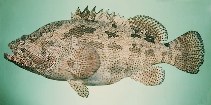
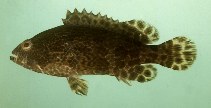
Espinas dorsales (total) : 11; Radios blandos dorsales (total) : 14 - 15; Espinas anales: 3; Radios blandos anales: 8. This species is distinguished by the following characters: body moderately deep, its depth 2.6-2.9 in SL (for specimens 11-55 cm SL); head length 2.3-2.5 in SL; interorbital area flat or slightly concave; dorsal head profile of adults indented at eyes and distinctly convex from there to dorsal-fin origin; rounded preopercle, finely serrate; upper edge of operculum distinctly convex, descending almost vertically to rear end of operculum; ventral edge of preorbital bone indented below nostrils; maxilla extends well posterior to eye; midlateral part of lower jaw with 3 or 4 rows of teeth; posterior nostrils triangular, 4-7 times larger than anteriors in adults; gill rakers on first gill arch 10-12 + 17-21 (rudiments often difficult to count), gill rakers short and stout, raker at angle subequal to longest gill filaments, other rakers distinctly shorter; cycloid scales except ctenoid in juvenile; body with auxiliary scales; caudal fin rounded; pectoral-fin rays 18-20; lateral-line scales 52 to 58. Colour: pale yellowish brown, with 5 vertical series of dark brown blotches that are very irregular in outline; head, body, and fins covered with close-set small brown spots, those on the dark blotches much darker than spots in between blotches; caudal peduncle with small black saddle dorsally; 2 or 3 faint, dark bars at side of jaws (Ref. 39231, 89707). Body shape (shape guide): fusiform / normal; Cross section: compressed.
Occurs in lagoon pinnacles, channels, and outer reef slopes, in coral-rich (Ref. 1937) areas and with clear waters. Juveniles in seagrass beds (Ref. 30573, 41878). Feeds on fishes, crabs, and cephalopods. May be ciguatoxic in some areas (Ref. 1602). Mainly active at dusk (Ref. 48635). Palau fishers increase their drop-line and spear-gun catches through knowledge of reproductive cycle of remochel, one of most important species in the area (Ref. 2928). Cultured under experimental conditions in the Philippines; a candidate for aquaculture in Singapore. In Hong Kong live fish markets (Ref. 27253). Caught with hook-and-line, traps, and spear and occasionally seen in local markets (Ref. 39231).
Heemstra, P.C. and J.E. Randall, 1993. FAO Species Catalogue. Vol. 16. Groupers of the world (family Serranidae, subfamily Epinephelinae). An annotated and illustrated catalogue of the grouper, rockcod, hind, coral grouper and lyretail species known to date. Rome: FAO. FAO Fish. Synop. 125(16):382 p. (Ref. 5222)
Situación en la Lista Roja de la UICN (Ref. 130435: Version 2025-2 (Global))