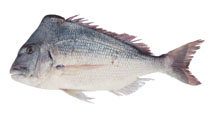
Argyrops spinifer, King soldierbream : fisheries

Argyrops spinifer (Forsskål, 1775)

King soldierbream
Ajouter votre observation dans Fish Watcher
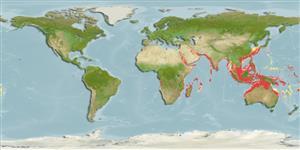
Native range | All suitable habitat | Point map | Year 2050
This map was computer-generated and has not yet been reviewed.
Argyrops spinifer   AquaMaps   Data sources: GBIF OBIS
Envoyez vos Photos et vidéos
Images | Images Google

Classification / Noms Noms communs | Synonymes | Catalog of Fishes(Genre, Espèce) | ITIS | CoL | WoRMS | Cloffa

> Eupercaria/misc (Various families in series Eupercaria) > Sparidae (Porgies)
Etymology: Argyrops: Greek, argyros = silver, silvered + Gree, ops = appearance (Ref. 45335).
More on author: Forsskål.

Environnement : milieu / zone climatique / profondeur / gamme de distribution Écologie

marin démersal; profondeur 1 - 450 m (Ref. 100719), usually 5 - 100 m (Ref. 30573). Tropical; 34°N - 28°S

Distribution Territoires | Zones FAO | Écosystèmes | Occurrences | Carte par point | Introductions | Faunafri

Indian Ocean: including the Red Sea and Persian Gulf, to Singapore and southernmost end of the Malay Peninsula.

Longueur à la première maturité / Taille / Poids / Âge

Maturité: Lm 30.9  range ? - ? cm
Max length : 80.0 cm TL mâle / non sexé; (Ref. 124569); common length : 30.0 cm TL mâle / non sexé; (Ref. 3507)

Description synthétique Clés d'identification | Morphologie | Morphométrie

Épines dorsales (Total) : 11 - 13; Rayons mous dorsaux (Total) : 9 - 10; Épines anales: 3; Rayons mous anaux: 7 - 8; Vertèbres: 24. This species is distinguished from all its congeners by the following set of characters: body deep and becoming compressed and less deep with growth; D XII,10, the first 2 dorsal-fin spines rudimentary (2 dorsal-fin spines on first dorsal pterygiophore); the dorsal-fin with two morpho types of configuration (Type I 'rigid type', fragile] as a rigid tapering spine and Type II ['flexible type', comparatively robust] as a flexible tapering spine in Group A - Red Sea, Group B - Gulf of Aden and eastern coast of Africa, and Group C - Persian Gulf, only Type II, is seen in both Group D - Madagascar to Sri Lanka and Group E - Eastern Indian Ocean, each Group is allopatric and is likely to have similar genetic structure (not analyzed in Group D or E). Colouration: body uniform pink with belly and lower jaw silvery, head red; spinous dorsal fin pink or red, other fins pink or pale pink; with pink tinge around eye; upper jaw often pinkish; anterior and posterior margins of the upper cheek scales nearly parallel just below rear edge of eye; orbit diameter is clearly less than suborbital depth (Ref. 124569).
Cross section: compressed.

Biologie     Glossaire (ex. epibenthic)

Found in a wide range of bottoms. Young fish occur in very shallow waters of sheltered bays; larger individuals in deeper water. Feed on benthic invertebrates, mainly mollusks (Ref. 5213). Important food fish.

Cycle de vie et comportement reproducteur Maturité | Reproduction | Frai | Œufs | Fécondité | Larves

Référence principale Téléchargez vos références | Références | Coordinateur | Collaborateurs

Iwatsuki, Y. and P.C. Heemstra, 2018. Taxonomic review of the genus Argyrops (Perciformes; Sparidae) with three new species from the Indo-West Pacific. Zootaxa 4438(3):401-442. (Ref. 124569)

Statut dans la liste rouge de l'IUCN (Ref. 130435: Version 2025-2 (Global))

  Préoccupation mineure (LC) ; Date assessed: 02 December 2009

CITES

Not Evaluated

CMS (Ref. 116361)

Not Evaluated

Menace pour l'homme

  Harmless


Utilisations par l'homme

Pêcheries: commercial
FAO - pêcheries: débarquements; Publication: search | FishSource | Sea Around Us

Plus d'informations

Écologie trophique
Aliments (proies)
Composition du régime alimentaire
Consommation alimentaire
Rations alimentaires
Prédateurs
Écologie
Écologie
Cycle de vie
Reproduction
Maturité
Maturité/épines rel.
Fécondité
Frai
Agrégats de frai
Œufs
Développement de l'œuf
Larves
Dynamique des populations larvaires
Distribution
Territoires
Zones FAO
Écosystèmes
Occurrences
Introductions
BRUVS - Vidéos
Anatomie
Surface branchiale
Cerveau
Otolithe
Physiologie
Composition corporelle
Nutriments
Consommation d'oxygène
Type de natation
Vitesse de nage
Pigments visuels
Son de poisson
Maladies et parasites
Toxicité (CL50)
Génétique
génôme
Génétique
Hétérozygotie
Héritabilité
Diversité génétique
Liées à l'homme
Systèmes d'aquaculture
Profils d'aquaculture
Souches
Cas de ciguatera
Timbres, pièces de monnaie, divers
Sensibilisation
Collaborateurs
Références
Références

Outils

Articles particuliers

Télécharger en XML

Sources Internet

AFORO (otoliths) | Aquatic Commons | BHL | Cloffa | Websites from users | FishWatcher | CISTI | Catalog of Fishes: Genre, Espèce | DiscoverLife | ECOTOX | FAO - pêcheries: débarquements; Publication: search | Faunafri | Fishipedia | Fishtrace | GloBI | Google Books | Google Scholar | Google | IGFA World Record | Bases de données nationales | OneZoom | Open Tree of Life | Otolith Atlas of Taiwan Fishes | PubMed | Reef Life Survey | Socotra Atlas | TreeBase | Arbre de Vie | Wikipedia: aller à, chercher | World Records Freshwater Fishing | Zoological Record

Estimations basées sur des modèles

Température préférée (Réf. 123201): 23.4 - 29, mean 27.9 °C (based on 3786 cells).
Indice de diversité phylogénétique (Réf. 82804):  PD50 = 0.5078   [Uniqueness, from 0.5 = low to 2.0 = high].
Bayesian length-weight: a=0.02188 (0.01857 - 0.02577), b=2.96 (2.92 - 3.00), in cm total length, based on LWR estimates for this species (Ref. 93245).
Niveau trophique (Réf. 69278):  3.7   ±0.38 se; based on food items.
Generation time: 7.3 (4.7 - 12.2) years. Estimated as median ln(3)/K based on 10 growth studies.
Résilience (Réf. 120179):  Faible, temps minimum de doublement de population : 4,5 à 14 années (K=0.08-0.21; tmax=25; tm=2; Fec = 47,000).
Vulnérabilité de la pêche (Ref. 59153):  High vulnerability (55 of 100). 🛈
Vulnérabilité climatique (Ref. 125649):  High vulnerability (61 of 100). 🛈
Catégorie de prix (Ref. 80766):   High.
Nutriments (Ref. 124155):  Calcium = 85.7 [37.7, 186.4] mg/100g; Iron = 1.02 [0.52, 2.18] mg/100g; Protein = 18.8 [17.4, 20.1] %; Omega3 = 0.234 [0.119, 0.453] g/100g; Selenium = 82.6 [34.7, 189.3] μg/100g; VitaminA = 16.6 [4.1, 69.2] μg/100g; Zinc = 0.607 [0.370, 0.930] mg/100g (wet weight);