



Waarneming toevoegen in Fish Watcher
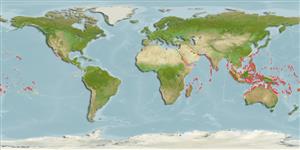
| Native range | All suitable habitat | Point map | Year 2050 |
|
| This map was computer-generated and has not yet been reviewed. |
| Stegastes nigricans AquaMaps Data sources: GBIF OBIS |
Uploaden van uw Foto's en video's
Afbeeldingen | video's | Google afbeelding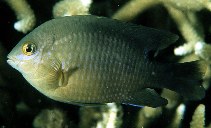 Stegastes nigricans
Afbeelding van Randall, J.E.
Afbeeldingen | video's | Google afbeelding
Afbeelding van Randall, J.E.
Classificatie / Namen Lokale namen | Synoniemen | Catalog of Fishes(Genus, Soort(en)) | ITIS | CoL | WoRMS | Cloffa
> Ovalentaria/misc (Various families in series Ovalentaria) > Pomacentridae (Damselfishes) > Microspathodontinae
Etymology: Stegastes: Greek, stegastos, -e, -on = covered (Ref. 45335).
More on author: Lacepède.
Etymology: Stegastes: Greek, stegastos, -e, -on = covered (Ref. 45335).
More on author: Lacepède.
Milieu: milieu / Klimaatzone / Diepte / verspreidingsgebied Ecologie
marien rifbewoner; standvastig; diepte 1 - 12 m (Ref. 7247). Tropical; 30°N - 30°S
Verspreiding Gebieden | FAO regio's | Ecosystemen | Voorkomen | Verspreidingskaart | Introducties | Faunafri
Indo-Pacific: Red Sea and East Africa to the Line, Marquesas, and Tuamoto islands, north to the Ryukyu and Bonin islands, south to New Caledonia and Tonga; throughout Micronesia. Excluding the Hawaiian Islands (Ref. 7247). Hawaiian population refers to Stegastes marginatus (Ref. 86689).
Grootte / Gewicht / Leeftijd
Maturiteit: Lm ? range ? - ? cm
Max length : 14.0 cm TL mannelijk / geslacht onbekend; (Ref. 4391); common length : 9.0 cm TL mannelijk / geslacht onbekend; (Ref. 5450)
Max length : 14.0 cm TL mannelijk / geslacht onbekend; (Ref. 4391); common length : 9.0 cm TL mannelijk / geslacht onbekend; (Ref. 5450)
Korte beschrijving Determinatiesleutels | Morfologie | Morfometrie
Dorsale stekels (totaal) : 12; Dorsale zachte stralen (totaal) : 15 - 17; Anale stekels: 2; Anale zachte stralen: 12 - 14. Diagnosis: Adults generally brown; dorsal part of head and nape darker, grading to tan on lower part of head and breast. The scales have darker brown margins. The lips are whitish lips; the suborbital is mostly blue; the preopercle and opercle scales with blue centers. The median and pelvic fins are brown; the pectorals are dusky; a well-defined dark brown or blackish spot is sometimes present at base of posteriormost dorsal rays, which distinguishes it from S. lividus where the spot is diffuse. Males in courtship or guarding eggs with broad white bar across middle of body and pale blue stripe from mouth to upper part of pectoral fin (Ref. 510).
Body shape (shape guide): short and / or deep; Cross section: oval.
Body shape (shape guide): short and / or deep; Cross section: oval.
Adults inhabit reef flats and lagoon reefs. Frequently occur in colonies associated with live or dead branching staghorn coral (Acropora). Feed on algae, gastropods, sponges, and copepods. Territorial, maintain and 'weed' filamentous algae patches growing on dead coral (Ref. 9710). They attack human intruders without hesitation, sometimes taking painful nips. Particularly aggressive during reproductive periods. The species emit clicking noises during aggressive encounters. Oviparous, males tend the nest visited by several females (Ref. 59295).
Levenscyclus en paargedrag Maturiteit | Voortplanting | Paaien | Eieren | Fecunditeit | Larven
Oviparous, distinct pairing during breeding (Ref. 205). Eggs are demersal and adhere to the substrate (Ref. 205). Males guard and aerate the eggs (Ref. 205).
Hoofdreferentie
Upload uw referenties | Referenties | Coördinator : Allen, Gerald R. | Medewerkers
Allen, G.R. and A.R. Emery, 1985. A review of the Pomacentrid fishes of the genus Stegastes from the Indo-Pacific, with descriptions of two new species. Indo-Pac. Fish. (3):31. (Ref. 510)
Status op de Rode Lijst van het IUCN (Ref. 130435: Version 2025-2 (Global))
Niet bedreigd (LC) ; Date assessed: 04 October 2021
CITES
Not Evaluated
Gevaar voor de mens
Traumatogenic (Ref. 510)
Gebruik door de mens
Visserij: van minder commercieel belang; Aquarium: Publieke aquaria
FAO - Publication: search | FishSource |
Meer informatie
Trofische ecologie
Voedsel (prooien)
Dieetsamenstelling
Voedselconsumptie
Voedselrantsoenen
Predatoren
Voedsel (prooien)
Dieetsamenstelling
Voedselconsumptie
Voedselrantsoenen
Predatoren
Populatiedynamica
Groeiparameters
Max. leeftijden / maten
Lengte-gewicht rel.
Lengte-lengte rel.
Lengtefrequenties
Massaconversie
Rekrutering
Abundantie
Groeiparameters
Max. leeftijden / maten
Lengte-gewicht rel.
Lengte-lengte rel.
Lengtefrequenties
Massaconversie
Rekrutering
Abundantie
Levenscyclus
Voortplanting
Maturiteit
Rijpheid/kieuwen rel.
Fecunditeit
Paaien
Paaibestanden
Eieren
Ontwikkeling van de eieren
Larven
Larvale populatiedynamiek
Voortplanting
Maturiteit
Rijpheid/kieuwen rel.
Fecunditeit
Paaien
Paaibestanden
Eieren
Ontwikkeling van de eieren
Larven
Larvale populatiedynamiek
Fysiologie
Lichaamssamenstelling
Voedingsstoffen
Zuurstofverbruik
Type zwemmen
Zwemsnelheid
Visuele pigmenten
Vis geluid
Ziekten en parasieten
Toxiciteit (LC50)
Lichaamssamenstelling
Voedingsstoffen
Zuurstofverbruik
Type zwemmen
Zwemsnelheid
Visuele pigmenten
Vis geluid
Ziekten en parasieten
Toxiciteit (LC50)
Menselijk gerelateerd
Aquacultuursystemen
Aquacultuurprofielen
Kweeklijnen
Ciguatera gevallen
Postzegels, munten, diversen.
Aquacultuursystemen
Aquacultuurprofielen
Kweeklijnen
Ciguatera gevallen
Postzegels, munten, diversen.
Tools
Biologische quiz | E-boek | Veldgids | Determinatiesleutels | Lengtefrequentie Tool | Levenscyclus tool | Verspreidingskaart |
Vangst-MSY |
Speciale rapporten
Bekijk gegevens voor het houden in een aquarium | Bekijk Fact Sheets voor de soort | Bekijk Aquacultuur Fact Sheets
Download XML
Internetbronnen
AFORO (otoliths) | Aquatic Commons | BHL | Cloffa | Websites from users | Bekijk FishWatcher | CISTI | Catalog of Fishes: Genus, Soort(en) | DiscoverLife | DORIS | ECOTOX | FAO - Publication: search | Faunafri | Fishipedia | Fishtrace | GloBI | Google Books | Google Scholar | Google | IGFA World Record | Nationale databanken | OneZoom | Open Tree of Life | Otolith Atlas of Taiwan Fishes | PubMed | Reef Life Survey | Socotra Atlas | TreeBase | Tree of Life | Wikipedia: ga naar, zoek | World Records Freshwater Fishing | Zoological Record
Schattingen op basis van modellen
Gewenste temperatuur (Ref. 123201): 25 - 29.3, mean 28.4 °C (based on 3006 cells).
Fylogenetische diversiteitsindex (Ref. 82804): PD50 = 0.5000 [Uniqueness, from 0.5 = low to 2.0 = high].
Bayesian length-weight: a=0.02399 (0.01454 - 0.03959), b=3.02 (2.88 - 3.16), in cm total length, based on LWR estimates for this species & Genus-body shape (Ref. 93245).
Trofisch niveau (Ref. 69278): 2.2 ±0.0 se; based on diet studies.
Generation time: 1.9 ( na - na) years. Estimated as median ln(3)/K based on 2 growth studies.
Weerstandsvermogen (Ref. 120179): Hoog, minimale populatieverdubbelingstijd minder dan 15 maanden (K=0.5-1.1).
Voedingsstoffen (Ref. 124155): Calcium = 130 [67, 211] mg/100g; Iron = 0.938 [0.553, 1.586] mg/100g; Protein = 18.2 [17.0, 19.4] %; Omega3 = 0.0973 [, ] g/100g; Selenium = 27.5 [14.6, 56.1] μg/100g; VitaminA = 45 [11, 168] μg/100g; Zinc = 1.96 [1.29, 2.92] mg/100g (wet weight);