



Plectroglyphidodon apicalis (De Vis, 1885)
Australian gregory
Envoyez vos Photos et vidéos
Images | Images Google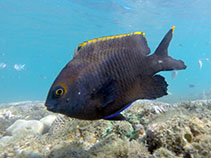 Plectroglyphidodon apicalis
Photo de Lavin, C.P.
Images | Images Google
Photo de Lavin, C.P.
Classification / Noms Noms communs | Synonymes | Catalog of Fishes(Genre, Espèce) | ITIS | CoL | WoRMS | Cloffa
> Ovalentaria/misc (Various families in series Ovalentaria) > Pomacentridae (Damselfishes) > Microspathodontinae
Etymology: Plectroglyphidodon: Greek,plektron = anything to strike with, spur + Greek, glyphis = carved + Greek, odous = teeth (Ref. 45335).
Etymology: Plectroglyphidodon: Greek,plektron = anything to strike with, spur + Greek, glyphis = carved + Greek, odous = teeth (Ref. 45335).
Environnement : milieu / zone climatique / profondeur / gamme de distribution Écologie
marin récifal; non migrateur; profondeur 1 - 5 m (Ref. 9710). Subtropical; 10°S - 38°S
Distribution Territoires | Zones FAO | Écosystèmes | Occurrences | Carte par point | Introductions | Faunafri
Western Pacific: known only from the east coast of Australia - Great Barrier Reef, Queensland, and New South Wales. More recently reported from Taiwan (Ref. 12711) and Ouvéa Atoll, Loyalty Islands (Ref. 13236).
Taille / Poids / Âge
Description synthétique Clés d'identification | Morphologie | Morphométrie
Épines dorsales (Total) : 13; Rayons mous dorsaux (Total) : 15 - 16; Épines anales: 2; Rayons mous anaux: 13. Body color is generally dark brown with yellow or reddish suffusion on antero-dorsal part of head and body. The scales have blackish streaks near margin, giving an overall appearance of narrow transverse bands; a few small blue spots is scattered on head, breast and posteriorly on the sides. The spinous dorsal fin is reddish brown with orange submarginal band while outer edge of soft rays orange. A black spot is on the distal part of membrane between 2nd and 3rd dorsal spine. The tip of the upper caudal lobe is orange; the anterior edge of pelvic and anal fins is blue.
Body shape (shape guide): short and / or deep; Cross section: oval.
Body shape (shape guide): short and / or deep; Cross section: oval.
Adults are found around dead coral outcrops, also in rubble areas in lagoons and on the outer edge of reefs (Ref. 510). Oviparous, distinct pairing during breeding (Ref. 205). Eggs are demersal and adhere to the substrate (Ref. 205). Males guard and aerate the eggs (Ref. 205).
Cycle de vie et comportement reproducteur Maturité | Reproduction | Frai | Œufs | Fécondité | Larves
Oviparous, distinct pairing during breeding (Ref. 205). Eggs are demersal and adhere to the substrate (Ref. 205). Males guard and aerate the eggs (Ref. 205).
Référence principale
Téléchargez vos références | Références | Coordinateur : Allen, Gerald R. | Collaborateurs
Allen, G.R. and A.R. Emery, 1985. A review of the Pomacentrid fishes of the genus Stegastes from the Indo-Pacific, with descriptions of two new species. Indo-Pac. Fish. (3):31. (Ref. 510)
CITES
Not Evaluated
Menace pour l'homme
Harmless
Utilisations par l'homme
FAO - Publication: search | FishSource |
Plus d'informations
Écologie trophique
Aliments (proies)
Composition du régime alimentaire
Consommation alimentaire
Rations alimentaires
Prédateurs
Aliments (proies)
Composition du régime alimentaire
Consommation alimentaire
Rations alimentaires
Prédateurs
Dynamique des populations
Paramètres de croissance
Âges / tailles maximales
Longueur-poids rel.
Rel. longueur-longueur.
Fréquences de longueurs
Conversion de masse
Recrutement
Abondance
Paramètres de croissance
Âges / tailles maximales
Longueur-poids rel.
Rel. longueur-longueur.
Fréquences de longueurs
Conversion de masse
Recrutement
Abondance
Cycle de vie
Reproduction
Maturité
Maturité/épines rel.
Fécondité
Frai
Agrégats de frai
Œufs
Développement de l'œuf
Larves
Dynamique des populations larvaires
Reproduction
Maturité
Maturité/épines rel.
Fécondité
Frai
Agrégats de frai
Œufs
Développement de l'œuf
Larves
Dynamique des populations larvaires
Anatomie
Surface branchiale
Cerveau
Otolithe
Surface branchiale
Cerveau
Otolithe
Physiologie
Composition corporelle
Nutriments
Consommation d'oxygène
Type de natation
Vitesse de nage
Pigments visuels
Son de poisson
Maladies et parasites
Toxicité (CL50)
Composition corporelle
Nutriments
Consommation d'oxygène
Type de natation
Vitesse de nage
Pigments visuels
Son de poisson
Maladies et parasites
Toxicité (CL50)
Génétique
génôme
Génétique
Hétérozygotie
Héritabilité
Diversité génétique
génôme
Génétique
Hétérozygotie
Héritabilité
Diversité génétique
Liées à l'homme
Systèmes d'aquaculture
Profils d'aquaculture
Souches
Cas de ciguatera
Timbres, pièces de monnaie, divers
Systèmes d'aquaculture
Profils d'aquaculture
Souches
Cas de ciguatera
Timbres, pièces de monnaie, divers
Outils
E-book | Guide de terrain | Clés d'identification | Générateur de fréquences de longueur | Outil de dynamique de population | Carte par point |
Capture-MSY |
Articles particuliers
Télécharger en XML
Sources Internet
AFORO (otoliths) | Aquatic Commons | BHL | Cloffa | Websites from users | FishWatcher | CISTI | Catalog of Fishes: Genre, Espèce | DiscoverLife | ECOTOX | FAO - Publication: search | Faunafri | Fishipedia | Fishtrace | GloBI | Google Books | Google Scholar | Google | IGFA World Record | Bases de données nationales | OneZoom | Open Tree of Life | Otolith Atlas of Taiwan Fishes | PubMed | Reef Life Survey | Socotra Atlas | TreeBase | Arbre de Vie | Wikipedia: aller à, chercher | World Records Freshwater Fishing | Zoological Record
Estimations basées sur des modèles
Température préférée (Réf. 123201): 24.4 - 28.3, mean 26.6 °C (based on 374 cells).
Indice de diversité phylogénétique (Réf. 82804): PD50 = 0.5000 [Uniqueness, from 0.5 = low to 2.0 = high].
Bayesian length-weight: a=0.01995 (0.00910 - 0.04376), b=2.99 (2.80 - 3.18), in cm total length, based on LWR estimates for this (Sub)family-body shape (Ref. 93245).
Résilience (Réf. 120179): Haut, temps minimum de doublement de population inférieur à 15 mois (Preliminary K or Fecundity.).
Nutriments (Ref. 124155): Calcium = 67.7 [28.6, 117.0] mg/100g; Iron = 0.715 [0.396, 1.321] mg/100g; Protein = 19 [18, 20] %; Omega3 = 0.136 [0.070, 0.262] g/100g; Selenium = 8.4 [3.7, 19.0] μg/100g; VitaminA = 49.7 [11.9, 200.3] μg/100g; Zinc = 1.18 [0.72, 1.92] mg/100g (wet weight);