Istigobius ornatus, Ornate goby : fisheries, aquarium

Istigobius ornatus (Rüppell, 1830)

Ornate goby
Beobachtung melden im Fish Watcher
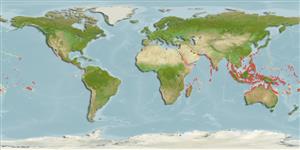
Native range | All suitable habitat | Point map | Year 2050
This map was computer-generated and has not yet been reviewed.
Istigobius ornatus   AquaMaps   Data sources: GBIF OBIS
Hochladen Photos und videos
Bilder | videos | Google Bild

Klassifizierung / Names Namen | Synonyme | Catalog of Fishes(Gattung, Arten) | ITIS | CoL | WoRMS | Cloffa

> Gobiiformes (Gobies) > Gobiidae (Gobies) > Gobiinae
Etymology: Istigobius: Greek, istios = sail + Latin, gobius = gudgeon (Ref. 45335).
More on author: Rüppell.

Umwelt: Milieu / Klimazone / Tiefenbereich / Verbreitungsgebiet Ökologie

seewasser; brackwasser riff-verbunden; tiefenbereich 0 - 5 m (Ref. 86942). Tropical; 21°C - 29°C (Ref. 27115); 30°N - 25°S

Verbreitung Territorien | FAO Gebiete | Ökosysteme | Vorkommen | Punkt Karte | Einführungen | Faunafri

Indo-Pacific: Red Sea south to northern Mozambique (Ref. 4343) and east to Fiji, north to southern Taiwan, south to New Caledonia. Recently recorded from Tonga (Ref. 53797).

Größe / Gewicht / Alter

Geschlechtsreife: Lm ?  range ? - ? cm
Max length : 11.0 cm TL Männchen/unbestimmt; (Ref. 9710)

Kurzbeschreibung Bestimmungsschlüssel | Morphologie | Morphometrie

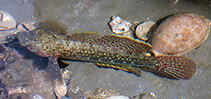
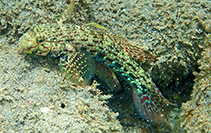
Rückenflossenstacheln (insgesamt) : 7; Rückenflossenweichstrahlen (insgesamt) : 10 - 12; Afterflossenstacheln: 1; Afterflossenweichstrahlen: 9 - 11; Wirbelzahl: 26. Upper 3-4 pectoral fin rays free. Body color pale gray; operculum with 5 small blue spots interspersed with brownish red spots; 5 vertical rows of white spots on pectoral fins; anterior tip of first dorsal fin bright yellow. 4th spine of 1st dorsal fin longest. Predorsal scales cycloid, trunk ctenoid. Mouth with overhanging snout, lips greatly thickened. Cheeks and operculae without scales. Female pelvic and anal fins not as darkly pigmented as in male. Also with terete body shape, slightly depressed; eyes situated dorso-laterally; reduced swim bladders (Ref. 92840).
Body shape (shape guide): fusiform / normal; Cross section: circular.

Biologie     Fachlexikon (Englisch) (z.B. epibenthic)

A common species that inhabits mangroves and silty, rocky areas; occasionally found in rubble reef areas. Only single individuals were observed; many individuals found scattered over a small area (Ref. 420). Found primarily in lower estuaries, usually in mangroves. This is the species of the genus that is found farthest inland. Feeds on small invertebrates (Ref. 12693).

Lebenszyklus und Paarungsverhalten Geschlechtsreife | Fortpflanzung | Ablaichen | Eier | Fruchtbarkeit | Larven

Genital papilla, of male varying from lightly to heavily pigmented and terminating to side of anal spine. Female genital papilla lightly pigmented and truncate, terminating well before anal spine (Ref. 420). Benthic spawner (Ref. 32023).

Hauptreferenz Laden Sie Ihre Referenzen hoch | Referenzen | Koordinator | Partner

Murdy, E.O. and D.F. Hoese, 1985. Revision of the gobiid fish genus Istigobius. Indo-Pac. Fish. (4):41 p. (Ref. 420)

IUCN Rote Liste Status (Ref. 130435: Version 2025-2 (Global))

  nicht bedroht (LC) ; Date assessed: 02 July 2016

CITES

Not Evaluated

CMS (Ref. 116361)

Not Evaluated

Bedrohung für Menschen

  Harmless


Nutzung durch Menschen

Fischereien: kommerziell; Aquarium: Kommerziell
FAO - Publication: search | FishSource |

Mehr Information

Trophische Ökologie
Lebensmittel (Beutetiere)
Nahrungszusammensetzung
Nahrungsaufnahme
Lebensmittelrationen
Räuber
Ökologie
Ökologie
Populationsdynamik
Wachstumsparameter
Max. Alter/Größen
Länge-Gewicht-Rel.
Länge-Länge-Verhältnis.
Längenhäufigkeiten
Massenkonvertierung
Rekrutierung
Dichte
Lebenszyklus
Fortpflanzung
Geschlechtsreife
Reifung/Kiemen rel.
Fruchtbarkeit
Ablaichen
Laichaggregationen
Eier
Eientwicklung
Larven
Larven Pop.Dyn.
Verbreitung
Territorien
FAO Gebiete
Ökosysteme
Vorkommen
Einführungen
BRUVS - Videos
Anatomie
Kiemenoberfläche
Gehirn
Otolith
Physiologie
Körperliche Zusammensetzung
Nährstoffe
Sauerstoffverbrauch
Schwimmart
Schwimmgeschwindigkeit
Visuelle Pigmente
Fischgeräusche
Krankheiten und Parasiten
Toxizität (LC50s)
Genetik
Genom
Genetik
Heterozygotie
Vererbbarkeit
Genetische Vielfalt
Menschenbezogen
Aquakultur-Systeme
Aquakultur Profile
Zuchtlinien
Ciguatera-Fälle
Briefmarken, Münzen, Verschiedenes.
Aufsuchen
Partner
Referenzen
Referenzen

Tools

Zusatzinformationen

Download XML

Internet Quellen

AFORO (otoliths) | Aquatic Commons | BHL | Cloffa | Websites from users | FishWatcher Einträge suchen | CISTI | Catalog of Fishes: Gattung, Arten | DiscoverLife | ECOTOX | FAO - Publication: search | Faunafri | Fishipedia | Fishtrace | GloBI | Google Books | Google Scholar | Google | IGFA World Record | Nationale Datenbanken | OneZoom | Open Tree of Life | Otolith Atlas of Taiwan Fishes | PubMed | Reef Life Survey | Socotra Atlas | TreeBase | Tree of Life | Wikipedia: Gehe zu, Suchen | World Records Freshwater Fishing | Zoologischer Rekord

Schätzungen auf der Grundlage von Modellen

Bevorzugte Temperatur (Ref. 123201): 25.5 - 29.3, mean 28.5 °C (based on 3131 cells).
Phylogenetischer Diversitätsindex (Ref. 82804):  PD50 = 0.5005   [Uniqueness, from 0.5 = low to 2.0 = high].
Bayesian length-weight: a=0.01096 (0.00647 - 0.01859), b=3.04 (2.89 - 3.19), in cm total length, based on LWR estimates for this species & (Sub)family-body (Ref. 93245).
Trophische Ebene (Ref. 69278):  4.3   ±0.26 se; based on food items.
Widerstandsfähigkeit (Ref. 120179):  hoch, Verdopplung der Population dauert weniger als 15 Monate. (Preliminary K or Fecundity.).
Anfälligkeit der Fischerei (Ref. 59153):  Low vulnerability (10 of 100). 🛈
Preiskategorie (Ref. 80766):   Very high.
Nährstoffe (Ref. 124155):  Calcium = 117 [60, 247] mg/100g; Iron = 0.778 [0.388, 1.423] mg/100g; Protein = 18.9 [17.0, 20.6] %; Omega3 = 0.138 [0.061, 0.267] g/100g; Selenium = 14.6 [7.1, 31.0] μg/100g; VitaminA = 134 [36, 471] μg/100g; Zinc = 2.17 [1.43, 3.24] mg/100g (wet weight);