



Cottus cognatus Richardson, 1836
Slimy sculpin
Ladda upp din foton och Videor
Bilder | Google image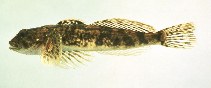 Cottus cognatus
Bild av Scarola, J.F.
Bilder | Google image
Bild av Scarola, J.F.
Klassificering / Namn Populärnamn | synonymer | Catalog of Fishes(Släkte, Arter) | ITIS | CoL | WoRMS | Cloffa
> Perciformes/Cottoidei (Sculpins) > Cottidae (Sculpins)
Etymology: Cottus: Greek, kottos = a fish (Ref. 45335); cognatus: cognatus due to its relation to the European species C. gobio (Ref. 1998).
More on author: Richardson.
Etymology: Cottus: Greek, kottos = a fish (Ref. 45335); cognatus: cognatus due to its relation to the European species C. gobio (Ref. 1998).
More on author: Richardson.
Miljö: miljö / Klimatzon / djupintervall / distributionsområde Ekologi
; sötvatten; brackvatten bottenlevande; ej vandrande (Ref. 126106); djupintervall 6 - 128 m (Ref. 1998). Temperate; 4°C - 16°C (Ref. 13614); 71°N - 37°N
Utbredning Territorier | FAO områden | Ekosystem | Förekomster | Prickkarta | Utplanteringar | Faunafri
North America: throughout most of mainland Canada and Alaska; Atlantic Slope drainages south to Potomac River in Virginia, USA; St. Lawrence-Great Lakes basin; upper Mississippi River basin in Wisconsin, Minnesota and Iowa, USA; upper Columbia River drainage in Canada and USA. Also in Siberia, Russia.
Längd vid första mognad / Storlek / Vikt / Ålder
Könsmognad: Lm 7.4 range ? - ? cm
Max length : 12.1 cm TL hane/ej könsbestämd; (Ref. 27547); common length : 7.5 cm TL hane/ej könsbestämd; (Ref. 27547); rapporterad maxålder: 7 år (Ref. 28921)
Max length : 12.1 cm TL hane/ej könsbestämd; (Ref. 27547); common length : 7.5 cm TL hane/ej könsbestämd; (Ref. 27547); rapporterad maxålder: 7 år (Ref. 28921)
Kort beskrivning Bestämningsnycklar | Morfologi | Morfometri
Taggstrålar i ryggfenan (totalt) : 7 - 10; Mjukstrålar i ryggfenan (totalt) : 14 - 19; Taggstrålar i analfenan: 0; Mjukstrålar i analfenan: 10 - 14; Ryggkotor: 31 - 35. Distinguished by the two pores on the chin and the short lateral line ending under the second dorsal fin (Ref. 27547). Gill rakers short and stubby, about 6 on first gill arch; lateral line incomplete, ending under middle of soft dorsal fin and usually having a few isolated pores behind this point; main portion with 12 to 26 pores (Ref. 27547). Pectorals large and fan-shaped, tips of lower rays projecting; fourth ray of pelvic much reduced; caudal rounded (Ref. 27547). Rather dark brown or green to dark gray on back and sides, whitish below, with vague, dark mottlings or bars below soft dorsal; belly sometimes with orange tints; soft dorsal, pectoral and caudal fins usually barred, pelvic fins and anal usually immaculate but sometimes barred; spiny dorsal dark at base, with a clear margin that may turn orange in breeding males; breeding males usually dark, sometimes black, all over (Ref. 27547).
Body shape (shape guide): elongated.
Body shape (shape guide): elongated.
Adults inhabit rocky riffles of cold streams, rocky areas of lakes (commonly at 90-106 m depth), springs and their effluents (Ref. 5723). They move into shallow water to spawn (Ref. 27547). In some areas, they are common in brackish water (Ref. 27843), presumably moving to and from fresh water, at least for spawning (Ref. 27547). They feed mostly on aquatic insect larvae and nymphs but also on crustaceans, small fishes, and plant materials (Ref. 1998). May be used as bait, but this seems rare (Ref. 27547).
Livscykel och parningsbeteende Könsmognad | Reproduktion | Lek | Ägg | Fekunditet | Larver
The male chooses a nesting site under a rock or ledge. Spawning males are territorial toward other males (Ref. 27547). He attracts a female into the nesting site and after more courting the female deposits her adhesive eggs. The female is then driven out and the male guards the eggs until hatching occurs. The nest usually contains eggs from several females (Ref. 27547). The male has also been observed to guard the young (Ref. 1998).
Huvudreferens
Ladda upp dina referenser | referenser | Koordinator | Medarbetare
Page, L.M. and B.M. Burr, 1991. A field guide to freshwater fishes of North America north of Mexico. Houghton Mifflin Company, Boston. 432 p. (Ref. 5723)
Status på IUCN:s rödlista (Ref. 130435: Version 2025-2 (Global))
Least Concern (LC) ; Date assessed: 24 June 2020
CITES
Not Evaluated
Hot mot människor
Harmless
Mänskliga användningsområden
Fiskeri: kommersiell; Akvarium: Offentliga akvarier
FAO - Publication: search | FishSource |
Ytterligare information
Populationsdynamik
Tillväxtparametrar
Max. åldrar / storlekar
Längd-vikt rel.
Längd-längd rel.
Längd-frekvenser
Massakonvertering
Rekrytering
Abundans
Tillväxtparametrar
Max. åldrar / storlekar
Längd-vikt rel.
Längd-längd rel.
Längd-frekvenser
Massakonvertering
Rekrytering
Abundans
Livscykel
Reproduktion
Könsmognad
Mognad/Gills rel.
Fekunditet
Lek
Lekande aggregat
Ägg
Utveckling av ägg
Larver
Larvdynamik
Reproduktion
Könsmognad
Mognad/Gills rel.
Fekunditet
Lek
Lekande aggregat
Ägg
Utveckling av ägg
Larver
Larvdynamik
Anatomi
Gälyta
Hjärna
Otolit
Gälyta
Hjärna
Otolit
Fysiologi
Kroppssammansättning
Näringsämnen
Syreförbrukning
Typ av simning
Simhastighet
Visuella pigment
Ljud från fisk
Sjukdomar & Parasiter
Toxicitet (LC50)
Kroppssammansättning
Näringsämnen
Syreförbrukning
Typ av simning
Simhastighet
Visuella pigment
Ljud från fisk
Sjukdomar & Parasiter
Toxicitet (LC50)
Genetik
Genom
Genetik
Heterozygositet
Ärftlighet
Genetisk mångfald
Genom
Genetik
Heterozygositet
Ärftlighet
Genetisk mångfald
Människorelaterad
Vattenbrukssystem
Vattenbruksprofiler
Avelslinjer
Ciguatera-fall
Frimärken, mynt, diverse.
Vattenbrukssystem
Vattenbruksprofiler
Avelslinjer
Ciguatera-fall
Frimärken, mynt, diverse.
Verktyg
E-bok | Fälthandbok | Bestämningsnycklar | Längdfördelnings-verktyg | Livshistorie-verktyg | Prickkarta |
Fångst-MSY |
Särskilda rapporter
Kontrollera för underhåll av akvarium | Kontrollera om det finns faktablad om arter | Kontrollera om det finns faktablad om vattenbruk
Ladda ner XML
Internet-källor
AFORO (otoliths) | Aquatic Commons | BHL | Cloffa | Websites from users | Check FishWatcher | CISTI | Catalog of Fishes: Släkte, Arter | DiscoverLife | ECOTOX | FAO - Publication: search | Faunafri | Fishipedia | Fishtrace | GloBI | Google Books | Google Scholar | Google | IGFA World Record | OneZoom | Open Tree of Life | Otolith Atlas of Taiwan Fishes | Offentliga akvarier | PubMed | Reef Life Survey | Socotra Atlas | TreeBase | Tree of Life | Wikipedia: Go, sök | World Records Freshwater Fishing | Zoobank | Zoologiskt register
Uppskattningar baserade på modeller
Index för fylogenetisk mångfald (Ref. 82804): PD50 = 0.5000 [Uniqueness, from 0.5 = low to 2.0 = high].
Bayesian length-weight: a=0.00832 (0.00345 - 0.02005), b=3.16 (2.98 - 3.34), in cm total length, based on LWR estimates for this Genus-body shape (Ref. 93245).
Trofisk nivå (Ref. 69278): 3.4 ±0.47 se; based on food items.
Generation time: 8.1 ( na - na) years. Estimated as median ln(3)/K based on 1 growth studies.
Resiliens (Ref. 120179): Mellan, lägsta populationsfördubblingstid 1,4-4,4 år (tm=2-4; tmax=7; Fec=42-1,420).