



Beobachtung melden im Fish Watcher
| Native range | All suitable habitat | Point map | Year 2050 |

|
| This map was computer-generated and has not yet been reviewed. |
| Cynoscion regalis AquaMaps Data sources: GBIF OBIS |
Hochladen Photos und videos
Bilder | Laute | Google Bild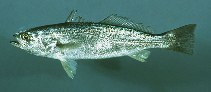 Cynoscion regalis
Photo von Flescher, D.
Bilder | Laute | Google Bild
Photo von Flescher, D.
Klassifizierung / Names Namen | Synonyme | Catalog of Fishes(Gattung, Arten) | ITIS | CoL | WoRMS | Cloffa
> Eupercaria/misc (Various families in series Eupercaria) > Sciaenidae (Drums or croakers)
Etymology: Cynoscion: Greek, kyon = dog + Greek, odous = teeth + Greek, skion, skiaina = barbel, red mullet (Ref. 45335).
More on authors: Bloch & Schneider.
Etymology: Cynoscion: Greek, kyon = dog + Greek, odous = teeth + Greek, skion, skiaina = barbel, red mullet (Ref. 45335).
More on authors: Bloch & Schneider.
Umwelt: Milieu / Klimazone / Tiefenbereich / Verbreitungsgebiet Ökologie
seewasser; brackwasser demersal; ozeanodrom (Ref. 51243); tiefenbereich 10 - 26 m (Ref. 54407). Subtropical; 17°C - 27°C (Ref. 54461); 47°N - 27°N, 82°W - 59°W
Verbreitung Territorien | FAO Gebiete | Ökosysteme | Vorkommen | Punkt Karte | Einführungen | Faunafri
Western Atlantic: Nova Scotia, Canada to northern Florida, USA. Introduced in Europe (Ref. 122657).
Länge bei der ersten Reifung / Größe / Gewicht / Alter
Geschlechtsreife: Lm 17.9, range 14 - 22.5 cm
Max length : 98.0 cm TL Männchen/unbestimmt; (Ref. 40637); common length : 50.0 cm TL Männchen/unbestimmt; (Ref. 3702); max. veröff. Gewicht: 8.9 kg (Ref. 40637)
Max length : 98.0 cm TL Männchen/unbestimmt; (Ref. 40637); common length : 50.0 cm TL Männchen/unbestimmt; (Ref. 3702); max. veröff. Gewicht: 8.9 kg (Ref. 40637)
Kurzbeschreibung Bestimmungsschlüssel | Morphologie | Morphometrie
Rückenflossenstacheln (insgesamt) : 11; Rückenflossenweichstrahlen (insgesamt) : 25 - 29; Afterflossenstacheln: 2; Afterflossenweichstrahlen: 11 - 13. Body greenish grey above and silvery below, back with small spots forming undulating dotted lines. Pelvic fins and anal fin yellowish other fins pale, sometimes with a yellowish tinge. Inside of opercle dark, visible externally. Mouth large, oblique, lower jaw projecting. Upper jaw with a pair of large canine-like teeth at tip. Chin without barbels or pores. Snout with only 1 marginal pore. Gas bladder with a pair of nearly straight, horn-like appendages. Soft portion of dorsal fin covered with small scales up to 1/2 of fin height (Ref 51721).
Body shape (shape guide): fusiform / normal.
Body shape (shape guide): fusiform / normal.
Occurs usually in shallow coastal waters over sand and sandy mud bottoms. Juveniles are euryhaline. During summer the fish move to their nursery and feeding grounds in river estuaries. Feeds mainly on crustaceans and fishes. Oviparous, with high fecundity (Ref. 54406). The species leave estuaries during the fall when water temperatures decrease, but are also known to overwinter in these areas. It has been reported that the fish cease feeding and die when the water temperature reaches 7.9 deg C and 3.3 deg. C, respectively (Ref. 122657). Utilized fresh and frozen; eaten steamed, pan-fried, broiled, microwaved and baked (Ref. 9988).
Lebenszyklus und Paarungsverhalten Geschlechtsreife | Fortpflanzung | Ablaichen | Eier | Fruchtbarkeit | Larven
Hauptreferenz
Laden Sie Ihre Referenzen hoch | Referenzen | Koordinator | Partner
Robins, C.R. and G.C. Ray, 1986. A field guide to Atlantic coast fishes of North America. Houghton Mifflin Company, Boston, U.S.A. 354 p. (Ref. 7251)
IUCN Rote Liste Status (Ref. 130435: Version 2025-2 (Global))
stark gefährdet (EN) (A2b); Date assessed: 08 August 2019
CITES
Not Evaluated
Bedrohung für Menschen
Harmless
Nutzung durch Menschen
Fischereien: kommerziell; Sportfisch: ja; Aquarium: Öffentliche Aquarien
FAO - Fischereien: landings search; Publication: search | FishSource | Das Meer um uns herum
Mehr Information
Trophische Ökologie
Lebensmittel (Beutetiere)
Nahrungszusammensetzung
Nahrungsaufnahme
Lebensmittelrationen
Räuber
Lebensmittel (Beutetiere)
Nahrungszusammensetzung
Nahrungsaufnahme
Lebensmittelrationen
Räuber
Populationsdynamik
Wachstumsparameter
Max. Alter/Größen
Länge-Gewicht-Rel.
Länge-Länge-Verhältnis.
Längenhäufigkeiten
Massenkonvertierung
Rekrutierung
Dichte
Wachstumsparameter
Max. Alter/Größen
Länge-Gewicht-Rel.
Länge-Länge-Verhältnis.
Längenhäufigkeiten
Massenkonvertierung
Rekrutierung
Dichte
Lebenszyklus
Fortpflanzung
Geschlechtsreife
Reifung/Kiemen rel.
Fruchtbarkeit
Ablaichen
Laichaggregationen
Eier
Eientwicklung
Larven
Larven Pop.Dyn.
Fortpflanzung
Geschlechtsreife
Reifung/Kiemen rel.
Fruchtbarkeit
Ablaichen
Laichaggregationen
Eier
Eientwicklung
Larven
Larven Pop.Dyn.
Physiologie
Körperliche Zusammensetzung
Nährstoffe
Sauerstoffverbrauch
Schwimmart
Schwimmgeschwindigkeit
Visuelle Pigmente
Fischgeräusche
Krankheiten und Parasiten
Toxizität (LC50s)
Körperliche Zusammensetzung
Nährstoffe
Sauerstoffverbrauch
Schwimmart
Schwimmgeschwindigkeit
Visuelle Pigmente
Fischgeräusche
Krankheiten und Parasiten
Toxizität (LC50s)
Genetik
Genom
Genetik
Heterozygotie
Vererbbarkeit
Genetische Vielfalt
Genom
Genetik
Heterozygotie
Vererbbarkeit
Genetische Vielfalt
Menschenbezogen
Aquakultur-Systeme
Aquakultur Profile
Zuchtlinien
Ciguatera-Fälle
Briefmarken, Münzen, Verschiedenes.
Aquakultur-Systeme
Aquakultur Profile
Zuchtlinien
Ciguatera-Fälle
Briefmarken, Münzen, Verschiedenes.
Tools
E-Book | Feldführer | Bestimmungsschlüssel | Längenhäufigkeits Tool | Lebensdaten Tool | Punkt Karte |
Catch-MSY |
Zusatzinformationen
Download XML
Zusammenfassung | Punktdaten | Namen | Photos
Internet Quellen
AFORO (otoliths) | Aquatic Commons | BHL | Cloffa | Websites from users | FishWatcher Einträge suchen | CISTI | Catalog of Fishes: Gattung, Arten | DiscoverLife | ECOTOX | FAO - Fischereien: landings search; Publication: search | Faunafri | Fishipedia | Fishtrace | GloBI | Google Books | Google Scholar | Google | IGFA World Record | Nationale Datenbanken | OceanAdapt | OneZoom | Open Tree of Life | Otolith Atlas of Taiwan Fishes | PubMed | Reef Life Survey | Socotra Atlas | TreeBase | Tree of Life | Wikipedia: Gehe zu, Suchen | | Zoologischer Rekord
Schätzungen auf der Grundlage von Modellen
|
Phylogenetischer Diversitätsindex (Ref. 82804) |
PD50 = 0.5000 [Uniqueness, from 0.5 = low to 2.0 = high]. |
| Bayesian length-weight | a=0.00776 (0.00676 - 0.00891), b=3.06 (3.04 - 3.08), in cm total length, based on LWR estimates for this species (Ref. 93245). |
|
Trophische Ebene (Ref. 69278) |
3.8 ±0.2 se; based on diet studies. |
|
Widerstandsfähigkeit (Ref. 120179) |
mittel, Verdopplung der Population dauert 1,4 - 4,4 Jahre. (K=0.26-0.3; Fec = 45,000). |
| Rate of population increase | Prior r = 0.30, 95% CL = 0.20 - 0.46, Based on 1 full stock assessment. |
|
Anfälligkeit der Fischerei (Ref. 59153) |
Moderate to high vulnerability (45 of 100). 🛈 |
|
Klimaanfälligkeit (Ref. 125649) |
High vulnerability (58 of 100). 🛈 |
|
Preiskategorie (Ref. 80766) |
Low. |
|
Nährstoffe (Ref. 124155) |
Calcium = 57.1 [32.9, 114.6] mg/100g; Iron = 0.985 [0.510, 1.744] mg/100g; Protein = 19.1 [17.6, 20.8] %; Omega3 = 0.286 [0.169, 0.468] g/100g; Selenium = 23 [12, 48] μg/100g; VitaminA = 11.8 [3.9, 41.6] μg/100g; Zinc = 0.635 [0.458, 0.956] mg/100g (wet weight); based on nutrient studies. |