



Clinocottus acuticeps (Gilbert, 1896)
Sharpnose sculpin
Beobachtung melden im Fish Watcher
| Native range | All suitable habitat | Point map | Year 2050 |

|
| This map was computer-generated and has not yet been reviewed. |
| Clinocottus acuticeps AquaMaps Data sources: GBIF OBIS |
Hochladen Photos und videos
Google Bild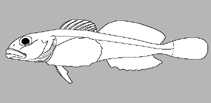 No image available for this species;
drawing shows typical species in Cottidae.
Google Bild
drawing shows typical species in Cottidae.
Klassifizierung / Names Namen | Synonyme | Catalog of Fishes(Gattung, Arten) | ITIS | CoL | WoRMS | Cloffa
> Perciformes/Cottoidei (Sculpins) > Cottidae (Sculpins)
Etymology: Clinocottus: Greek, klinein, kline = sloping and bed, due to the four apophyses of sphenoid bone + Greek, kottos = a kind of fish (Ref. 45335).
More on author: Gilbert.
Etymology: Clinocottus: Greek, klinein, kline = sloping and bed, due to the four apophyses of sphenoid bone + Greek, kottos = a kind of fish (Ref. 45335).
More on author: Gilbert.
Umwelt: Milieu / Klimazone / Tiefenbereich / Verbreitungsgebiet Ökologie
seewasser; süßwasser; brackwasser demersal; tiefenbereich 0 - 20 m (Ref. 96339). Temperate; 66°N - 34°N
Verbreitung Territorien | FAO Gebiete | Ökosysteme | Vorkommen | Punkt Karte | Einführungen | Faunafri
Eastern Pacific: Bering Sea coast of Alaska to Big Sur River, central California, USA.
Größe / Gewicht / Alter
Geschlechtsreife: Lm ? range ? - ? cm
Max length : 6.4 cm TL Männchen/unbestimmt; (Ref. 2850); common length : 4.4 cm TL Männchen/unbestimmt; (Ref. 12193)
Max length : 6.4 cm TL Männchen/unbestimmt; (Ref. 2850); common length : 4.4 cm TL Männchen/unbestimmt; (Ref. 12193)
Kurzbeschreibung Bestimmungsschlüssel | Morphologie | Morphometrie
Rückenflossenstacheln (insgesamt) : 7 - 9; Rückenflossenweichstrahlen (insgesamt) : 14 - 16; Afterflossenstacheln: 0; Afterflossenweichstrahlen: 10 - 13; Wirbelzahl: 32 - 33. Distinguished by the flattened tripartite anal papilla and the cirri on the eyeballs, head, lateral line and at the tip of each dorsal spine (Ref. 27547). Gill rakers reduced to low smooth mounds; lateral line high toward the head, curving downward to middle of sides, straight toward the tail, each of the anterior 15 or so pores having a slender cirrus (Ref. 27547). Next to the last anal ray longer than the rays before and behind it; pectorals reach to or just beyond front of anal fin; caudal rounded (Ref. 6885, 27547). Color varies with the environment, sometimes nearly uniform bright green but more often green to light brown above with dark wedge-shaped saddles, broader below, on upper part of sides, with lighter color between; sometimes, along or below lateral line, a dark longitudinal stripe that is in some cases interrupted with light spots; ventral region creamy to white; three dark lines radiating from the eye, the first to the snout, another downward to behind the mouth, the third rearward to base of preopercular spine; spiny dorsal with a dark blotch between first and third spine; pelvic fins plain, others usually dusky, mottled or indistinctly barred (Ref. 27547).
Body shape (shape guide): elongated.
Body shape (shape guide): elongated.
Facultative air-breathing in the genus (Ref. 126274); Commonly found in rocky intertidal and subtidal areas, but also over sand and in eelgrass and seaweeds (Ref. 2850). May leave tide pools if aquatic conditions become inhospitable (Ref. 31184). Occasionally enters fresh water (Ref. 27547). Probably feeds on small invertebrates common among seaweed and in tide pools. Breathes air when out of water (Ref. 31184).
Lebenszyklus und Paarungsverhalten Geschlechtsreife | Fortpflanzung | Ablaichen | Eier | Fruchtbarkeit | Larven
Oviparous (Ref. 101741).
Hauptreferenz
Laden Sie Ihre Referenzen hoch | Referenzen | Koordinator | Partner
Eschmeyer, W.N., E.S. Herald and H. Hammann, 1983. A field guide to Pacific coast fishes of North America. Boston (MA, USA): Houghton Mifflin Company. xii+336 p. (Ref. 2850)
CITES
Not Evaluated
Bedrohung für Menschen
Harmless
Nutzung durch Menschen
Fischereien: nicht kommerziell
FAO - Publication: search | FishSource |
Mehr Information
Trophische Ökologie
Lebensmittel (Beutetiere)
Nahrungszusammensetzung
Nahrungsaufnahme
Lebensmittelrationen
Räuber
Lebensmittel (Beutetiere)
Nahrungszusammensetzung
Nahrungsaufnahme
Lebensmittelrationen
Räuber
Populationsdynamik
Wachstumsparameter
Max. Alter/Größen
Länge-Gewicht-Rel.
Länge-Länge-Verhältnis.
Längenhäufigkeiten
Massenkonvertierung
Rekrutierung
Dichte
Wachstumsparameter
Max. Alter/Größen
Länge-Gewicht-Rel.
Länge-Länge-Verhältnis.
Längenhäufigkeiten
Massenkonvertierung
Rekrutierung
Dichte
Lebenszyklus
Fortpflanzung
Geschlechtsreife
Reifung/Kiemen rel.
Fruchtbarkeit
Ablaichen
Laichaggregationen
Eier
Eientwicklung
Larven
Larven Pop.Dyn.
Fortpflanzung
Geschlechtsreife
Reifung/Kiemen rel.
Fruchtbarkeit
Ablaichen
Laichaggregationen
Eier
Eientwicklung
Larven
Larven Pop.Dyn.
Anatomie
Kiemenoberfläche
Gehirn
Otolith
Kiemenoberfläche
Gehirn
Otolith
Physiologie
Körperliche Zusammensetzung
Nährstoffe
Sauerstoffverbrauch
Schwimmart
Schwimmgeschwindigkeit
Visuelle Pigmente
Fischgeräusche
Krankheiten und Parasiten
Toxizität (LC50s)
Körperliche Zusammensetzung
Nährstoffe
Sauerstoffverbrauch
Schwimmart
Schwimmgeschwindigkeit
Visuelle Pigmente
Fischgeräusche
Krankheiten und Parasiten
Toxizität (LC50s)
Genetik
Genom
Genetik
Heterozygotie
Vererbbarkeit
Genetische Vielfalt
Genom
Genetik
Heterozygotie
Vererbbarkeit
Genetische Vielfalt
Menschenbezogen
Aquakultur-Systeme
Aquakultur Profile
Zuchtlinien
Ciguatera-Fälle
Briefmarken, Münzen, Verschiedenes.
Aquakultur-Systeme
Aquakultur Profile
Zuchtlinien
Ciguatera-Fälle
Briefmarken, Münzen, Verschiedenes.
Tools
Zusatzinformationen
Download XML
Zusammenfassung | Punktdaten | Namen | Photos
Internet Quellen
AFORO (otoliths) | Aquatic Commons | BHL | Cloffa | Websites from users | FishWatcher Einträge suchen | CISTI | Catalog of Fishes: Gattung, Arten | DiscoverLife | ECOTOX | FAO - Publication: search | Faunafri | Fishipedia | Fishtrace | GloBI | Google Books | Google Scholar | Google | IGFA World Record | OneZoom | Open Tree of Life | Otolith Atlas of Taiwan Fishes | PubMed | Reef Life Survey | Socotra Atlas | TreeBase | Tree of Life | Wikipedia: Gehe zu, Suchen | World Records Freshwater Fishing | Zoologischer Rekord
Schätzungen auf der Grundlage von Modellen
Bevorzugte Temperatur (Ref. 123201): 4.6 - 12.8, mean 7.1 °C (based on 597 cells).
Phylogenetischer Diversitätsindex (Ref. 82804): PD50 = 0.5312 [Uniqueness, from 0.5 = low to 2.0 = high].
Bayesian length-weight: a=0.00603 (0.00290 - 0.01252), b=3.14 (2.96 - 3.32), in cm total length, based on LWR estimates for this (Sub)family-body shape (Ref. 93245).
Trophische Ebene (Ref. 69278): 3.5 ±0.37 se; based on food items.
Widerstandsfähigkeit (Ref. 120179): hoch, Verdopplung der Population dauert weniger als 15 Monate. (Preliminary K or Fecundity.).