



Artedius harringtoni (Starks, 1896)
Scalyhead sculpin
Añada su observación en Fish Watcher
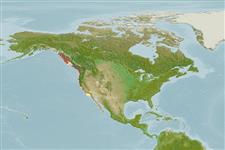
| Native range | All suitable habitat | Point map | Year 2050 |
|
| This map was computer-generated and has not yet been reviewed. |
| Artedius harringtoni AquaMaps Data sources: GBIF OBIS |
Sube tu fotos y Vídeos
Imágenes | Google image Artedius harringtoni
Foto de Valkenier - Pope, C.
Imágenes | Google image
Foto de Valkenier - Pope, C.
Clasificación / Nombres Nombres comunes | Sinónimos | Catalog of Fishes(Género, Especie) | ITIS | CoL | WoRMS | Cloffa
> Perciformes/Cottoidei (Sculpins) > Cottidae (Sculpins)
Etymology: Artedius: Petrus (Peter) Artedi, (10 Mar.) 1705-35 (28 Sep.), a son of a clergyman from Anundsjö named Olaus Arctaedius, in the northern part of Sweden.In 1729 he changed his name from Arctaedius to Arctædi, a name still later simplified to Artedi (Ref. 45335); harringtoni: Named for Mark W. Harrington, President of the University of Washington (Ref. 6885).
Eponymy: Peter Artedi (1705–1735) was a Swedish ichthyologist, sometimes regarded as ‘the father of ichthyology”. [...] Mark Walrod Harrington (1848–1926) was an American botanist, astronomer and meteorologist who became President of the University of Washington. [...] (Ref. 128868), visit book page.
More on author: Starks.
Etymology: Artedius: Petrus (Peter) Artedi, (10 Mar.) 1705-35 (28 Sep.), a son of a clergyman from Anundsjö named Olaus Arctaedius, in the northern part of Sweden.In 1729 he changed his name from Arctaedius to Arctædi, a name still later simplified to Artedi (Ref. 45335); harringtoni: Named for Mark W. Harrington, President of the University of Washington (Ref. 6885).
Eponymy: Peter Artedi (1705–1735) was a Swedish ichthyologist, sometimes regarded as ‘the father of ichthyology”. [...] Mark Walrod Harrington (1848–1926) was an American botanist, astronomer and meteorologist who became President of the University of Washington. [...] (Ref. 128868), visit book page.
More on author: Starks.
Entorno: milieu / zona climática / rango de profundidad / gama de distribución Ecología
marino demersal; rango de profundidad 1 - 21 m (Ref. 2850). Temperate; 58°N - 32°N, 155°W - 118°W
Distribución Territorios | Áreas FAO | Ecosistemas | Ocurrencias, apariciones | Mapa de puntos | Introducciones | Faunafri
Eastern Pacific: Kodiak Island, Alaska to San Miguel Island, southern California, USA.
Tamaño / Peso / Edad
Descripción breve Claves de identificación | Morfología | Morfometría
Espinas dorsales (total) : 9 - 10; Radios blandos dorsales (total) : 16 - 18; Espinas anales: 0; Radios blandos anales: 10 - 14. Pelvic fins small.
Body shape (shape guide): elongated.
Body shape (shape guide): elongated.
Found in intertidal and subtidal rocky areas, around pilings (Ref. 2850). Males are territorial (Ref. 6885). Sexual dimorphism is remarkable (Ref. 74407). Males guard eggs (Ref. 74407).
Ciclo vital y comportamiento de apareamiento Madurez | Reproducción | Puesta | Huevos | Fecundidad | Larva
Males guard clutches of eggs and are quite territorial (Ref. 74407). The following account of mating behaviour comes from Ragland et.al. (1978): observed from an aquarium, courtship began 'when a gravid female approached a shelter occupied by a male. The male, which was not guarding eggs, responded by rolling its head in a circle and flaring the orange branchiostegal membranes. The cirri were not moved or deployed in any obvious fashion.
The female either ignored the male or responded by snapping the head horizontally several times in rapid succession and occasionally quivering. Once she entered the nest, the male often extruded its pene and performed bouts of a fanning display similar to those of other cottids (Ref. 205). The female left the nest shortly after laying eggs.'
Occurrence of intromission was not observed from this study due to technical problems. However, eggs stripped from gravid females developed and hatched after 11-15 days in the absence of a male, thereby supporting the hypothesis that internal fertilization had occurred.
Referencia principal
Suba sus referencias | Referencias | Coordinador | Colaboradores
Eschmeyer, W.N., E.S. Herald and H. Hammann, 1983. A field guide to Pacific coast fishes of North America. Boston (MA, USA): Houghton Mifflin Company. xii+336 p. (Ref. 2850)
CITES
Not Evaluated
Amenaza para el ser humano
Harmless
Usos humanos
Pesquerías: comercial; Acuario: Acuarios públicos
FAO - Publication: search | FishSource |
Más información
Ecología Trófica
Alimentos (presas)
Composición de la dieta
consumo de alimento
Raciones de comida
Despredadores
Alimentos (presas)
Composición de la dieta
consumo de alimento
Raciones de comida
Despredadores
Dinámica de la población
Coeficiente del crecimiento para
Edades / tallas máximas
Longitud-peso rel.
Longitud-longitud rel.
Longitud-frecuencias
Conversión de masas
Reclutamiento
Abundancia
Coeficiente del crecimiento para
Edades / tallas máximas
Longitud-peso rel.
Longitud-longitud rel.
Longitud-frecuencias
Conversión de masas
Reclutamiento
Abundancia
Ciclo de vida
Reproducción
Madurez
Madurez/Gills rel.
Fecundidad
Puesta
Agregaciones de desove
Huevos
Desarrollo de los huevos
Larva
Dinámica larvaria
Reproducción
Madurez
Madurez/Gills rel.
Fecundidad
Puesta
Agregaciones de desove
Huevos
Desarrollo de los huevos
Larva
Dinámica larvaria
Distribución
Territorios
Áreas FAO
Ecosistemas
Ocurrencias, apariciones
Introducciones
BRUVS - Vídeos
Territorios
Áreas FAO
Ecosistemas
Ocurrencias, apariciones
Introducciones
BRUVS - Vídeos
Anatomía
Superficie branquial
Cerebro
Otolito
Superficie branquial
Cerebro
Otolito
Fisiología
Composición corporal
Nutrientes
Consumo del oxígeno
Tipo de natación
Velocidad de natación
Pigmentos visuales
Sonido de peces
Enfermedades y parásitos
Toxicidad (CL50)
Composición corporal
Nutrientes
Consumo del oxígeno
Tipo de natación
Velocidad de natación
Pigmentos visuales
Sonido de peces
Enfermedades y parásitos
Toxicidad (CL50)
Genética
Genoma
Genética
Heterocigosidad
heritabilidad
Diversidad genética
Genoma
Genética
Heterocigosidad
heritabilidad
Diversidad genética
Relacionados con el ser humano
Sistemas de acuicultura
Perfiles de acuicultura
Razas
Ciguatera cases
Sellos, monedas, varios
Sistemas de acuicultura
Perfiles de acuicultura
Razas
Ciguatera cases
Sellos, monedas, varios
Herramientas
Cuestionario orgánico | Libro electrónico | Guía de campo | Asistente para frecuencias de tallas | Herramienta de ciclo de vida | Mapa de puntos |
Catch-MSY |
Informes especiales
Comprobar el mantenimiento del acuario | Buscar fichas sobre especies | Consulte las hojas informativas sobre acuicultura
Descargar XML
Fuentes de Internet
AFORO (otoliths) | Aquatic Commons | BHL | Cloffa | Websites from users | Check FishWatcher | CISTI | Catalog of Fishes: Género, Especie | DiscoverLife | ECOTOX | FAO - Publication: search | Faunafri | Fishipedia | Fishtrace | GloBI | Google Books | Google Scholar | Google | IGFA World Record | OneZoom | Open Tree of Life | Otolith Atlas of Taiwan Fishes | Acuarios públicos | PubMed | Reef Life Survey | Socotra Atlas | TreeBase | Árbol de la vida | Wikipedia: Go, búsqueda | World Records Freshwater Fishing | Expediente Zoológico
Estimaciones basadas en modelos
Temperatura preferida (Referencia 123201): 7.1 - 12.8, mean 10.1 °C (based on 178 cells).
Índice de diversidad filogenética (Referencia 82804): PD50 = 0.5312 [Uniqueness, from 0.5 = low to 2.0 = high].
Bayesian length-weight: a=0.00603 (0.00290 - 0.01252), b=3.14 (2.96 - 3.32), in cm total length, based on LWR estimates for this (Sub)family-body shape (Ref. 93245).
Nivel trófico (Referencia 69278): 3.4 ±0.52 se; based on food items.
Resiliencia (Referencia 120179): Medio, población duplicada en un tiempo mínimo de 1.4-4.4 años (Preliminary K or Fecundity.).
Nutrientes (Ref. 124155): Calcium = 142 [51, 339] mg/100g; Iron = 0.46 [0.21, 1.08] mg/100g; Protein = 17.3 [15.0, 19.5] %; Omega3 = 0.602 [0.229, 1.706] g/100g; Selenium = 7.75 [3.04, 20.40] μg/100g; VitaminA = 35.5 [9.1, 131.4] μg/100g; Zinc = 0.973 [0.600, 1.752] mg/100g (wet weight);