



Waarneming toevoegen in Fish Watcher
| Native range | All suitable habitat | Point map | Year 2050 |

|
| This map was computer-generated and has not yet been reviewed. |
| Engraulis ringens AquaMaps Data sources: GBIF OBIS |
Uploaden van uw Foto's en video's
Afbeeldingen | video's | Postzegels, munten, diversen. | Google afbeelding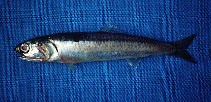 Engraulis ringens
Afbeelding van Béarez, P.
Afbeeldingen | video's | Postzegels, munten, diversen. | Google afbeelding
Afbeelding van Béarez, P.
Classificatie / Namen Lokale namen | Synoniemen | Catalog of Fishes(Genus, Soort(en)) | ITIS | CoL | WoRMS | Cloffa
> Clupeiformes (Herrings) > Engraulidae (Anchovies) > Engraulinae
Etymology: Engraulis: Greek, eggraulis, -eos = anchovy (Ref. 45335).
More on author: Jenyns.
Etymology: Engraulis: Greek, eggraulis, -eos = anchovy (Ref. 45335).
More on author: Jenyns.
Milieu: milieu / Klimaatzone / Diepte / verspreidingsgebied Ecologie
marien pelagic-neritic; oceanodroom; diepte 3 - 80 m. Subtropical; 13°C - 23°C (Ref. 6); 5°S - 43°S, 82°W - 69°W (Ref. 54434)
Verspreiding Gebieden | FAO regio's | Ecosystemen | Voorkomen | Verspreidingskaart | Introducties | Faunafri
Southeast Pacific: Aguja Point, Peru to Chiloé, Chile (distribution dependent on the coastal extent of the Peru Current).
Lengte bij maturiteit / Grootte / Gewicht / Leeftijd
Maturiteit: Lm 12.0, range 10 - 12.5 cm
Max length : 20.0 cm SL mannelijk / geslacht onbekend; (Ref. 189); common length : 14.0 cm TL mannelijk / geslacht onbekend; (Ref. 5504); max. gerapporteerde leeftijd: 3.00 Jaren (Ref. 189)
Max length : 20.0 cm SL mannelijk / geslacht onbekend; (Ref. 189); common length : 14.0 cm TL mannelijk / geslacht onbekend; (Ref. 5504); max. gerapporteerde leeftijd: 3.00 Jaren (Ref. 189)
Korte beschrijving Determinatiesleutels | Morfologie | Morfometrie
Dorsale stekels (totaal) : 0; Anale stekels: 0. Body elongate, slender, and rounded in cross section; snout long and prominent; lower branch of first gill arch with 34 to 49 gill rakers; anal fin with fewer than 22 rays, located behind dorsal fin base; body shiny blue or green (Ref. 55763). There is a silver stripe along flank in juveniles which disappears with age. The high number of gill rakers distinguishes it from all Pacific species of Anchoa.
Body shape (shape guide): elongated; Cross section: oval.
Body shape (shape guide): elongated; Cross section: oval.
Adults occur mainly within 80 km of coast, forming huge schools, chiefly in surface waters. Are filter-feeders entirely dependent on the rich plankton of the Peruvian Current. In some studies, diatoms constituted as much as 98% of the diet. Large populations of guano birds and pelicans also depend on this fish (Ref. 9988). Utilized as fish meal and oil (Ref. 9988).
Levenscyclus en paargedrag Maturiteit | Voortplanting | Paaien | Eieren | Fecunditeit | Larven
Eggs ellipsoidal.
Hoofdreferentie
Upload uw referenties | Referenties | Coördinator | Medewerkers
Whitehead, P.J.P., G.J. Nelson and T. Wongratana, 1988. FAO Species Catalogue. Vol. 7. Clupeoid fishes of the world (Suborder Clupeoidei). An annotated and illustrated catalogue of the herrings, sardines, pilchards, sprats, shads, anchovies and wolf-herrings. FAO Fish. Synop. 125(7/2):305-579. Rome: FAO. (Ref. 189)
Status op de Rode Lijst van het IUCN (Ref. 130435: Version 2025-2 (Global))
Niet bedreigd (LC) ; Date assessed: 18 August 2020
CITES
Not Evaluated
Gevaar voor de mens
Harmless
Gebruik door de mens
Visserij: van groot commercieel belang
FAO - visserij: aanvoer, soortsprofiel; Publication: search | FishSource | Sea Around Us
Meer informatie
Trofische ecologie
Voedsel (prooien)
Dieetsamenstelling
Voedselconsumptie
Voedselrantsoenen
Predatoren
Voedsel (prooien)
Dieetsamenstelling
Voedselconsumptie
Voedselrantsoenen
Predatoren
Populatiedynamica
Groeiparameters
Max. leeftijden / maten
Lengte-gewicht rel.
Lengte-lengte rel.
Lengtefrequenties
Massaconversie
Rekrutering
Abundantie
Groeiparameters
Max. leeftijden / maten
Lengte-gewicht rel.
Lengte-lengte rel.
Lengtefrequenties
Massaconversie
Rekrutering
Abundantie
Levenscyclus
Voortplanting
Maturiteit
Rijpheid/kieuwen rel.
Fecunditeit
Paaien
Paaibestanden
Eieren
Ontwikkeling van de eieren
Larven
Larvale populatiedynamiek
Voortplanting
Maturiteit
Rijpheid/kieuwen rel.
Fecunditeit
Paaien
Paaibestanden
Eieren
Ontwikkeling van de eieren
Larven
Larvale populatiedynamiek
Fysiologie
Lichaamssamenstelling
Voedingsstoffen
Zuurstofverbruik
Type zwemmen
Zwemsnelheid
Visuele pigmenten
Vis geluid
Ziekten en parasieten
Toxiciteit (LC50)
Lichaamssamenstelling
Voedingsstoffen
Zuurstofverbruik
Type zwemmen
Zwemsnelheid
Visuele pigmenten
Vis geluid
Ziekten en parasieten
Toxiciteit (LC50)
Menselijk gerelateerd
Aquacultuursystemen
Aquacultuurprofielen
Kweeklijnen
Ciguatera gevallen
Postzegels, munten, diversen.
Aquacultuursystemen
Aquacultuurprofielen
Kweeklijnen
Ciguatera gevallen
Postzegels, munten, diversen.
Tools
Speciale rapporten
Bekijk gegevens voor het houden in een aquarium | Bekijk Fact Sheets voor de soort | Bekijk Aquacultuur Fact Sheets
Download XML
Internetbronnen
AFORO (otoliths) | Aquatic Commons | BHL | Cloffa | Websites from users | Bekijk FishWatcher | CISTI | Catalog of Fishes: Genus, Soort(en) | DiscoverLife | ECOTOX | FAO - visserij: aanvoer, soortsprofiel; Publication: search | Faunafri | Fishipedia | Fishtrace | GloBI | Google Books | Google Scholar | Google | IGFA World Record | OneZoom | Open Tree of Life | Otolith Atlas of Taiwan Fishes | PubMed | Reef Life Survey | Socotra Atlas | TreeBase | Tree of Life | Wikipedia: ga naar, zoek | World Records Freshwater Fishing | Zoobank | Zoological Record
Schattingen op basis van modellen
Gewenste temperatuur (Ref. 123201): 17 - 20.8, mean 19.7 °C (based on 10 cells).
Fylogenetische diversiteitsindex (Ref. 82804): PD50 = 0.5020 [Uniqueness, from 0.5 = low to 2.0 = high].
Bayesian length-weight: a=0.00457 (0.00361 - 0.00579), b=3.13 (3.09 - 3.17), in cm total length, based on LWR estimates for this species (Ref. 93245).
Trofisch niveau (Ref. 69278): 2.9 ±0.38 se; based on food items.
Generation time: 1.3 (1.1 - 1.3) years. Estimated as median ln(3)/K based on 60 growth studies.
Weerstandsvermogen (Ref. 120179): Hoog, minimale populatieverdubbelingstijd minder dan 15 maanden (K=0.6-0.9; tm=1; tmax=3; batch fecundity > 10,000).
Prior r = 0.83, 95% CL = 0.54 - 1.24, Based on 3 full stock assessments.
Voedingsstoffen (Ref. 124155): Calcium = 233 [104, 574] mg/100g; Iron = 1.55 [0.73, 3.65] mg/100g; Protein = 18.7 [17.4, 20.0] %; Omega3 = 0.764 [0.444, 1.331] g/100g; Selenium = 16.8 [7.9, 39.6] μg/100g; VitaminA = 11 [2, 47] μg/100g; Zinc = 1.18 [0.73, 1.89] mg/100g (wet weight);