This website uses cookies to enhance your browsing experience and ensure the functionality of our site. For more detailed information about the types of cookies we use and how we protect your privacy, please visit our Privacy Information page.
×
Cookie Settings
This website uses different types of cookies to enhance your experience. Please select your preferences below:
> Carangiformes (Jacks) > Carangidae (Jacks and pompanos) > Naucratinae
Etymology: Seriola:Latin word diminutive with the meaning of a large earthenware pot (Ref. 45335). Eponymy: Brazilian Sharpnose Shark Rhizoprionodon lalandii JP Müller & FGJ Henle, 1839 Pierre Antoine Delalande (1787–1823). (See Delalande) (Ref. 128868), visit book page. More on author: Valenciennes.
Taxonomic Remarks Junior synonyms Seriola aureovittata Temminck and Schlegel, 1845 (in Japan, Northwest Pacific) and Seriola dorsalis (Gill, 1863) (in California, Pacific Baja, and the Gulf of California, Mexico; Northeast Pacific ) are considered valid with Seriola lalandi Valenciennes 1833 confined in Brazil, South Africa, Australia, New Zealand, and Chile (Southern distribution only), according to Martinez-Takeshita et al., 2015 (Ref. 121056).
Entorno: milieu / zona climática / rango de profundidad / gama de distribución Ecología
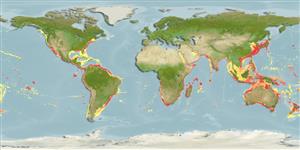
marino; salobre bentopelágico; rango de profundidad 3 - 825 m (Ref. 4517). Subtropical; 18°C - 24°C (Ref. 6390); 55°N - 57°S, 180°W - 180°E
Circumglobal in subtropical waters: Series of disjunct populations. Indo-Pacific: South Africa, Walter Shoals, Amsterdam Island, Japan, Australia, New Zealand, New Caledonia, Hawaii, Rapa, Pitcairn Island, and Easter Island. Eastern Pacific: British Columbia, Canada to Chile (Ref. 2850), including Desventuradas Is. and Juan Fernández Is. (Ref. 89357). Eastern Atlantic: St. Helena, South Africa (Ref. 7097).
Longitud en la primera madurez / Tamaño / Peso / Edad
Madurez: Lm?, range 51 - ? cm Max length : 250 cm TL macho / no sexado; (Ref. 27865); common length : 80.0 cm TL macho / no sexado; (Ref. 9137); peso máximo publicado: 96.8 kg (Ref. 40637); edad máxima reportada: 12 años (Ref. 72462)
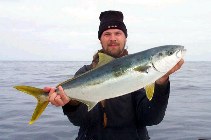
Espinas dorsales (total) : 5 - 6; Radios blandos dorsales (total) : 33 - 35; Espinas anales: 2 - 3; Radios blandos anales: 20 - 21. The only jack without scutella on the caudal peduncle. Dark blue dorsally and almost white ventrally; with a well defined line of demarcation between the two colors. Body shape (shape guide): fusiform / normal; Cross section: compressed.
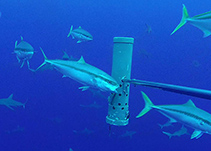
Adults are benthopelagic in coastal and oceanic waters, off kelp beds and rocky areas (Ref. 2850), sometimes entering estuaries (Ref. 9563). They are solitary or in small groups and can be found near rocky shores, reefs and islands (Ref. 6390). Schools of juveniles are generally found in offshore waters, often near or beyond the continental shelf (Ref. 27865). They prefer warmer water (18-24°C) although they are occasionally found in cooler water (Ref. 27128). Adults feed on small fish, squid and crustaceans (Ref. 27121). Marketed fresh and salted or dried (Ref. 9283).
Paxton, J.R., D.F. Hoese, G.R. Allen and J.E. Hanley, 1989. Pisces. Petromyzontidae to Carangidae. Zoological Catalogue of Australia, Vol. 7. Australian Government Publishing Service, Canberra, 665 p. (Ref. 7300)
Situación en la Lista Roja de la UICN (Ref. 130435: Version 2025-2 (Global))
Temperatura preferida (Referencia 123201): 9 - 23, mean 14.9 °C (based on 1169 cells).
Índice de diversidad filogenética (Referencia 82804): PD50 = 0.5020 [Uniqueness, from 0.5 = low to 2.0 = high].
Bayesian length-weight: a=0.01862 (0.01013 - 0.03425), b=2.92 (2.75 - 3.09), in cm total length, based on LWR estimates for this species & (Sub)family-body (Ref. 93245).
Nivel trófico (Referencia 69278): 4.2 ±0.1 se; based on diet studies.
Resiliencia (Referencia 120179): Bajo, población duplicada en un tiempo mínimo de 4.5-14 años (K=0.05-0.32; tm=2; tmax=12).
Prior r = 0.28, 95% CL = 0.19 - 0.42, Based on 5 data-limited stock assessments.
Vulnerabilidad pesquera (Ref. 59153): High vulnerability (61 of 100). 🛈
Vulnerabilidad climática (Ref. 125649): Moderate to high vulnerability (50 of 100). 🛈