



Ajouter votre observation dans Fish Watcher
| Native range | All suitable habitat | Point map | Year 2050 |

|
| This map was computer-generated and has not yet been reviewed. |
| Ronquilus jordani AquaMaps Data sources: GBIF OBIS |
Envoyez vos Photos et vidéos
Images | Images Google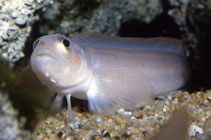 Ronquilus jordani
Photo de Wirtz, P.
Images | Images Google
Photo de Wirtz, P.
Classification / Noms Noms communs | Synonymes | Catalog of Fishes(Genre, Espèce) | ITIS | CoL | WoRMS | Cloffa
> Perciformes/Zoarcoidei (Eelpouts and pricklebacks) > Bathymasteridae (Ronquils)
Etymology: Ronquilus: Spanish, "ronquillo" = slightly hoarse; jordani: Named after David Starr Jordan, U.S. ichthyologist (Ref. 6885).
Eponymy: Dr David Starr Jordan (1851–1931) was a leading American ichthyologist, physician, educator, peace activist and believer in eugenics; moreover, he was founding President of Stanford University. [...] (Ref. 128868), visit book page.
More on author: Gilbert.
Etymology: Ronquilus: Spanish, "ronquillo" = slightly hoarse; jordani: Named after David Starr Jordan, U.S. ichthyologist (Ref. 6885).
Eponymy: Dr David Starr Jordan (1851–1931) was a leading American ichthyologist, physician, educator, peace activist and believer in eugenics; moreover, he was founding President of Stanford University. [...] (Ref. 128868), visit book page.
More on author: Gilbert.
Environnement : milieu / zone climatique / profondeur / gamme de distribution Écologie
marin démersal; profondeur 3 - 275 m (Ref. 6793). Temperate; - 37°N
Distribution Territoires | Zones FAO | Écosystèmes | Occurrences | Carte par point | Introductions | Faunafri
Eastern Pacific: Pribilof Canyon in the Bering Sea and Amchitka Island in the Aleutian chain to Monterey Bay, California, USA.
Taille / Poids / Âge
Description synthétique Clés d'identification | Morphologie | Morphométrie
Épines dorsales (Total) : 0; Rayons mous dorsaux (Total) : 41 - 48; Épines anales: 0; Rayons mous anaux: 31 - 34. Caudal rounded (Ref. 6885). Males orange dorsally, dull olive green ventrally; vague darker vertical bars on sides, fine yellow longitudinal lines below lateral line canal, and yellow on upper part of pectoral fin; golden bars below eye and across middle of cheek; black on top of head and across occiput, and behind eye; dusky blotch at anterior end of dorsal fin; black margined with yellow on dorsal and caudal fins; iridescent light blue margined with black on anal fin with golden spots at base; pelvic fins and lower parts of pectorals black. Females olive green dorsally, lighter ventrally; yellow longitudinal lines on sides; reddish on occiput; dusky blotch on anterior part of dorsal fin; bright orange on edges of dorsal and caudal; pale light blue margined with brown on anal; white on pelvic fins (Ref. 6885).
Body shape (shape guide): elongated.
Body shape (shape guide): elongated.
Usually among rocks (Ref. 2850).
Cycle de vie et comportement reproducteur Maturité | Reproduction | Frai | Œufs | Fécondité | Larves
Référence principale
Téléchargez vos références | Références | Coordinateur | Collaborateurs
Eschmeyer, W.N., E.S. Herald and H. Hammann, 1983. A field guide to Pacific coast fishes of North America. Boston (MA, USA): Houghton Mifflin Company. xii+336 p. (Ref. 2850)
CITES
Not Evaluated
Menace pour l'homme
Harmless
Utilisations par l'homme
Pêcheries: commercial; Aquarium: Aquariums publics
FAO - Publication: search | FishSource |
Plus d'informations
Écologie trophique
Aliments (proies)
Composition du régime alimentaire
Consommation alimentaire
Rations alimentaires
Prédateurs
Aliments (proies)
Composition du régime alimentaire
Consommation alimentaire
Rations alimentaires
Prédateurs
Dynamique des populations
Paramètres de croissance
Âges / tailles maximales
Longueur-poids rel.
Rel. longueur-longueur.
Fréquences de longueurs
Conversion de masse
Recrutement
Abondance
Paramètres de croissance
Âges / tailles maximales
Longueur-poids rel.
Rel. longueur-longueur.
Fréquences de longueurs
Conversion de masse
Recrutement
Abondance
Cycle de vie
Reproduction
Maturité
Maturité/épines rel.
Fécondité
Frai
Agrégats de frai
Œufs
Développement de l'œuf
Larves
Dynamique des populations larvaires
Reproduction
Maturité
Maturité/épines rel.
Fécondité
Frai
Agrégats de frai
Œufs
Développement de l'œuf
Larves
Dynamique des populations larvaires
Anatomie
Surface branchiale
Cerveau
Otolithe
Surface branchiale
Cerveau
Otolithe
Physiologie
Composition corporelle
Nutriments
Consommation d'oxygène
Type de natation
Vitesse de nage
Pigments visuels
Son de poisson
Maladies et parasites
Toxicité (CL50)
Composition corporelle
Nutriments
Consommation d'oxygène
Type de natation
Vitesse de nage
Pigments visuels
Son de poisson
Maladies et parasites
Toxicité (CL50)
Liées à l'homme
Systèmes d'aquaculture
Profils d'aquaculture
Souches
Cas de ciguatera
Timbres, pièces de monnaie, divers
Systèmes d'aquaculture
Profils d'aquaculture
Souches
Cas de ciguatera
Timbres, pièces de monnaie, divers
Outils
Quiz bio | E-book | Guide de terrain | Générateur de fréquences de longueur | Outil de dynamique de population | Carte par point |
Capture-MSY |
Articles particuliers
Télécharger en XML
Sources Internet
AFORO (otoliths) | Aquatic Commons | BHL | Cloffa | Websites from users | FishWatcher | CISTI | Catalog of Fishes: Genre, Espèce | DiscoverLife | ECOTOX | FAO - Publication: search | Faunafri | Fishipedia | Fishtrace | GloBI | Google Books | Google Scholar | Google | IGFA World Record | OceanAdapt | OneZoom | Open Tree of Life | Otolith Atlas of Taiwan Fishes | Aquariums publics | PubMed | Reef Life Survey | Socotra Atlas | TreeBase | Arbre de Vie | Wikipedia: aller à, chercher | | Zoological Record
Estimations basées sur des modèles
|
Indice de diversité phylogénétique (Réf. 82804) |
PD50 = 1.0078 [Uniqueness, from 0.5 = low to 2.0 = high]. |
| Bayesian length-weight | a=0.00389 (0.00180 - 0.00842), b=3.12 (2.94 - 3.30), in cm total length, based on all LWR estimates for this body shape (Ref. 93245). |
|
Niveau trophique (Réf. 69278) |
3.1 ±0.29 se; based on food items. |
|
Résilience (Réf. 120179) |
Haut, temps minimum de doublement de population inférieur à 15 mois (Preliminary K or Fecundity.). |
|
Vulnérabilité de la pêche (Ref. 59153) |
Low to moderate vulnerability (27 of 100). 🛈 |
|
Catégorie de prix (Ref. 80766) |
Unknown. |