This website uses cookies to enhance your browsing experience and ensure the functionality of our site. For more detailed information about the types of cookies we use and how we protect your privacy, please visit our Privacy Information page.
×
Cookie Settings
This website uses different types of cookies to enhance your experience. Please select your preferences below:
> Cichliformes (Cichlids, convict blennies) > Cichlidae (Cichlids) > Cichlasomatinae
Etymology: Amatitlania:Named for the type locality of the type species; 'Amatitlán' means 'a place abundant in amate' in Nahuatl, 'amate' is a kind of rustic paper made from the bark of Ficus petiolaris or Ficus indica. More on author: Günther.
Environnement : milieu / zone climatique / profondeur / gamme de distribution Écologie
Central America: Pacific slope, from Río Sucio, El Salvador to Río Suchiate, Guatemala; Atlantic slope, from Río Patuca, Honduras to Río Jutiapa, Guatemala. Not in slope to Panama (Am. coatepeque), Costa Rica or even Nicaragua (Am. siquia), as formerly considered. Introduced elsewhere.
Taille / Poids / Âge
Maturité: Lm? range ? - ? cm Max length : 10.0 cm SL mâle / non sexé; (Ref. 36377); common length : 8.5 cm TL mâle / non sexé; (Ref. 12193)
Épines dorsales (Total) : 17 - 19; Rayons mous dorsaux (Total) : 7 - 9; Épines anales: 8 - 10; Rayons mous anaux: 6 - 7; Vertèbres: 27 - 28. This species is distinguished by the following characters: two (vs. one) distal rows of
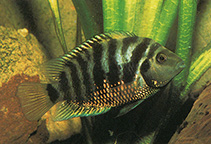
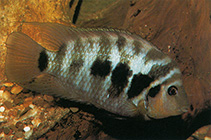
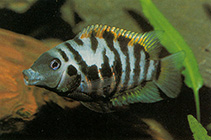
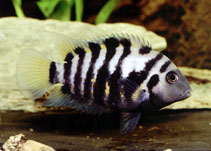
interradial scales on anal fin; arms in the first epibranchial bone are parallel (vs. divergent); posterior end of dentigerous arm of dentary rounded or squarish (vs. triple-spined or bluntly pointed); peritoneal coloration is uniformly dark (vs. not uniformly dark); rostrad directed pronounced convexity on the ventral process of the articular absent (vs. present); body less deep than as compared with its congeners kanna and siquia; 4th bar not Y-shaped (Ref. 74403). Body shape (shape guide): short and / or deep.
Adults inhabit flowing water from small creeks and streams to the shallows of large and fast flowing rivers (Ref. 7335). Prefer rocky habitats and finds sanctuary in the various cracks and crevices provided by this type of environment (Ref. 7335), or among roots and debris (Ref. 44091). They occur in warm pools of springs and their effluents (Ref. 7020). Feed on worms, crustaceans, insects, fish and plant matter (Refs. 7020; 44091). Also used in behavioral studies (Ref. 4537). Approximately 100-150 eggs are deposited and are vigorously guarded and cared for by both male and female (Ref. 44091). A popular aquarium fish which requires high temperature to maintain itself in an environment, e.g. artificially heated waters of power stations. Aquarium keeping: in pairs; minimum aquarium size 80 cm (Ref. 51539).
Cycle de vie et comportement reproducteur Maturité | Reproduction | Frai | Œufs | Fécondité | Larves
Lays eggs on cleaned surfaces of rocks. Parents incubate eggs and guard young. Tends and fans the embryos and free embryos and transfers them several times into new pits excavated in the bottom using its mouth (huddling) (Ref. 34155).
Dark cavities are preferred as nests to conceal the brood and make them less conspicuous to visual predators (Ref. 38966). When in caves, single entrances are favored to reduce the probability of intrusion and are probably more manageable for the females in terms of defending their brood (Ref. 38966). Approximately 100-150 eggs are deposited and are vigorously guarded and cared for by both male and female (Ref. 44091).
Schmitter-Soto, J.J., 2007. A systematic revision of the genus Archocentrus (Perciformes: Cichlidae), with the description of two new genera and six new species. Zootaxa 1603:1-78. (Ref. 74403)
Statut dans la liste rouge de l'IUCN (Ref. 130435: Version 2025-2 (Global))
Cycle de vie Reproduction Maturité Maturité/épines rel. Fécondité Frai Agrégats de frai Œufs Développement de l'œuf Larves Dynamique des populations larvaires
Physiologie Composition corporelle Nutriments Consommation d'oxygène Type de natation Vitesse de nage Pigments visuels Son de poisson Maladies et parasites Toxicité (CL50)
Indice de diversité phylogénétique (Réf. 82804): PD50 = 0.5020 [Uniqueness, from 0.5 = low to 2.0 = high].
Bayesian length-weight: a=0.02692 (0.01211 - 0.05983), b=3.02 (2.83 - 3.21), in cm total length, based on LWR estimates for this (Sub)family-body shape (Ref. 93245).
Niveau trophique (Réf. 69278): 3.3 ±0.45 se; based on food items.
Résilience (Réf. 120179): Haut, temps minimum de doublement de population inférieur à 15 mois (tm<1 and multiple spawning events per year; Fec=100-150).
Vulnérabilité de la pêche (Ref. 59153): Low vulnerability (13 of 100). 🛈