



Ajouter votre observation dans Fish Watcher
| Native range | All suitable habitat | Point map | Year 2050 |

|
| This map was computer-generated and has not yet been reviewed. |
| Kyphosus ocyurus AquaMaps Data sources: GBIF OBIS |
Classification / Noms Noms communs | Synonymes | Catalog of Fishes(Genre, Espèce) | ITIS | CoL | WoRMS | Cloffa
> Centrarchiformes (Basses) > Kyphosidae (Sea chubs)
Etymology: Kyphosus: Greek, kyphos = bent (Ref. 45335).
More on authors: Jordan & Gilbert.
Etymology: Kyphosus: Greek, kyphos = bent (Ref. 45335).
More on authors: Jordan & Gilbert.
Environnement : milieu / zone climatique / profondeur / gamme de distribution Écologie
marin pelagic-oceanic; profondeur 1 - 20 m (Ref. 89972). Tropical; 37°N - 18°S, 138°E - 77°W
Distribution Territoires | Zones FAO | Écosystèmes | Occurrences | Carte par point | Introductions | Faunafri
Eastern Pacific: from Galapagos to Hawaii and across the Pacific to SE Japan, Guam and Palau, and Marquesas; possibly Micronesia.
Taille / Poids / Âge
Maturité: Lm ? range ? - ? cm
Max length : 59.0 cm TL mâle / non sexé; (Ref. 38398); common length : 25.0 cm TL mâle / non sexé; (Ref. 55763); poids max. publié: 2.0 kg (Ref. 38398)
Max length : 59.0 cm TL mâle / non sexé; (Ref. 38398); common length : 25.0 cm TL mâle / non sexé; (Ref. 55763); poids max. publié: 2.0 kg (Ref. 38398)
Description synthétique Clés d'identification | Morphologie | Morphométrie
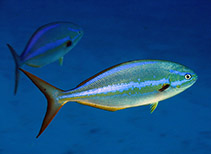
Épines dorsales (Total) : 11; Rayons mous dorsaux (Total) : 15; Épines anales: 3; Rayons mous anaux: 14; Vertèbres: 26. This species is distinguished by the following characters: body oval elongate, somewhat compressed; body distinctively coloured with wavy yellow and bluish stripes horizontal to the body, originating from mouth with a yellow and a blue wavy stripe stretching back to the caudal peduncle; head yellow to silvery with blue streak behind eye on operculum; metallic blue dorsally and white ventrally; caudal fin deeply forked; very low dorsal and anal fins; D XI,15; A III,14; teeth incisor-shaped: scales on interorbital region; external side of first gill arch with high number of gill rakers, 16-19 on lower limb, 7-8 on upper; total lateral line scale rows 80-85, 59-64 with pores; longitudinal scale rows 68-77; precaudal vertebrae 10, caudal 16; pterygiophores, anal 15 and dorsal 24 (Ref. 95491).
Body shape (shape guide): short and / or deep; Cross section: compressed.
Body shape (shape guide): short and / or deep; Cross section: compressed.
Occurs both as solitary individuals and in schools together with K. elegans and K. vaigiensis and are found close to the surface (< 25 m) on rocky shores, the open ocean and reefs on isolated islands (Ref. 95491). Also swim rapidly in small, somewhat polarized groups or schools in open water over deep reefs, along walls and drop-offs (Ref. 5227) or usually seen near floating logs far out to sea (Ref. 11482). This species differs from its congeners in having an omnivorous diet that includes zooplankton (Ref. 95491). Not common.
Cycle de vie et comportement reproducteur Maturité | Reproduction | Frai | Œufs | Fécondité | Larves
Référence principale
Téléchargez vos références | Références | Coordinateur | Collaborateurs
Knudsen, S.W. and K.D. Clements, 2013. Revision of the fish family Kyphosidae (Teleostei: Perciformes). Zootaxa 3751(1):001-101. (Ref. 95491)
CITES
Not Evaluated
Menace pour l'homme
Harmless
Utilisations par l'homme
Pêcheries: intérêt commercial mineur
FAO - Publication: search | FishSource |
Plus d'informations
Écologie trophique
Aliments (proies)
Composition du régime alimentaire
Consommation alimentaire
Rations alimentaires
Prédateurs
Aliments (proies)
Composition du régime alimentaire
Consommation alimentaire
Rations alimentaires
Prédateurs
Dynamique des populations
Paramètres de croissance
Âges / tailles maximales
Longueur-poids rel.
Rel. longueur-longueur.
Fréquences de longueurs
Conversion de masse
Recrutement
Abondance
Paramètres de croissance
Âges / tailles maximales
Longueur-poids rel.
Rel. longueur-longueur.
Fréquences de longueurs
Conversion de masse
Recrutement
Abondance
Cycle de vie
Reproduction
Maturité
Maturité/épines rel.
Fécondité
Frai
Agrégats de frai
Œufs
Développement de l'œuf
Larves
Dynamique des populations larvaires
Reproduction
Maturité
Maturité/épines rel.
Fécondité
Frai
Agrégats de frai
Œufs
Développement de l'œuf
Larves
Dynamique des populations larvaires
Anatomie
Surface branchiale
Cerveau
Otolithe
Surface branchiale
Cerveau
Otolithe
Physiologie
Composition corporelle
Nutriments
Consommation d'oxygène
Type de natation
Vitesse de nage
Pigments visuels
Son de poisson
Maladies et parasites
Toxicité (CL50)
Composition corporelle
Nutriments
Consommation d'oxygène
Type de natation
Vitesse de nage
Pigments visuels
Son de poisson
Maladies et parasites
Toxicité (CL50)
Génétique
génôme
Génétique
Hétérozygotie
Héritabilité
Diversité génétique
génôme
Génétique
Hétérozygotie
Héritabilité
Diversité génétique
Liées à l'homme
Systèmes d'aquaculture
Profils d'aquaculture
Souches
Cas de ciguatera
Timbres, pièces de monnaie, divers
Systèmes d'aquaculture
Profils d'aquaculture
Souches
Cas de ciguatera
Timbres, pièces de monnaie, divers
Outils
E-book | Guide de terrain | Clés d'identification | Générateur de fréquences de longueur | Outil de dynamique de population | Carte par point |
Capture-MSY |
Articles particuliers
Télécharger en XML
Sources Internet
AFORO (otoliths) | Aquatic Commons | BHL | Cloffa | Websites from users | FishWatcher | CISTI | Catalog of Fishes: Genre, Espèce | DiscoverLife | ECOTOX | FAO - Publication: search | Faunafri | Fishipedia | Fishtrace | GloBI | Google Books | Google Scholar | Google | IGFA World Record | OneZoom | Open Tree of Life | Otolith Atlas of Taiwan Fishes | PubMed | Reef Life Survey | Socotra Atlas | TreeBase | Arbre de Vie | Wikipedia: aller à, chercher | World Records Freshwater Fishing | Zoological Record
Estimations basées sur des modèles
Température préférée (Réf. 123201): 21 - 29.3, mean 27.1 °C (based on 17166 cells).
Indice de diversité phylogénétique (Réf. 82804): PD50 = 0.5000 [Uniqueness, from 0.5 = low to 2.0 = high].
Bayesian length-weight: a=0.01778 (0.00751 - 0.04211), b=3.01 (2.81 - 3.21), in cm total length, based on LWR estimates for this (Sub)family-body shape (Ref. 93245).
Niveau trophique (Réf. 69278): 3.5 ±0.37 se; based on food items.
Résilience (Réf. 120179): Milieu, temps minimum de doublement de population : 1,4 à 4,4 années (Preliminary K or Fecundity.).
Nutriments (Ref. 124155): Calcium = 101 [48, 199] mg/100g; Iron = 1.06 [0.62, 1.86] mg/100g; Protein = 18.4 [17.2, 19.4] %; Omega3 = 0.159 [0.087, 0.281] g/100g; Selenium = 37.2 [18.4, 82.1] μg/100g; VitaminA = 14.4 [4.1, 49.7] μg/100g; Zinc = 1.05 [0.72, 1.61] mg/100g (wet weight);