



Add your observation in Fish Watcher
| Native range | All suitable habitat | Point map | Year 2050 |

|
| This map was computer-generated and has not yet been reviewed. |
| Kyphosus ocyurus AquaMaps Data sources: GBIF OBIS |
Classification / Names Common names | Synonyms | Catalog of Fishes(genus, species) | ITIS | CoL | WoRMS | Cloffa
Teleostei (teleosts) > Centrarchiformes (Basses) > Kyphosidae (Sea chubs)
Etymology: Kyphosus: Greek, kyphos = bent (Ref. 45335).
More on authors: Jordan & Gilbert.
Etymology: Kyphosus: Greek, kyphos = bent (Ref. 45335).
More on authors: Jordan & Gilbert.
Environment: milieu / climate zone / depth range / distribution range Ecology
Marine; pelagic-oceanic; depth range 1 - 20 m (Ref. 89972). Tropical; 37°N - 18°S, 138°E - 77°W
Distribution Territories | FAO areas | Ecosystems | Occurrences | Point map | Introductions | Faunafri
Eastern Pacific: from Galapagos to Hawaii and across the Pacific to SE Japan, Guam and Palau, and Marquesas; possibly Micronesia.
Size / Weight / Age
Maturity: Lm ? range ? - ? cm
Max length : 59.0 cm TL male/unsexed; (Ref. 38398); common length : 25.0 cm TL male/unsexed; (Ref. 55763); max. published weight: 2.0 kg (Ref. 38398)
Max length : 59.0 cm TL male/unsexed; (Ref. 38398); common length : 25.0 cm TL male/unsexed; (Ref. 55763); max. published weight: 2.0 kg (Ref. 38398)
Short description Identification keys | Morphology | Morphometrics
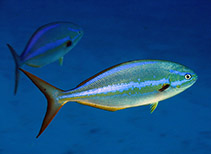
Dorsal spines (total): 11; Dorsal soft rays (total): 15; Anal spines: 3; Anal soft rays: 14; Vertebrae: 26. This species is distinguished by the following characters: body oval elongate, somewhat compressed; body distinctively coloured with wavy yellow and bluish stripes horizontal to the body, originating from mouth with a yellow and a blue wavy stripe stretching back to the caudal peduncle; head yellow to silvery with blue streak behind eye on operculum; metallic blue dorsally and white ventrally; caudal fin deeply forked; very low dorsal and anal fins; D XI,15; A III,14; teeth incisor-shaped: scales on interorbital region; external side of first gill arch with high number of gill rakers, 16-19 on lower limb, 7-8 on upper; total lateral line scale rows 80-85, 59-64 with pores; longitudinal scale rows 68-77; precaudal vertebrae 10, caudal 16; pterygiophores, anal 15 and dorsal 24 (Ref. 95491).
Body shape (shape guide): short and / or deep; Cross section: compressed.
Body shape (shape guide): short and / or deep; Cross section: compressed.
Occurs both as solitary individuals and in schools together with K. elegans and K. vaigiensis and are found close to the surface (< 25 m) on rocky shores, the open ocean and reefs on isolated islands (Ref. 95491). Also swim rapidly in small, somewhat polarized groups or schools in open water over deep reefs, along walls and drop-offs (Ref. 5227) or usually seen near floating logs far out to sea (Ref. 11482). This species differs from its congeners in having an omnivorous diet that includes zooplankton (Ref. 95491). Not common.
Life cycle and mating behavior Maturity | Reproduction | Spawning | Eggs | Fecundity | Larvae
Main reference
Upload your references | References | Coordinator | Collaborators
Knudsen, S.W. and K.D. Clements, 2013. Revision of the fish family Kyphosidae (Teleostei: Perciformes). Zootaxa 3751(1):001-101. (Ref. 95491)
CITES
Not Evaluated
Threat to humans
Harmless
Human uses
Fisheries: minor commercial
FAO - Publication: search | FishSource |
More information
Population dynamics
Growth parameters
Max. ages / sizes
Length-weight rel.
Length-length rel.
Length-frequencies
Mass conversion
Recruitment
Abundance
Growth parameters
Max. ages / sizes
Length-weight rel.
Length-length rel.
Length-frequencies
Mass conversion
Recruitment
Abundance
Life cycle
Reproduction
Maturity
Maturity/Gills rel.
Fecundity
Spawning
Spawning aggregations
Eggs
Egg development
Larvae
Larval dynamics
Reproduction
Maturity
Maturity/Gills rel.
Fecundity
Spawning
Spawning aggregations
Eggs
Egg development
Larvae
Larval dynamics
Anatomy
Gill area
Brain
Otolith
Gill area
Brain
Otolith
Physiology
Body composition
Nutrients
Oxygen consumption
Swimming type
Swimming speed
Visual pigments
Fish sound
Diseases & Parasites
Toxicity (LC50s)
Body composition
Nutrients
Oxygen consumption
Swimming type
Swimming speed
Visual pigments
Fish sound
Diseases & Parasites
Toxicity (LC50s)
Genetics
Genome
Genetics
Heterozygosity
Heritability
Genetic Diversity
Genome
Genetics
Heterozygosity
Heritability
Genetic Diversity
Human related
Aquaculture systems
Aquaculture profiles
Strains
Ciguatera cases
Stamps, coins, misc.
Aquaculture systems
Aquaculture profiles
Strains
Ciguatera cases
Stamps, coins, misc.
Tools
E-book | Field guide | Identification keys | Length-frequency wizard | Life-history tool | Point map |
Catch-MSY |
Special reports
Download XML
Internet sources
AFORO (otoliths) | Aquatic Commons | BHL | Cloffa | Websites from users | Check FishWatcher | CISTI | Catalog of Fishes: genus, species | DiscoverLife | ECOTOX | FAO - Publication: search | Faunafri | Fishipedia | Fishtrace | GloBI | Google Books | Google Scholar | Google | IGFA World Record | OneZoom | Open Tree of Life | Otolith Atlas of Taiwan Fishes | PubMed | Reef Life Survey | Socotra Atlas | TreeBase | Tree of Life | Wikipedia: Go, Search | | Zoological Record
Estimates based on models
|
Phylogenetic diversity index (Ref. 82804) |
PD50 = 0.5000 [Uniqueness, from 0.5 = low to 2.0 = high]. |
| Bayesian length-weight | a=0.01778 (0.00758 - 0.04173), b=3.01 (2.81 - 3.21), in cm total length, based on LWR estimates for this (Sub)family-body shape (Ref. 93245). |
|
Trophic level (Ref. 69278) |
3.5 ±0.37 se; based on food items. |
|
Resilience (Ref. 120179) |
Medium, minimum population doubling time 1.4 - 4.4 years (Preliminary K or Fecundity.). |
|
Fishing Vulnerability (Ref. 59153) |
Moderate vulnerability (45 of 100). 🛈 |
|
Price category (Ref. 80766) |
Unknown. |
|
Nutrients (Ref. 124155) |
Calcium = 101 [48, 199] mg/100g; Iron = 1.06 [0.62, 1.86] mg/100g; Protein = 18.4 [17.2, 19.4] %; Omega3 = 0.159 [0.087, 0.281] g/100g; Selenium = 37.2 [18.4, 82.1] μg/100g; VitaminA = 14.4 [4.1, 49.7] μg/100g; Zinc = 1.05 [0.72, 1.61] mg/100g (wet weight); |