



Perca fluviatilis Linnaeus, 1758
European perch
Sube tu fotos y Vídeos
Imágenes | Vídeos | Sonidos | Sellos, monedas, varios | Google image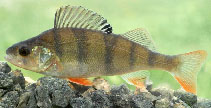 Perca fluviatilis
Foto de Kohout, J.
Imágenes | Vídeos | Sonidos | Sellos, monedas, varios | Google image
Foto de Kohout, J.
Clasificación / Nombres Nombres comunes | Sinónimos | Catalog of Fishes(Género, Especie) | ITIS | CoL | WoRMS | Cloffa
> Perciformes/Percoidei (Perchs) > Percidae (Perches) > Percinae
Etymology: Perca: Greek, perke = perch, a fish without identificaction (Ref. 45335).
More on author: Linnaeus.
Etymology: Perca: Greek, perke = perch, a fish without identificaction (Ref. 45335).
More on author: Linnaeus.
Entorno: milieu / zona climática / rango de profundidad / gama de distribución Ecología
; agua dulce; salobre demersal; pH range: 7.0 - 7.5; dH range: 8 - 12; anadromo (Ref. 51243); rango de profundidad 1 - 30 m (Ref. 9988), usually 3 - 4 m (Ref. 55947). Temperate; 10°C - 22°C (Ref. 1672); 74°N - 38°N, 91°W - 168°E
Distribución Territorios | Áreas FAO | Ecosistemas | Ocurrencias, apariciones | Mapa de puntos | Introducciones | Faunafri
Eurasia: throughout Europe to northernmost extremity of Scandinavia, except Iberian Peninsula, central Italy, and Adriatic basin; Aegean Sea basin in Matriza and from Struma to Aliakmon drainages; Aral Sea basin; Siberia in rivers draining the Arctic Ocean eastward to Kolyma. Widely introduced. Several countries report adverse ecological impact after introduction.
Longitud en la primera madurez / Tamaño / Peso / Edad
Madurez: Lm 16.3, range 11 - 23.4 cm
Max length : 60.0 cm SL macho / no sexado; (Ref. 59043); common length : 25.0 cm TL macho / no sexado; (Ref. 556); peso máximo publicado: 4.8 kg (Ref. 2058); edad máxima reportada: 22 años (Ref. 796)
Max length : 60.0 cm SL macho / no sexado; (Ref. 59043); common length : 25.0 cm TL macho / no sexado; (Ref. 556); peso máximo publicado: 4.8 kg (Ref. 2058); edad máxima reportada: 22 años (Ref. 796)
Descripción breve Claves de identificación | Morfología | Morfometría
Espinas dorsales (total) : 14 - 20; Radios blandos dorsales (total) : 13 - 16; Espinas anales: 2; Radios blandos anales: 7 - 10; Vértebra: 39 - 42. Diagnosed from other species of Percidae in Europe by having the following unique characters: pelvic and anal fins yellow to red; posterior part of first dorsal fin with dark blotch; and flank with 5-8 bold dark bars, usually Y-shaped. Differs further by the combination of the following features: two dorsal fins, clearly separated from each other; and 56-77 scales along lateral line (Ref. 59043). Body greenish-yellow; 5-9 transverse black bands on the sides; first dorsal fin gray, black spot at the tip; second dorsal greenish-yellow; pectorals yellow; other fins red. First dorsal fin markedly higher than the second. Caudal fin emarginate (Ref. 2058).
Body shape (shape guide): fusiform / normal; Cross section: compressed.
Body shape (shape guide): fusiform / normal; Cross section: compressed.
Inhabits a very wide range of habitats from estuarine lagoons, lakes of all types to medium-sized streams. Feeding larvae occur in open water. This is an opportunistic diurnal feeder which preys mainly during sunrise and sunset, using all available prey. Larvae and small juveniles usually feed on planktonic invertebrates. During first summer, many juveniles move near shores to feed on benthic prey. Often feeds on fishes at about 12 cm SL. May undertake short spawning migrations. Males attain first sexual maturity at 1-2 years and females at 2-4 years of age. Spawns in February-July (Ref. 59043). Eggs grouped in long white ribbons (up to 1 m) are found over submerged objects (Ref. 41678). Its flesh is excellent and not so bony. Utilized fresh and frozen; eaten pan-fried and baked (Ref. 9988). May be captured with natural or artificial bait (Ref. 30578).
Ciclo vital y comportamiento de apareamiento Madurez | Reproducción | Puesta | Huevos | Fecundidad | Larva
During breeding, males arrive at the spawning area ahead of the females. One or two of these males chases a ripe female as soon as it arrives in the area (polyandry) (Ref. 6258). The queue of males maybe longer composed of about 15 to 25 individuals, but only two prod their snouts against the female's belly (Ref. 205). After rounds of curved course through the interlacing branches near the surface (Ref. 205), males fertilize the egg ribbon as the female lays them over weeds or other submerged objects (Ref. 6258). Eggs grouped in long white ribbons (up to 1 m) are found over submerged objects (Ref. 41678). Eggs hatch in about 8 to 16 days at normal temperatures (Ref. 6258).
Males mature at 2-3 years and females at 4 years. Spawning, in the Northern hemisphere, happens in spring in waters with temperatures between 7-8°C. Eggs are laid in sticky strings becoming fixed to
aquatic plants and rocks. Incubation lasts about 1- 8 days at 1- 3°. Egg size 2.0-2.5mm, larval length at hatching 5mm.
Referencia principal
Suba sus referencias | Referencias | Coordinador | Colaboradores
Kottelat, M. and J. Freyhof, 2007. Handbook of European freshwater fishes. Publications Kottelat, Cornol and Freyhof, Berlin. 646 pp. (Ref. 59043)
Situación en la Lista Roja de la UICN (Ref. 130435: Version 2025-2 (Global))
Least Concern (LC) ; Date assessed: 27 May 2022
CITES
Not Evaluated
Amenaza para el ser humano
Potential pest
Usos humanos
Pesquerías: muy comercial; Acuicultura: comercial; pesca deportiva: si
FAO - Sistemas de acuicultura: producción; pesquerías: desembarques, perfil de la especie; Publication: search | FishSource | Sea Around Us
Más información
Ecología Trófica
Alimentos (presas)
Composición de la dieta
consumo de alimento
Raciones de comida
Despredadores
Alimentos (presas)
Composición de la dieta
consumo de alimento
Raciones de comida
Despredadores
Dinámica de la población
Coeficiente del crecimiento para
Edades / tallas máximas
Longitud-peso rel.
Longitud-longitud rel.
Longitud-frecuencias
Conversión de masas
Reclutamiento
Abundancia
Coeficiente del crecimiento para
Edades / tallas máximas
Longitud-peso rel.
Longitud-longitud rel.
Longitud-frecuencias
Conversión de masas
Reclutamiento
Abundancia
Ciclo de vida
Reproducción
Madurez
Madurez/Gills rel.
Fecundidad
Puesta
Agregaciones de desove
Huevos
Desarrollo de los huevos
Larva
Dinámica larvaria
Reproducción
Madurez
Madurez/Gills rel.
Fecundidad
Puesta
Agregaciones de desove
Huevos
Desarrollo de los huevos
Larva
Dinámica larvaria
Distribución
Territorios
Áreas FAO
Ecosistemas
Ocurrencias, apariciones
Introducciones
BRUVS - Vídeos
Territorios
Áreas FAO
Ecosistemas
Ocurrencias, apariciones
Introducciones
BRUVS - Vídeos
Fisiología
Composición corporal
Nutrientes
Consumo del oxígeno
Tipo de natación
Velocidad de natación
Pigmentos visuales
Sonido de peces
Enfermedades y parásitos
Toxicidad (CL50)
Composición corporal
Nutrientes
Consumo del oxígeno
Tipo de natación
Velocidad de natación
Pigmentos visuales
Sonido de peces
Enfermedades y parásitos
Toxicidad (CL50)
Relacionados con el ser humano
Sistemas de acuicultura
Perfiles de acuicultura
Razas
Ciguatera cases
Sellos, monedas, varios
Sistemas de acuicultura
Perfiles de acuicultura
Razas
Ciguatera cases
Sellos, monedas, varios
Herramientas
Cuestionario orgánico | Libro electrónico | Guía de campo | Claves de identificación | Asistente para frecuencias de tallas | Herramienta de ciclo de vida | Mapa de puntos |
Catch-MSY |
Informes especiales
Comprobar el mantenimiento del acuario | Buscar fichas sobre especies | Consulte las hojas informativas sobre acuicultura
Descargar XML
Fuentes de Internet
AFORO (otoliths) | Alien/Invasive Species database | Aquatic Commons | BHL | Cloffa | Websites from users | Check FishWatcher | CISTI | Catalog of Fishes: Género, Especie | DiscoverLife | DORIS | ECOTOX | FAO - Sistemas de acuicultura: producción; pesquerías: desembarques, perfil de la especie; Publication: search | Faunafri | Fishipedia | Fishtrace | GloBI | Google Books | Google Scholar | Google | IGFA World Record | Bases de datos nacionales | OneZoom | Open Tree of Life | OsteoBase: skull, spine | Otolith Atlas of Taiwan Fishes | Acuarios públicos | PubMed | Reef Life Survey | Socotra Atlas | TreeBase | Árbol de la vida | Wikipedia: Go, búsqueda | World Records Freshwater Fishing | Zoobank | Expediente Zoológico
Estimaciones basadas en modelos
Índice de diversidad filogenética (Referencia 82804): PD50 = 0.6250 [Uniqueness, from 0.5 = low to 2.0 = high].
Bayesian length-weight: a=0.00912 (0.00772 - 0.01077), b=3.11 (3.06 - 3.16), in cm total length, based on LWR estimates for this species (Ref. 93245).
Nivel trófico (Referencia 69278): 4.4 ±0.0 se; based on diet studies.
Generation time: 5.8 (5.3 - 7.3) years. Estimated as median ln(3)/K based on 38 growth studies.
Resiliencia (Referencia 120179): Bajo, población duplicada en un tiempo mínimo de 4.5-14 años (K=0.1-0.4; tm=2-4; tmax=22; Fecundity=13,000).
Nutrientes (Ref. 124155): Calcium = 17.2 [9.5, 33.2] mg/100g; Iron = 0.133 [0.093, 0.191] mg/100g; Protein = 18.1 [17.1, 19.2] %; Omega3 = 0.281 [0.115, 0.660] g/100g; Selenium = 7.26 [1.99, 22.72] μg/100g; VitaminA = 14 [5, 44] μg/100g; Zinc = 0.477 [0.389, 0.602] mg/100g (wet weight); based on nutrient studies.