



Hoplostethus atlanticus Collett, 1889
Orange roughy
Beobachtung melden im Fish Watcher
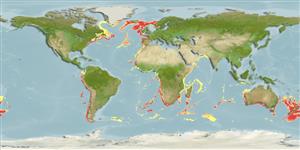
| Native range | All suitable habitat | Point map | Year 2050 |
|
| This map was computer-generated and has not yet been reviewed. |
| Hoplostethus atlanticus AquaMaps Data sources: GBIF OBIS |
Klassifizierung / Names Namen | Synonyme | Catalog of Fishes(Gattung, Arten) | ITIS | CoL | WoRMS | Cloffa
> Trachichthyiformes (Roughies) > Trachichthyidae (Slimeheads)
Etymology: Hoplostethus: Greek, hoplon = weapon + Greek, stetho, stethion = brest; literal = to prick a little breast (Ref. 45335).
Etymology: Hoplostethus: Greek, hoplon = weapon + Greek, stetho, stethion = brest; literal = to prick a little breast (Ref. 45335).
Umwelt: Milieu / Klimazone / Tiefenbereich / Verbreitungsgebiet Ökologie
seewasser bathypelagisch; ozeanodrom (Ref. 51243); tiefenbereich 180 - 1809 m (Ref. 6390), usually 400 - 900 m (Ref. 3583). Deep-water; 3°C - 9°C (Ref. 36694); 65°N - 56°S, 84°W - 168°W
Verbreitung Territorien | FAO Gebiete | Ökosysteme | Vorkommen | Punkt Karte | Einführungen | Faunafri
Western Atlantic: Gulf of Maine (Ref. 4784) [in error according to Moore (Fishes of the Gulf of Maine, in press), should be off northern Nova Scotia]. Eastern Atlantic: Iceland to Morocco; Walvis Bay, Namibia to off Durban, South Africa. Indo-Pacific: south-central Indian Ocean and New Zealand. Eastern Pacific: Chile (Ref. 27363). Several stocks may exist as suggested by distinct spawning sites and seasons.
Länge bei der ersten Reifung / Größe / Gewicht / Alter
Geschlechtsreife: Lm 34.5, range 18 - 32.5 cm
Max length : 75.0 cm TL Männchen/unbestimmt; (Ref. 36696); common length : 40.0 cm TL Männchen/unbestimmt; (Ref. 4181); max. veröff. Gewicht: 7.0 kg (Ref. 36697); max. veröff. Alter: 149 Jahre (Ref. 3680)
Max length : 75.0 cm TL Männchen/unbestimmt; (Ref. 36696); common length : 40.0 cm TL Männchen/unbestimmt; (Ref. 4181); max. veröff. Gewicht: 7.0 kg (Ref. 36697); max. veröff. Alter: 149 Jahre (Ref. 3680)
Kurzbeschreibung Bestimmungsschlüssel | Morphologie | Morphometrie
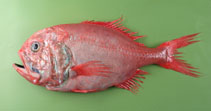
Rückenflossenstacheln (insgesamt) : 4 - 6; Rückenflossenweichstrahlen (insgesamt) : 15 - 19; Afterflossenstacheln: 3; Afterflossenweichstrahlen: 10 - 12. Bright brick-red in color, mouth and gill cavity bluish black (Ref. 4181). Ventral scutes: 19-25.
Body shape (shape guide): short and / or deep.
Body shape (shape guide): short and / or deep.
Inhabits deep, cold waters over steep continental slopes, ocean ridges and sea-mounts. Shallow range of usual occurrence from Ref. 27121. Appears to be dispersed over both rough bottoms and steep, rough grounds where it feeds on crustaceans and fish. In New Zealand, the main prey include mesopelagic and benthopelagic prawns, fish, and squid, with other organisms such as mysids, amphipods and euphausiids occasionally being important (Ref. 9072). Juveniles feed mainly on crustaceans (Ref. 27075, 27076). Grows very slowly and is one of the longest lived fish species known. Based on parasite and trace-element analyses, orange roughy is a sedentary species with little movement between fish-management zones (Ref. 27089). Little is known of the larvae and juveniles which are probably confined to deep water (Ref. 27088). The fishery targets sporadically formed dense spawning and non-spawning aggregations. Marketed fresh and frozen; eaten steamed, fried, microwaved and baked (Ref. 9988). Because of severe overfishing the species has been listed as threatened by the Australian Government in 2006.
Lebenszyklus und Paarungsverhalten Geschlechtsreife | Fortpflanzung | Ablaichen | Eier | Fruchtbarkeit | Larven
Orange roughy are synchronous annual spawners (Ref. 7030). They form dense spawning aggregations over sea hills and slopes. Eggs and sperms are shed into the water at the same time. Individual males appear to spawn over a 1-2 week period and females spawn for up to 1 week. Little is known of the larvae and juveniles.
Hauptreferenz
Laden Sie Ihre Referenzen hoch | Referenzen | Koordinator : Moore, Jon A. | Partner
Maul, G.E., 1986. Trachichthyidae. p. 749-752. In P.J.P. Whitehead, M.-L. Bauchot, J.-C. Hureau, J. Nielsen and E. Tortonese (eds.) Fishes of the north-eastern Atlantic and the Mediterranean. UNESCO, Paris. Vol. 2. (Ref. 4784)
CITES
Not Evaluated
Bedrohung für Menschen
Harmless
Nutzung durch Menschen
Fischereien: hoch kommerziell
FAO - Fischereien: Artbeschreibung, landings search; Publication: search | FIRMS - Stock assessments | FishSource | Das Meer um uns herum
Mehr Information
Trophische Ökologie
Lebensmittel (Beutetiere)
Nahrungszusammensetzung
Nahrungsaufnahme
Lebensmittelrationen
Räuber
Lebensmittel (Beutetiere)
Nahrungszusammensetzung
Nahrungsaufnahme
Lebensmittelrationen
Räuber
Populationsdynamik
Wachstumsparameter
Max. Alter/Größen
Länge-Gewicht-Rel.
Länge-Länge-Verhältnis.
Längenhäufigkeiten
Massenkonvertierung
Rekrutierung
Dichte
Wachstumsparameter
Max. Alter/Größen
Länge-Gewicht-Rel.
Länge-Länge-Verhältnis.
Längenhäufigkeiten
Massenkonvertierung
Rekrutierung
Dichte
Lebenszyklus
Fortpflanzung
Geschlechtsreife
Reifung/Kiemen rel.
Fruchtbarkeit
Ablaichen
Laichaggregationen
Eier
Eientwicklung
Larven
Larven Pop.Dyn.
Fortpflanzung
Geschlechtsreife
Reifung/Kiemen rel.
Fruchtbarkeit
Ablaichen
Laichaggregationen
Eier
Eientwicklung
Larven
Larven Pop.Dyn.
Anatomie
Kiemenoberfläche
Gehirn
Otolith
Kiemenoberfläche
Gehirn
Otolith
Physiologie
Körperliche Zusammensetzung
Nährstoffe
Sauerstoffverbrauch
Schwimmart
Schwimmgeschwindigkeit
Visuelle Pigmente
Fischgeräusche
Krankheiten und Parasiten
Toxizität (LC50s)
Körperliche Zusammensetzung
Nährstoffe
Sauerstoffverbrauch
Schwimmart
Schwimmgeschwindigkeit
Visuelle Pigmente
Fischgeräusche
Krankheiten und Parasiten
Toxizität (LC50s)
Menschenbezogen
Aquakultur-Systeme
Aquakultur Profile
Zuchtlinien
Ciguatera-Fälle
Briefmarken, Münzen, Verschiedenes.
Aquakultur-Systeme
Aquakultur Profile
Zuchtlinien
Ciguatera-Fälle
Briefmarken, Münzen, Verschiedenes.
Tools
E-Book | Feldführer | Bestimmungsschlüssel | Längenhäufigkeits Tool | Lebensdaten Tool | Punkt Karte |
Catch-MSY |
Zusatzinformationen
Download XML
Zusammenfassung | Punktdaten | Namen | Photos
Internet Quellen
AFORO (otoliths) | Aquatic Commons | BHL | Cloffa | Websites from users | FishWatcher Einträge suchen | CISTI | Catalog of Fishes: Gattung, Arten | DiscoverLife | ECOTOX | FAO - Fischereien: Artbeschreibung, landings search; Publication: search | Faunafri | Fishipedia | Fishtrace | GloBI | Google Books | Google Scholar | Google | IGFA World Record | Nationale Datenbanken | OneZoom | Open Tree of Life | Otolith Atlas of Taiwan Fishes | PubMed | Reef Life Survey | RFE Bestimmung | Socotra Atlas | TreeBase | Tree of Life | Wikipedia: Gehe zu, Suchen | World Records Freshwater Fishing | Zoobank | Zoologischer Rekord
Schätzungen auf der Grundlage von Modellen
|
Phylogenetischer Diversitätsindex (Ref. 82804) |
PD50 = 0.5000 [Uniqueness, from 0.5 = low to 2.0 = high]. |
| Bayesian length-weight | a=0.02239 (0.01598 - 0.03136), b=3.08 (2.98 - 3.18), in cm total length, based on LWR estimates for this species (Ref. 93245). |
|
Trophische Ebene (Ref. 69278) |
4.3 ±0.1 se; based on diet studies. |
|
Widerstandsfähigkeit (Ref. 120179) |
sehr niedrig, Verdopplung der Population dauert mehr als 14 Jahre. (K=0.04-0.06; tm=5-33; tmax=140; Fec=10,000). |
| Rate of population increase | Prior r = 0.07, 95% CL = 0.05 - 0.11, Based on 3 full stock assessments. |
|
Anfälligkeit der Fischerei (Ref. 59153) |
High to very high vulnerability (72 of 100). 🛈 |
|
Klimaanfälligkeit (Ref. 125649) |
Moderate to high vulnerability (54 of 100). 🛈 |
|
Preiskategorie (Ref. 80766) |
Medium. |
|
Nährstoffe (Ref. 124155) |
Calcium = 12.4 [4.3, 62.9] mg/100g; Iron = 0.266 [0.095, 0.925] mg/100g; Protein = 17.5 [15.8, 19.2] %; Omega3 = 0.16 [0.05, 0.53] g/100g; Selenium = 20.4 [6.3, 69.4] μg/100g; VitaminA = 26.7 [2.7, 276.6] μg/100g; Zinc = 0.379 [0.183, 0.821] mg/100g (wet weight); |