This website uses cookies to enhance your browsing experience and ensure the functionality of our site. For more detailed information about the types of cookies we use and how we protect your privacy, please visit our Privacy Information page.
×
Cookie Settings
This website uses different types of cookies to enhance your experience. Please select your preferences below:
> Cyprinodontiformes (Rivulines, killifishes and live bearers) > Poeciliidae (Poeciliids) > Poeciliinae
Etymology: Poecilia:Greek, poikilos = with a lot of colours (Ref. 45335). Eponymy: Robert John Lechmere Guppy (1836–1916) was a British-born civil engineer, schools inspector, civil servant and naturalist in Trinidad & Tobago, who contributed much to the geology, palaeontology and zoology of the West Indies. [...] (Ref. 128868), visit book page. More on author: Peters.
Umwelt: Milieu / Klimazone / Tiefenbereich / Verbreitungsgebiet Ökologie
South America: Venezuela, Barbados, Trinidad, northern Brazil and the Guyanas. Widely introduced and established elsewhere, mainly for mosquito control, but had rare to non-existing effects on mosquitoes, and negative to perhaps neutral effects on native fishes (Ref. 12217). Africa: Feral populations reported from the coastal reaches of Natal rivers from Durban southwards, as well as in the Kuruman Eye and Lake Otjikoto in Namibia (Ref. 7248). Several countries report adverse ecological impact after introduction.
Größe / Gewicht / Alter
Geschlechtsreife: Lm? range ? - ? cm Max length : 5.0 cm SL Männchen/unbestimmt; (Ref. 59043); 6.0 cm SL (female); common length : 2.8 cm TL Männchen/unbestimmt; (Ref. 12193)
Adults inhabit warm springs and their effluents, weedy ditches and canals (Ref. 5723). They are found in various habitats, ranging from highly turbid water in ponds, canals and ditches at low elevations to pristine mountain streams at high elevations (Ref. 11225). They occur in wide variety of habitats with low predation pressure, usually in very small streams and densely vegetated lakes and springs (Ref. 59043). Their salinity range is wide but requires fairly warm temperatures (23-24 °C) and quiet vegetated water for survival (Ref. 7248, 44894, 79840). They feed on zooplankton, small insects and detritus. One of the most popular aquarium fishes with many standardized varieties. Used in genetics research. Female reaches 5 cm SL (Ref. 2847). Males mature at 2 months and females at 3 months of age (Ref. 1672). Aquarium keeping: in groups of 5 or more individuals; minimum aquarium size 60 cm (Ref. 51539). A very popular and widely available species in the aquarium trade. In Australia, wild populations were established prior to the 1970s, undoubtedly the result of thoughtless aquarists discarding unwanted pets (Ref. 44894). Maximum length for female taken from Ref. 43281.
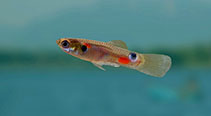
Males are about half the size of females with colorful tail and caudal fin; the anal fin is transformed into a gonopodium for internal fertilization. Males are continuously chasing and mating females. Females can store sperms for later fertilization and may produce young every four weeks. Pregnant females are recognizable by black triangle between anal and pelvic fins. After a gestation period of four to six weeks females give birth to 20-40 live young. No parental care is exercised and parents may even prey on their young.