



Waarneming toevoegen in Fish Watcher
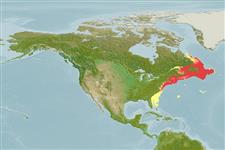
| Native range | All suitable habitat | Point map | Year 2050 |
|
| This map was computer-generated and has not yet been reviewed. |
| Nezumia bairdii AquaMaps Data sources: GBIF OBIS |
Uploaden van uw Foto's en video's
Afbeeldingen | Google afbeelding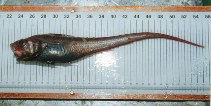 Nezumia bairdii
Afbeelding van Román Marcote, E.
Afbeeldingen | Google afbeelding
Afbeelding van Román Marcote, E.
Classificatie / Namen Lokale namen | Synoniemen | Catalog of Fishes(Genus, Soort(en)) | ITIS | CoL | WoRMS | Cloffa
> Gadiformes (Cods) > Macrouridae (Grenadiers or rattails)
Etymology: Nezumia: A Japanese word that means "mouse".
Eponymy: Spencer Fullerton Baird (1823–1887) was an American zoologist and giant of American ornithology. [...] (Ref. 128868), visit book page.
More on authors: Goode & Bean.
Etymology: Nezumia: A Japanese word that means "mouse".
Eponymy: Spencer Fullerton Baird (1823–1887) was an American zoologist and giant of American ornithology. [...] (Ref. 128868), visit book page.
More on authors: Goode & Bean.
Milieu: milieu / Klimaatzone / Diepte / verspreidingsgebied Ecologie
marien benthopelagisch; standvastig; diepte 16 - 1000 m (Ref. 1371), usually 90 - 700 m (Ref. 1371). Subtropical; 59°N - 24°N, 81°W - 42°W (Ref. 1371)
Verspreiding Gebieden | FAO regio's | Ecosystemen | Voorkomen | Verspreidingskaart | Introducties | Faunafri
Northwest Atlantic: Newfoundland, Canada to the northern end of the Straits of Florida, USA. A species reported from the northeastern Atlantic (Ref. 6321) should be reexamined. Report of specimen from the Azores and records from the Gulf of Mexico and West Indies (Ref. 6322) probably refer to other species.
Grootte / Gewicht / Leeftijd
Maturiteit: Lm ? range ? - ? cm
Max length : 40.0 cm TL mannelijk / geslacht onbekend; (Ref. 1371); max. gerapporteerde leeftijd: 11 Jaren (Ref. 40732)
Max length : 40.0 cm TL mannelijk / geslacht onbekend; (Ref. 1371); max. gerapporteerde leeftijd: 11 Jaren (Ref. 40732)
Korte beschrijving Determinatiesleutels | Morfologie | Morfometrie
Dorsale stekels (totaal) : 2; Anale stekels: 0. Snout pointed; naked area on snout confined to median-ventral strip, otherwise head surfaces completely scaled. Spinules on scales slender, conical to lanceolate, arranged in convergent rows. Color when fresh gray with violet hue on trunk and lower jaw; silvery reflections on gill cover, parts of the suborbital, and trunk and tail below the lateral line; pelvic fins and membrane between spinous dorsal ray and first segmented ray black; pectoral and median fins otherwise dusky; oral and branchial cavities mostly black.
Body shape (shape guide): elongated; Cross section: oval.
Body shape (shape guide): elongated; Cross section: oval.
Benthic, reported as deep as 2295m (Ref. 58426). Taken much shallower in areas with cold surface waters. Feeds primarily on euphausiids, amphipods, and polychaetes, although a 200 mm individual had many copepods in its stomach (Ref. 1371).
Levenscyclus en paargedrag Maturiteit | Voortplanting | Paaien | Eieren | Fecunditeit | Larven
Hoofdreferentie
Upload uw referenties | Referenties | Coördinator : Iwamoto, Tomio | Medewerkers
Cohen, D.M., T. Inada, T. Iwamoto and N. Scialabba, 1990. FAO species catalogue. Vol. 10. Gadiform fishes of the world (Order Gadiformes). An annotated and illustrated catalogue of cods, hakes, grenadiers and other gadiform fishes known to date. FAO Fish. Synop. 125(10). Rome: FAO. 442 p. (Ref. 1371)
CITES
Not Evaluated
Gevaar voor de mens
Harmless
Gebruik door de mens
Visserij: van minder commercieel belang
FAO - Publication: search | FishSource |
Meer informatie
Trofische ecologie
Voedsel (prooien)
Dieetsamenstelling
Voedselconsumptie
Voedselrantsoenen
Predatoren
Voedsel (prooien)
Dieetsamenstelling
Voedselconsumptie
Voedselrantsoenen
Predatoren
Populatiedynamica
Groeiparameters
Max. leeftijden / maten
Lengte-gewicht rel.
Lengte-lengte rel.
Lengtefrequenties
Massaconversie
Rekrutering
Abundantie
Groeiparameters
Max. leeftijden / maten
Lengte-gewicht rel.
Lengte-lengte rel.
Lengtefrequenties
Massaconversie
Rekrutering
Abundantie
Levenscyclus
Voortplanting
Maturiteit
Rijpheid/kieuwen rel.
Fecunditeit
Paaien
Paaibestanden
Eieren
Ontwikkeling van de eieren
Larven
Larvale populatiedynamiek
Voortplanting
Maturiteit
Rijpheid/kieuwen rel.
Fecunditeit
Paaien
Paaibestanden
Eieren
Ontwikkeling van de eieren
Larven
Larvale populatiedynamiek
Anatomie
Kieuwoppervlak
Hersenen
Otoliet
Kieuwoppervlak
Hersenen
Otoliet
Fysiologie
Lichaamssamenstelling
Voedingsstoffen
Zuurstofverbruik
Type zwemmen
Zwemsnelheid
Visuele pigmenten
Vis geluid
Ziekten en parasieten
Toxiciteit (LC50)
Lichaamssamenstelling
Voedingsstoffen
Zuurstofverbruik
Type zwemmen
Zwemsnelheid
Visuele pigmenten
Vis geluid
Ziekten en parasieten
Toxiciteit (LC50)
Genetica
genoom
Genetica
Heterozygositeit
Erfelijkheid
Genetische diversiteit
genoom
Genetica
Heterozygositeit
Erfelijkheid
Genetische diversiteit
Menselijk gerelateerd
Aquacultuursystemen
Aquacultuurprofielen
Kweeklijnen
Ciguatera gevallen
Postzegels, munten, diversen.
Aquacultuursystemen
Aquacultuurprofielen
Kweeklijnen
Ciguatera gevallen
Postzegels, munten, diversen.
Tools
E-boek | Veldgids | Determinatiesleutels | Lengtefrequentie Tool | Levenscyclus tool | Verspreidingskaart |
Vangst-MSY |
Speciale rapporten
Bekijk gegevens voor het houden in een aquarium | Bekijk Fact Sheets voor de soort | Bekijk Aquacultuur Fact Sheets
Download XML
Internetbronnen
AFORO (otoliths) | Aquatic Commons | BHL | Cloffa | Websites from users | Bekijk FishWatcher | CISTI | Catalog of Fishes: Genus, Soort(en) | DiscoverLife | ECOTOX | FAO - Publication: search | Faunafri | Fishipedia | Fishtrace | GloBI | Google Books | Google Scholar | Google | IGFA World Record | OceanAdapt | OneZoom | Open Tree of Life | Otolith Atlas of Taiwan Fishes | PubMed | Reef Life Survey | Socotra Atlas | TreeBase | Tree of Life | Wikipedia: ga naar, zoek | World Records Freshwater Fishing | Zoological Record
Schattingen op basis van modellen
Gewenste temperatuur (Ref. 123201): 0.6 - 7.8, mean 3.7 °C (based on 335 cells).
Fylogenetische diversiteitsindex (Ref. 82804): PD50 = 0.5000 [Uniqueness, from 0.5 = low to 2.0 = high].
Bayesian length-weight: a=0.00219 (0.00111 - 0.00432), b=3.20 (3.03 - 3.37), in cm total length, based on LWR estimates for this (Sub)family-body shape (Ref. 93245).
Trofisch niveau (Ref. 69278): 3.3 ±0.1 se; based on diet studies.
Weerstandsvermogen (Ref. 120179): Gemiddeld, minimale populatieverdubbelingstijd 1,4-4,4 jaar (K=0.28).
Voedingsstoffen (Ref. 124155): Calcium = 58.8 [29.7, 119.1] mg/100g; Iron = 0.901 [0.502, 1.679] mg/100g; Protein = 16.9 [15.1, 18.5] %; Omega3 = 0.242 [0.119, 0.442] g/100g; Selenium = 51.5 [22.0, 114.1] μg/100g; VitaminA = 26.5 [6.9, 98.0] μg/100g; Zinc = 0.791 [0.535, 1.171] mg/100g (wet weight);