



Vexillichthys atripinnis (Bailey, 1959)
Blackfin sucker
Adicionar o seu Fotografias e vídeos
Imagem do Google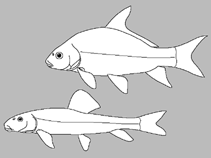 No image available for this species;
drawing shows typical species in Catostomidae.
Imagem do Google
drawing shows typical species in Catostomidae.
Classificação / Nomes Nomes comuns | Sinónimos | Catalog of Fishes(Género, Espécies) | ITIS | CoL | WoRMS | Cloffa
> Cypriniformes (Carps) > Catostomidae (Suckers) > Catostominae
Etymology: Vexillichthys: From the Latin vexillum; atripinnis: From the words atri, meaning black; and pinne, fin (Ref. 10294).
Etymology: Vexillichthys: From the Latin vexillum; atripinnis: From the words atri, meaning black; and pinne, fin (Ref. 10294).
Ambiente: milieu / zona climática / intervalo de profundidade / gama de distribuição Ecologia
; Água doce demersal; não migratória (Ref. 126106). Temperate; 37°N - 36°N
Distribuição Territórios | Áreas FAO | Ecossistemas | Ocorrências | Mapa dos pontos | Introduções | Faunafri
North America: Upper Barren River system (in Green River drainage) in Kentucky and Tennessee, USA.
Tamanho / Peso / Idade
Maturidade: Lm ? range ? - ? cm
Max length : 17.0 cm TL macho/indeterminado; (Ref. 5723); common length : 12.3 cm TL macho/indeterminado; (Ref. 12193); Idade máx. registada: 4 anos (Ref. 12193)
Max length : 17.0 cm TL macho/indeterminado; (Ref. 5723); common length : 12.3 cm TL macho/indeterminado; (Ref. 12193); Idade máx. registada: 4 anos (Ref. 12193)
Adults inhabit rocky pools and adjacent riffles of creeks and small rivers. They hide in bedrock crevices, near boulders or under shoreline brush (Ref. 5723, 10294). Food consists of midge larvae, microcrustacea and occasional larger insect larvae (Ref. 10294).
Ciclo de vida e comportamento de acasalamento Maturidade | Reprodução | Desova | Ovos | Fecundidade | Larvas
Referência principal
Carregar as suas referências | Referências | Coordenador | Colaboradores
Page, L.M. and B.M. Burr, 1991. A field guide to freshwater fishes of North America north of Mexico. Houghton Mifflin Company, Boston. 432 p. (Ref. 5723)
Categoria na Lista Vermelha da IUCN (Ref. 130435: Version 2025-2 (Global))
Quase ameaçada (NT) ; Date assessed: 03 August 2012
CITES
Not Evaluated
Ameaça para o homem
Harmless
Utilização humana
FAO - Publication: search | FishSource |
Mais informação
Ecologia Trófica
Produtos alimentares (presas)
Composição da dieta
Consumo alimentar
Rações alimentares
Predadores
Produtos alimentares (presas)
Composição da dieta
Consumo alimentar
Rações alimentares
Predadores
Ecologia
Ecologia
Ecologia
Dinâmica das populações
Parâmetros de crescimento
Idades / tamanhos máximos
Comprimento-peso rel.
Comprimento-comprimento rel.
Frequência de comprimento
Conversão de massa
Recrutamento
Abundância
Parâmetros de crescimento
Idades / tamanhos máximos
Comprimento-peso rel.
Comprimento-comprimento rel.
Frequência de comprimento
Conversão de massa
Recrutamento
Abundância
Ciclo de vida
Reprodução
Maturidade
Maturidade/Rel. das guelras
Fecundidade
Desova
Agregações de desova
Ovos
Desenvolvimento dos ovos
Larvas
Dinâmica larvar
Reprodução
Maturidade
Maturidade/Rel. das guelras
Fecundidade
Desova
Agregações de desova
Ovos
Desenvolvimento dos ovos
Larvas
Dinâmica larvar
Anatomia
Área branquial
Cérebro
Otólitos
Área branquial
Cérebro
Otólitos
Fisiologia
Composição corporal
Nutrientes
Consumo de oxigénio
Tipo de natação
Velocidade de natação
Pigmentos visuais
Som de peixe
Doenças e Parasitas
Toxicidade (LC50s)
Composição corporal
Nutrientes
Consumo de oxigénio
Tipo de natação
Velocidade de natação
Pigmentos visuais
Som de peixe
Doenças e Parasitas
Toxicidade (LC50s)
Genética
genoma
Genética
Heterozigotia
Hereditariedade
Diversidade genética
genoma
Genética
Heterozigotia
Hereditariedade
Diversidade genética
Relacionado com o ser humano
Sistemas de aquacultura
Perfis para aquacultura
Estirpes
Casos de Ciguatera
Selos, moedas, diversos.
Sistemas de aquacultura
Perfis para aquacultura
Estirpes
Casos de Ciguatera
Selos, moedas, diversos.
Ferramentas
E-book | Guia de campo | Ferramenta auxiliar de frequências de comprimento | Ferramenta sobre a história de vida | Mapa dos pontos |
Captura-MSY |
Relatórios especiais
Descarregue XML
Fontes da internet
AFORO (otoliths) | Aquatic Commons | BHL | Cloffa | Websites from users | Consultar FishWatcher | CISTI | Catalog of Fishes: Género, Espécies | DiscoverLife | ECOTOX | FAO - Publication: search | Faunafri | Fishipedia | Fishtrace | GloBI | Google Books | Google Scholar | Google | IGFA World Record | OneZoom | Open Tree of Life | Otolith Atlas of Taiwan Fishes | PubMed | Reef Life Survey | Socotra Atlas | TreeBase | Árvore da vida | Wikipedia: ir para, procurar | World Records Freshwater Fishing | Zoobank | Registo zoológico
Estimativas baseadas em modelos
Índice de diversidade filogenética (Ref. 82804): PD50 = 1.0000 [Uniqueness, from 0.5 = low to 2.0 = high].
Bayesian length-weight: a=0.00537 (0.00228 - 0.01266), b=3.05 (2.84 - 3.26), in cm total length, based on LWR estimates for this (Sub)family-body shape (Ref. 93245).
Nível Trófico (Ref. 69278): 3.0 ±0.4 se; based on size and trophs of closest relatives
Resiliência (Ref. 120179): Médio, tempo mínimo de duplicação da população 1,4 - 4,4 anos (tmax=4).