



Barbonymus gonionotus (Bleeker, 1849)
Silver barb
Hochladen Photos und videos
Bilder | Google Bild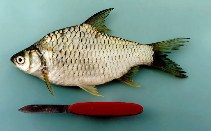 Barbonymus gonionotus
Photo von Warren, T.
Bilder | Google Bild
Photo von Warren, T.
Klassifizierung / Names Namen | Synonyme | Catalog of Fishes(Gattung, Arten) | ITIS | CoL | WoRMS | Cloffa
Umwelt: Milieu / Klimazone / Tiefenbereich / Verbreitungsgebiet Ökologie
; süßwasser benthopelagisch; potamodrom (Ref. 138296); tiefenbereich 15 - ? m (Ref. 12693). Tropical; 22°C - 28°C; 24°N - 8°S
Verbreitung Territorien | FAO Gebiete | Ökosysteme | Vorkommen | Punkt Karte | Einführungen | Faunafri
Asia: Mekong and Chao Phraya basins, Malay Peninsula, Sumatra and Java (Ref. 27732). Occurs throughout the whole stretch on the Mekong, from the delta around the saline intrusion zone to Chiang Khong in Thailand (Ref. 37770).
Länge bei der ersten Reifung / Größe / Gewicht / Alter
Kurzbeschreibung Bestimmungsschlüssel | Morphologie | Morphometrie
Rückenflossenstacheln (insgesamt) : 4; Rückenflossenweichstrahlen (insgesamt) : 8; Afterflossenstacheln: 3; Afterflossenweichstrahlen: 6 - 7. Body is strongly compressed. The back is elevated, its dorsal profile arched, often concave above the occiput. The head is small; the snout pointed; the mouth terminal. The barbels are very minute or rudimentary, especially the upper ones, which sometimes disappear entirely. Color when fresh is silvery white, sometimes with a golden tint. The dorsal and caudal fins are gray to gray-yellow; the anal and pelvic fins light orange, their tips reddish; the pectoral fins pale to light yellow (Ref. 4792). Very few tubercles on the snout which are not visible without magnification; snout length much less than the width of the eye socket (Ref. 37768). Anal-fin with 6-7 branches rays (Ref. 12693).
Body shape (shape guide): fusiform / normal; Cross section: oval.
Body shape (shape guide): fusiform / normal; Cross section: oval.
Occurs at midwater to bottom depths in rivers, streams, floodplains, and occasionally in reservoirs. Seems to prefer standing water habitats instead of flowing waters. Inhabits the flooded forest during high water period (Ref. 12693). Feeds on plant matter (e.g. leaves, weeds, Ipomea reptans and Hydrilla) and invertebrates (Ref. 4835). A migratory species but not considered to be a long-distance migrant. Regarded as local migrant which moves from the Mekong up into small streams and canals and onto flooded areas during the rainy season and back again during receding water (Ref. 37770). Some reports indicated that upstream migration of this fish is triggered by the first rains and rising water levels. When it finds a tributary, canal or stream it moves upstream and eventually onto flooded areas. When water recedes, it migrates back into canals and streams and into the Mekong again (Ref. 37770). Often used as a pituitary donor for artificial propagation in aquaculture. Escapees from culture installations have become established in rivers and form the basis for capture fisheries on several Southeast Asian islands (Ref. 1739). Useful in cropping excessive vegetation in reservoirs (Ref. 2686). Used for lap pa (in the preparation of which the numerous small bones are ground fine) or grilled or used to make som pa. Usually marketed fresh and occasionally seen in the aquarium trade (Ref. 12693). A specimen measuring 45 cm TL (2,100 g) was reportedly caught from Dan Tchang Reservoir, Thailand on 8 July 2003 (Jean-Francois Helias, pers. comm., FISHING ADVENTURES THAILAND [mailto:fishasia@ksc.th.com] ).
Lebenszyklus und Paarungsverhalten Geschlechtsreife | Fortpflanzung | Ablaichen | Eier | Fruchtbarkeit | Larven
Assuming same reproductive mode as B. schwanenfeldii (RF).
Hauptreferenz
Laden Sie Ihre Referenzen hoch | Referenzen | Koordinator | Partner
Kottelat, M., A.J. Whitten, S.N. Kartikasari and S. Wirjoatmodjo, 1993. Freshwater fishes of Western Indonesia and Sulawesi. Periplus Editions, Hong Kong. 221 p. (Ref. 7050)
IUCN Rote Liste Status (Ref. 130435: Version 2025-2 (Global))
nicht bedroht (LC) ; Date assessed: 10 January 2019
CITES
Not Evaluated
Bedrohung für Menschen
Harmless
Nutzung durch Menschen
Fischereien: kommerziell; Aquakultur: kommerziell; Sportfisch: ja; Aquarium: Kommerziell
FAO - Aquakultur-Systeme: produktion; Fischereien: landungen, Artbeschreibung; Publication: search | FishSource | Das Meer um uns herum
Mehr Information
Trophische Ökologie
Lebensmittel (Beutetiere)
Nahrungszusammensetzung
Nahrungsaufnahme
Lebensmittelrationen
Räuber
Lebensmittel (Beutetiere)
Nahrungszusammensetzung
Nahrungsaufnahme
Lebensmittelrationen
Räuber
Populationsdynamik
Wachstumsparameter
Max. Alter/Größen
Länge-Gewicht-Rel.
Länge-Länge-Verhältnis.
Längenhäufigkeiten
Massenkonvertierung
Rekrutierung
Dichte
Wachstumsparameter
Max. Alter/Größen
Länge-Gewicht-Rel.
Länge-Länge-Verhältnis.
Längenhäufigkeiten
Massenkonvertierung
Rekrutierung
Dichte
Lebenszyklus
Fortpflanzung
Geschlechtsreife
Reifung/Kiemen rel.
Fruchtbarkeit
Ablaichen
Laichaggregationen
Eier
Eientwicklung
Larven
Larven Pop.Dyn.
Fortpflanzung
Geschlechtsreife
Reifung/Kiemen rel.
Fruchtbarkeit
Ablaichen
Laichaggregationen
Eier
Eientwicklung
Larven
Larven Pop.Dyn.
Anatomie
Kiemenoberfläche
Gehirn
Otolith
Kiemenoberfläche
Gehirn
Otolith
Physiologie
Körperliche Zusammensetzung
Nährstoffe
Sauerstoffverbrauch
Schwimmart
Schwimmgeschwindigkeit
Visuelle Pigmente
Fischgeräusche
Krankheiten und Parasiten
Toxizität (LC50s)
Körperliche Zusammensetzung
Nährstoffe
Sauerstoffverbrauch
Schwimmart
Schwimmgeschwindigkeit
Visuelle Pigmente
Fischgeräusche
Krankheiten und Parasiten
Toxizität (LC50s)
Menschenbezogen
Aquakultur-Systeme
Aquakultur Profile
Zuchtlinien
Ciguatera-Fälle
Briefmarken, Münzen, Verschiedenes.
Aquakultur-Systeme
Aquakultur Profile
Zuchtlinien
Ciguatera-Fälle
Briefmarken, Münzen, Verschiedenes.
Tools
Zusatzinformationen
Download XML
Zusammenfassung | Punktdaten | Namen | Photos
Internet Quellen
AFORO (otoliths) | Alien/Invasive Species database | Aquatic Commons | BHL | Cloffa | Websites from users | FishWatcher Einträge suchen | CISTI | Catalog of Fishes: Gattung, Arten | DiscoverLife | ECOTOX | FAO - Aquakultur-Systeme: produktion; Fischereien: landungen, Artbeschreibung; Publication: search | Faunafri | Fishipedia | Fishtrace | GloBI | Google Books | Google Scholar | Google | IGFA World Record | OneZoom | Open Tree of Life | Otolith Atlas of Taiwan Fishes | PubMed | Reef Life Survey | Socotra Atlas | TreeBase | Tree of Life | Wikipedia: Gehe zu, Suchen | World Records Freshwater Fishing | Zoologischer Rekord
Schätzungen auf der Grundlage von Modellen
Phylogenetischer Diversitätsindex (Ref. 82804): PD50 = 0.5156 [Uniqueness, from 0.5 = low to 2.0 = high].
Bayesian length-weight: a=0.01122 (0.00927 - 0.01358), b=2.99 (2.94 - 3.04), in cm total length, based on LWR estimates for this species (Ref. 93245).
Trophische Ebene (Ref. 69278): 2.4 ±0.13 se; based on food items.
Widerstandsfähigkeit (Ref. 120179): mittel, Verdopplung der Population dauert 1,4 - 4,4 Jahre. (Assuming tm=2).
Nährstoffe (Ref. 124155): Calcium = 244 [122, 623] mg/100g; Iron = 0.899 [0.517, 1.679] mg/100g; Protein = 16.5 [15.2, 17.8] %; Omega3 = 0.457 [0.202, 1.037] g/100g; Selenium = 71.7 [32.2, 148.3] μg/100g; VitaminA = 32.2 [11.4, 103.8] μg/100g; Zinc = 1.44 [0.84, 2.23] mg/100g (wet weight); based on nutrient studies.