



Mylocheilus caurinus (Richardson, 1836)
Peamouth
Carica il tuo foto e Video
Immagini | Google image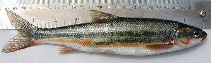 Mylocheilus caurinus
Immagine di Shaw, P.
Immagini | Google image
Immagine di Shaw, P.
Classificazione / Nomi Nomi Comuni | Sinonimi | Catalog of Fishes(Genere, Specie) | ITIS | CoL | WoRMS | Cloffa
> Cypriniformes (Carps) > Leuciscidae (Minnows) > Pogonichthyinae
Etymology: Mylocheilus: Greek, mylo = mill + Greek, cheilos =lip (Ref. 45335); caurinus: Species name taken after caurus which means northwest wind; named caurinus --- northwestern (Ref. 1998).
More on author: Richardson.
Etymology: Mylocheilus: Greek, mylo = mill + Greek, cheilos =lip (Ref. 45335); caurinus: Species name taken after caurus which means northwest wind; named caurinus --- northwestern (Ref. 1998).
More on author: Richardson.
Ambiente: milieu / zona climatica / distribuzione batimetrica / gamma di distribuzione Ecologia
; acqua dolce; salmastro demersale; potamodromo (Ref. 126106). Temperate; 59°N - 40°N
Distribuzione Territories | Aree FAO | Ecosistemi | Presenze | Mappa dei ritrovamenti | Introduzioni | Faunafri
North America: Nass (Pacific Slope) and Peace River (Arctic basin) systems in British Columbia, Canada south to Columbia River drainage in Oregon and Idaho, USA; also in Vancouver, British Columbia and Mackenzie River drainage (Arctic basin) in Northwest Territories, Canada (Ref. 86798). Sometimes occurs at Spanish Banks (Ref. 4569).
Lunghezza alla prima maturità / Dimensione / Peso / Età
Maturità: Lm 24.9 range ? - ? cm
Max length : 36.0 cm TL maschio/sesso non determinato; (Ref. 86798); common length : 19.8 cm SL maschio/sesso non determinato; (Ref. 1998); common length :22.5 cm SL (female)
Max length : 36.0 cm TL maschio/sesso non determinato; (Ref. 86798); common length : 19.8 cm SL maschio/sesso non determinato; (Ref. 1998); common length :22.5 cm SL (female)
Breve descrizione Chiavi di identificazione | Morfologia | Morfometria
Raggi dorsali molli (totale) : 8; Raggi anali molli: 8. Lateral line complete with 66-84 scales; dorsal fin with 8 rays; anal fin with 8 rays; molarlike pharyngeal teeth 1,5--5,1; slender body, somewhat compressed; large eye; long rounded snout; barbel at corner of slightly subterminal mouth; large forked caudal fin; dorsal-fin origin over or in front of pelvic-fin origin; axillary process at pelvic-fin base; dark gray-brown to green above; 2 dark stripes, lower one ending in front of anal fin, on silver yellow side; yellow to brown fins; and large male with red on side, belly mouth, gill cover and pectoral-fin base (Ref. 86798).
Body shape (shape guide): fusiform / normal.
Body shape (shape guide): fusiform / normal.
Adults inhabit lakes and slow-flowing areas of small to medium rivers. Common around vegetation (Ref. 86798). They form schools. Can withstand brackish waters for a limited period (Ref. 1998). Newly hatched individuals school near the shore, moving into deeper water in the summer (Ref. 4569). They feed mainly on aquatic insects and its larvae and some terrestrial insects (Ref. 10288); but also on planktonic crustaceans, mollusks, and small fishes (Ref. 1998). Preyed upon by fish-eating birds and mammals (Ref. 1998). Utilized as game fish and as food in the past (Ref. 1998).
Ciclo vitale e comportamento di accoppiamento Maturità | Riproduzione | Deposizione | Uova | Fecondità | Larve
Spawning fish come close to shore in groups of 50-400. Groups are about 25 to 100 feet apart from each other. Females are crowded by 2 or more males into 1 or 2 inches of water by the shoreline and eggs and sperms are released.
Riferimento principale
Caricare le referenze | Bibliografia | Coordinatore | Collaboratori
Page, L.M. and B.M. Burr, 2011. A field guide to freshwater fishes of North America north of Mexico. Boston : Houghton Mifflin Harcourt, 663p. (Ref. 86798)
Stato della Lista Rossa IUCN (Ref. 130435: Version 2025-2 (Global))
Least Concern (LC) ; Date assessed: 01 March 2012
CITES
Not Evaluated
Minaccia per l'uomo
Harmless
Usi umani
Pesca: commerciale; Acquario: Acquari pubblici
FAO - Publication: search | FishSource |
Informazioni ulteriori
Ecologia trofica
Articoli alimentari (prede)
Alimentazione
Consumo di cibo
Razioni alimentari
Predatori
Articoli alimentari (prede)
Alimentazione
Consumo di cibo
Razioni alimentari
Predatori
Dinamica della popolazione
Parametri di crescita
Età massima / dimensioni massime
Rapporto lunghezza-peso.
Lunghezza-lunghezza rel.
Lunghezza-frequenze
Conversione di massa
Reclutamento
Abbondanza
Parametri di crescita
Età massima / dimensioni massime
Rapporto lunghezza-peso.
Lunghezza-lunghezza rel.
Lunghezza-frequenze
Conversione di massa
Reclutamento
Abbondanza
Ciclo di vita
Riproduzione
Maturità
Maturità/Gli occhielli sono relativi.
Fecondità
Deposizione
Aggregazioni riproduttive
Uova
Sviluppo delle uova
Larve
Dinamica popolazioni larvali
Riproduzione
Maturità
Maturità/Gli occhielli sono relativi.
Fecondità
Deposizione
Aggregazioni riproduttive
Uova
Sviluppo delle uova
Larve
Dinamica popolazioni larvali
Anatomia
Area branchiale
Cervello
Otolite
Area branchiale
Cervello
Otolite
Fisiologia
Composizione corporea
Nutrienti
Consumo di ossigeno
Tipo di nuoto
Velocità di nuoto
Pigmenti visivi
Suono del pesce
Malattie e parassiti
Tossicità (LC50)
Composizione corporea
Nutrienti
Consumo di ossigeno
Tipo di nuoto
Velocità di nuoto
Pigmenti visivi
Suono del pesce
Malattie e parassiti
Tossicità (LC50)
Legato all'uomo
Sistemi di acquacoltura
Profili di acquacoltura
Varietà
Casi di Ciguatera
Francobolli, monete, materiale vario.
Sistemi di acquacoltura
Profili di acquacoltura
Varietà
Casi di Ciguatera
Francobolli, monete, materiale vario.
Strumenti
Libro elettronico | Giuda pratica | Chiavi di identificazione | Generatore frequenze di lunghezza | Strumento Parametri Biologici | Mappa dei ritrovamenti |
Cattura-MSY |
Rapporti speciali
Controllo della manutenzione dell'acquario | Verificare la presenza di schede informative sulle specie | Verifica delle schede informative sull'acquacoltura
Scarica XML
Fonti Internet
AFORO (otoliths) | Alien/Invasive Species database | Aquatic Commons | BHL | Cloffa | Websites from users | Check FishWatcher | CISTI | Catalog of Fishes: Genere, Specie | DiscoverLife | ECOTOX | FAO - Publication: search | Faunafri | Fishipedia | Fishtrace | GloBI | Google Books | Google Scholar | Google | IGFA World Record | OneZoom | Open Tree of Life | Otolith Atlas of Taiwan Fishes | Acquari pubblici | PubMed | Reef Life Survey | Socotra Atlas | TreeBase | Tree of Life | Wikipedia: Go, ricerca | World Records Freshwater Fishing | Record zoologico
Stime basate su modelli
Indice di diversità filogenetica (Fonte Biblio. 82804): PD50 = 1.0000 [Uniqueness, from 0.5 = low to 2.0 = high].
Bayesian length-weight: a=0.00871 (0.00401 - 0.01893), b=3.06 (2.88 - 3.24), in cm total length, based on LWR estimates for this (Sub)family-body shape (Ref. 93245).
Livello trofico (Fonte Biblio. 69278): 3.5 ±0.49 se; based on food items.
Resilienza (Fonte Biblio. 120179): Medio, tempo minimo di raddoppiamento della popolazione 1.4 - 4.4 anni (tm=4).