



Notemigonus crysoleucas (Mitchill, 1814)
Golden shiner
Hochladen Photos und videos
Bilder | Google Bild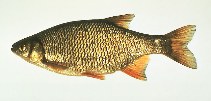 Notemigonus crysoleucas
Photo von Scarola, J.F.
Bilder | Google Bild
Photo von Scarola, J.F.
Klassifizierung / Names Namen | Synonyme | Catalog of Fishes(Gattung, Arten) | ITIS | CoL | WoRMS | Cloffa
> Cypriniformes (Carps) > Leuciscidae (Minnows) > Leuciscinae
Etymology: Notemigonus: Greek, noton = back + Greek, gonia = angled (Ref. 45335); crysoleucas: notemigonus, angled back; cryso, meaning gold; and leucas, white (Ref. 10294).
More on author: Mitchill.
Etymology: Notemigonus: Greek, noton = back + Greek, gonia = angled (Ref. 45335); crysoleucas: notemigonus, angled back; cryso, meaning gold; and leucas, white (Ref. 10294).
More on author: Mitchill.
Umwelt: Milieu / Klimazone / Tiefenbereich / Verbreitungsgebiet Ökologie
; süßwasser; brackwasser demersal; tiefenbereich 10 - ? m. Subtropical; 0°C - 35°C (Ref. 35682); 52°N - 25°N
Verbreitung Territorien | FAO Gebiete | Ökosysteme | Vorkommen | Punkt Karte | Einführungen | Faunafri
North America: Atlantic and Gulf Slope drainages from Nova Scotia in Canada to southern Texas, USA; Great Lakes, Hudson Bay (Red River), and Mississippi River basins west to Saskatchewan in Canada, and Montana, west Oklahoma and Texas in USA.
Länge bei der ersten Reifung / Größe / Gewicht / Alter
Geschlechtsreife: Lm 6.4 range ? - ? cm
Max length : 32.0 cm TL Männchen/unbestimmt; (Ref. 86798); common length : 14.4 cm TL Männchen/unbestimmt; (Ref. 12193); max. veröff. Alter: 9 Jahre (Ref. 72462)
Max length : 32.0 cm TL Männchen/unbestimmt; (Ref. 86798); common length : 14.4 cm TL Männchen/unbestimmt; (Ref. 12193); max. veröff. Alter: 9 Jahre (Ref. 72462)
Kurzbeschreibung Bestimmungsschlüssel | Morphologie | Morphometrie
Rückenflossenweichstrahlen (insgesamt) : 7 - 9; Afterflossenweichstrahlen: 8 - 19. Body extremely compressed; lateral line strongly decurved; scaleless keel along belly from pelvic to anal fin; dorsal- fin origin behind pelvic-fin origin; mouth small, upturned on pointed snout; appears silver in clear and turbid water, and gold side and fins in coffee-colored water; fins red in southern hemisphere; dusky stripe along side, herringbone lines on upper side of young. Scales on lateral line 44-54; dorsal fin with 7-9 rays; anal fin with 8-19 rays, usually 11-14; rakers on 1st gill arch 17-19; and pharyngeal teeth 0,5-5,0 (Ref. 86798).
Body shape (shape guide): fusiform / normal.
Body shape (shape guide): fusiform / normal.
Adults inhabis vegetated lakes, ponds, swamps, backwaters and pools of creeks and small to medium rivers (Ref. 86798). Can tolerate low oxygen levels, high turbidity and high temperature; omnivorous but principally feed on plankton, insects and mollusks (Ref. 27549). Migratory behaviour is undetermined (Ref. 126106).
Lebenszyklus und Paarungsverhalten Geschlechtsreife | Fortpflanzung | Ablaichen | Eier | Fruchtbarkeit | Larven
Hauptreferenz
Laden Sie Ihre Referenzen hoch | Referenzen | Koordinator | Partner
Page, L.M. and B.M. Burr, 2011. A field guide to freshwater fishes of North America north of Mexico. Boston : Houghton Mifflin Harcourt, 663p. (Ref. 86798)
IUCN Rote Liste Status (Ref. 130435: Version 2025-2 (Global))
nicht bedroht (LC) ; Date assessed: 01 March 2012
CITES
Not Evaluated
Bedrohung für Menschen
Harmless
Nutzung durch Menschen
Fischereien: weniger kommerziell; Aquakultur: kommerziell; Aquarium: Öffentliche Aquarien; Köder: usually
FAO - Publication: search | FishSource |
Mehr Information
Trophische Ökologie
Lebensmittel (Beutetiere)
Nahrungszusammensetzung
Nahrungsaufnahme
Lebensmittelrationen
Räuber
Lebensmittel (Beutetiere)
Nahrungszusammensetzung
Nahrungsaufnahme
Lebensmittelrationen
Räuber
Populationsdynamik
Wachstumsparameter
Max. Alter/Größen
Länge-Gewicht-Rel.
Länge-Länge-Verhältnis.
Längenhäufigkeiten
Massenkonvertierung
Rekrutierung
Dichte
Wachstumsparameter
Max. Alter/Größen
Länge-Gewicht-Rel.
Länge-Länge-Verhältnis.
Längenhäufigkeiten
Massenkonvertierung
Rekrutierung
Dichte
Lebenszyklus
Fortpflanzung
Geschlechtsreife
Reifung/Kiemen rel.
Fruchtbarkeit
Ablaichen
Laichaggregationen
Eier
Eientwicklung
Larven
Larven Pop.Dyn.
Fortpflanzung
Geschlechtsreife
Reifung/Kiemen rel.
Fruchtbarkeit
Ablaichen
Laichaggregationen
Eier
Eientwicklung
Larven
Larven Pop.Dyn.
Anatomie
Kiemenoberfläche
Gehirn
Otolith
Kiemenoberfläche
Gehirn
Otolith
Physiologie
Körperliche Zusammensetzung
Nährstoffe
Sauerstoffverbrauch
Schwimmart
Schwimmgeschwindigkeit
Visuelle Pigmente
Fischgeräusche
Krankheiten und Parasiten
Toxizität (LC50s)
Körperliche Zusammensetzung
Nährstoffe
Sauerstoffverbrauch
Schwimmart
Schwimmgeschwindigkeit
Visuelle Pigmente
Fischgeräusche
Krankheiten und Parasiten
Toxizität (LC50s)
Menschenbezogen
Aquakultur-Systeme
Aquakultur Profile
Zuchtlinien
Ciguatera-Fälle
Briefmarken, Münzen, Verschiedenes.
Aquakultur-Systeme
Aquakultur Profile
Zuchtlinien
Ciguatera-Fälle
Briefmarken, Münzen, Verschiedenes.
Tools
Bio-Quiz | E-Book | Feldführer | Bestimmungsschlüssel | Längenhäufigkeits Tool | Lebensdaten Tool | Punkt Karte |
Catch-MSY |
Zusatzinformationen
Download XML
Zusammenfassung | Punktdaten | Namen | Photos
Internet Quellen
AFORO (otoliths) | Alien/Invasive Species database | Aquatic Commons | BHL | Cloffa | Websites from users | FishWatcher Einträge suchen | CISTI | Catalog of Fishes: Gattung, Arten | DiscoverLife | ECOTOX | FAO - Publication: search | Faunafri | Fishipedia | Fishtrace | GloBI | Google Books | Google Scholar | Google | IGFA World Record | OneZoom | Open Tree of Life | Otolith Atlas of Taiwan Fishes | Öffentliche Aquarien | PubMed | Reef Life Survey | Socotra Atlas | TreeBase | Tree of Life | Wikipedia: Gehe zu, Suchen | World Records Freshwater Fishing | Zoologischer Rekord
Schätzungen auf der Grundlage von Modellen
Phylogenetischer Diversitätsindex (Ref. 82804): PD50 = 1.0000 [Uniqueness, from 0.5 = low to 2.0 = high].
Bayesian length-weight: a=0.01023 (0.00680 - 0.01539), b=3.07 (2.95 - 3.19), in cm total length, based on LWR estimates for this species & (Sub)family-body (Ref. 93245).
Trophische Ebene (Ref. 69278): 2.7 ±0.1 se; based on diet studies.
Widerstandsfähigkeit (Ref. 120179): mittel, Verdopplung der Population dauert 1,4 - 4,4 Jahre. (tm=2; tmax=9; Fec=200,000).