This website uses cookies to enhance your browsing experience and ensure the functionality of our site. For more detailed information about the types of cookies we use and how we protect your privacy, please visit our Privacy Information page.
×
Cookie Settings
This website uses different types of cookies to enhance your experience. Please select your preferences below:
> Cypriniformes (Carps) > Cyprinidae (Minnows or carps) > Labeoninae
Etymology: Ceratogarra:Greek noun κzρας, -ατος (keras, keratos) meaning horn, and the ge genus name Garra; referring to the two ‘horns’ at the tip of the snout.
Milieu: milieu / Klimaatzone / Diepte / verspreidingsgebied Ecologie
; zoet water benthopelagisch. Tropical; 20°C - 25°C (Ref. 13614)
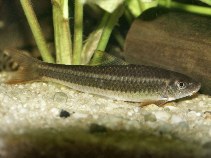
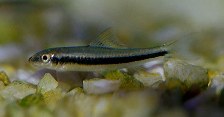
This species is distinguished from by the following set of characters: with a pair of large conical tubercles at the tip of the snout, directed laterally; top and side of the snout (between the tip and the eye) with numerous tubercles, all conical, of various sizes; with a broad, contrasted dark brown to black midlateral stripe on a pale brown background and whitish to yellow lower half of flank; a red to black marginal or submarginal band along the upper and lower edges of the caudal fin; a single pair of barbels (maxillary); the pulvinus of the gular disc thin, flat, covering the posterior edge of the torus; no groove between the pulvinus and the labrum; lateral extremities of the torus continuous with the labrum and the labella; the labrum connected to the rostral cap by the labella (partly folded under the labrum); the torus, labella and labrum (sometimes also the anterior edge of the pulvinus) are entirely covered by small papillae; no subtoral fold and proboscis (Ref. 128869). Cross section: compressed.
Inhabits rocky bottoms in swiftly moving water of small and medium-sized streams. Feeds on periphyton, phytoplankton and some insects (Ref. 12693). usually abundant; the adults live in loose groups of 4-10 individuals while juveniles 3.0-4.0 cm SL may form loose schools of tens of individuals (Ref. 128869). Not fished commercially, but occasionally seen in the aquarium trade (Ref 12693).
Kottelat, M., 2020. Ceratogarra, a genus name for Garra cambodgiensis and G. fasciacauda and comments on the oral and gular soft anatomy in labeonine fishes (Teleostei: Cyprinidae). Raffles Bulletin of Zoology Suppl. 35:156-178. (Ref. 128869)
Status op de Rode Lijst van het IUCN (Ref. 130435: Version 2025-2 (Global))
Fylogenetische diversiteitsindex (Ref. 82804): PD50 = 0.6250 [Uniqueness, from 0.5 = low to 2.0 = high].
Bayesian length-weight: a=0.00891 (0.00461 - 0.01723), b=3.02 (2.86 - 3.18), in cm total length, based on LWR estimates for this species & (Sub)family-body (Ref. 93245).
Trofisch niveau (Ref. 69278): 2.4 ±0.21 se; based on food items.
Weerstandsvermogen (Ref. 120179): Gemiddeld, minimale populatieverdubbelingstijd 1,4-4,4 jaar (Preliminary K or Fecundity.).
Kwetsbaarheid van de visserij (Ref. 59153): Low vulnerability (14 of 100). 🛈