



Envoyez vos Photos et vidéos
Images | Images Google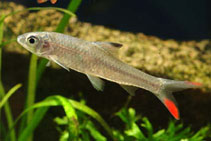 Discherodontus ashmeadi
Photo de Hippocampus-Bildarchiv
Images | Images Google
Photo de Hippocampus-Bildarchiv
Classification / Noms Noms communs | Synonymes | Catalog of Fishes(Genre, Espèce) | ITIS | CoL | WoRMS | Cloffa
> Cypriniformes (Carps) > Cyprinidae (Minnows or carps) > Cyprininae
Etymology: Discherodontus: Greek, di = two + Greek, scheo, scheros = to carry + Greek, odous = teeth (Ref. 45335).
Eponymy: Charles C Ashmead lived in Philadelphia and collected locally in Pennsylvania. He was an early local contributor to the Philadelphia Academy of Natural Sciences’ fish collection. (Ref. 128868), visit book page.
More on author: Fowler.
Etymology: Discherodontus: Greek, di = two + Greek, scheo, scheros = to carry + Greek, odous = teeth (Ref. 45335).
Eponymy: Charles C Ashmead lived in Philadelphia and collected locally in Pennsylvania. He was an early local contributor to the Philadelphia Academy of Natural Sciences’ fish collection. (Ref. 128868), visit book page.
More on author: Fowler.
Environnement : milieu / zone climatique / profondeur / gamme de distribution Écologie
; eau douce benthopélagique. Tropical
Distribution Territoires | Zones FAO | Écosystèmes | Occurrences | Carte par point | Introductions | Faunafri
Longueur à la première maturité / Taille / Poids / Âge
Description synthétique Clés d'identification | Morphologie | Morphométrie
Last simple dorsal ray feebly serrated posteriorly; a large black apical blotch on the dorsal fin; a bright red caudal fin without black lobe tips when live (Ref. 27732).
Body shape (shape guide): fusiform / normal.
Body shape (shape guide): fusiform / normal.
Seems to be associated with streams and rivers with clear water, moderate to fast current and a gravel to stony bottom (Ref. 27732). Found near the bottom in pools of small to medium-sized rivers. Typically occurs near decaying plant debris where it feeds on insects and other invertebrates. Possibly moves out into flooded forests during high-water periods. Apparently found in localized populations and encountered sporadically (Ref. 12693). Reported as a nocturnal species by villagers in Ban Pakphanang (Laos), where all specimens were obtained at night (Ref. 27732). Rare in markets (Ref. 12693).
Cycle de vie et comportement reproducteur Maturité | Reproduction | Frai | Œufs | Fécondité | Larves
Référence principale
Téléchargez vos références | Références | Coordinateur | Collaborateurs
Rainboth, W.J., 1996. Fishes of the Cambodian Mekong. FAO species identification field guide for fishery purposes. FAO, Rome, 265 p. (Ref. 12693)
Statut dans la liste rouge de l'IUCN (Ref. 130435: Version 2025-2 (Global))
Préoccupation mineure (LC) ; Date assessed: 01 April 2020
CITES
Not Evaluated
Menace pour l'homme
Harmless
Utilisations par l'homme
Pêcheries: sans intérêt
FAO - Publication: search | FishSource |
Plus d'informations
Écologie trophique
Aliments (proies)
Composition du régime alimentaire
Consommation alimentaire
Rations alimentaires
Prédateurs
Aliments (proies)
Composition du régime alimentaire
Consommation alimentaire
Rations alimentaires
Prédateurs
Dynamique des populations
Paramètres de croissance
Âges / tailles maximales
Longueur-poids rel.
Rel. longueur-longueur.
Fréquences de longueurs
Conversion de masse
Recrutement
Abondance
Paramètres de croissance
Âges / tailles maximales
Longueur-poids rel.
Rel. longueur-longueur.
Fréquences de longueurs
Conversion de masse
Recrutement
Abondance
Anatomie
Surface branchiale
Cerveau
Otolithe
Surface branchiale
Cerveau
Otolithe
Physiologie
Composition corporelle
Nutriments
Consommation d'oxygène
Type de natation
Vitesse de nage
Pigments visuels
Son de poisson
Maladies et parasites
Toxicité (CL50)
Composition corporelle
Nutriments
Consommation d'oxygène
Type de natation
Vitesse de nage
Pigments visuels
Son de poisson
Maladies et parasites
Toxicité (CL50)
Génétique
génôme
Génétique
Hétérozygotie
Héritabilité
Diversité génétique
génôme
Génétique
Hétérozygotie
Héritabilité
Diversité génétique
Liées à l'homme
Systèmes d'aquaculture
Profils d'aquaculture
Souches
Cas de ciguatera
Timbres, pièces de monnaie, divers
Systèmes d'aquaculture
Profils d'aquaculture
Souches
Cas de ciguatera
Timbres, pièces de monnaie, divers
Outils
Quiz bio | E-book | Guide de terrain | Générateur de fréquences de longueur | Outil de dynamique de population | Carte par point |
Capture-MSY |
Articles particuliers
Télécharger en XML
Sources Internet
AFORO (otoliths) | Aquatic Commons | BHL | Cloffa | Websites from users | FishWatcher | CISTI | Catalog of Fishes: Genre, Espèce | DiscoverLife | ECOTOX | FAO - Publication: search | Faunafri | Fishipedia | Fishtrace | GloBI | Google Books | Google Scholar | Google | IGFA World Record | OneZoom | Open Tree of Life | Otolith Atlas of Taiwan Fishes | PubMed | Reef Life Survey | Socotra Atlas | TreeBase | Arbre de Vie | Wikipedia: aller à, chercher | World Records Freshwater Fishing | Zoological Record
Estimations basées sur des modèles
Indice de diversité phylogénétique (Réf. 82804): PD50 = 0.5625 [Uniqueness, from 0.5 = low to 2.0 = high].
Bayesian length-weight: a=0.01023 (0.00604 - 0.01735), b=3.00 (2.86 - 3.14), in cm total length, based on LWR estimates for this species & (Sub)family-body (Ref. 93245).
Niveau trophique (Réf. 69278): 3.3 ±0.41 se; based on food items.
Generation time: 0.9 ( na - na) years. Estimated as median ln(3)/K based on 1 growth studies.
Résilience (Réf. 120179): Haut, temps minimum de doublement de population inférieur à 15 mois (Preliminary K or Fecundity.).