



Macropinna microstoma Chapman, 1939
Barreleye
Beobachtung melden im Fish Watcher
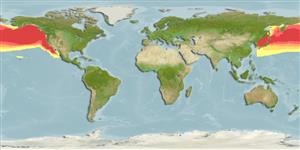
| Native range | All suitable habitat | Point map | Year 2050 |
|
| This map was computer-generated and has not yet been reviewed. |
| Macropinna microstoma AquaMaps Data sources: GBIF OBIS |
Hochladen Photos und videos
Bilder | Google Bild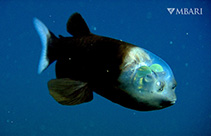 Macropinna microstoma
Photo von MBARI
Bilder | Google Bild
Photo von MBARI
Klassifizierung / Names Namen | Synonyme | Catalog of Fishes(Gattung, Arten) | ITIS | CoL | WoRMS | Cloffa
> Argentiniformes (Marine smelts) > Opisthoproctidae (Barreleyes or spookfishes)
Etymology: Macropinna: Greek, makros = great + Latin, pinna = thorn (Ref. 45335).
Etymology: Macropinna: Greek, makros = great + Latin, pinna = thorn (Ref. 45335).
Umwelt: Milieu / Klimazone / Tiefenbereich / Verbreitungsgebiet Ökologie
seewasser bathypelagisch; tiefenbereich 16 - 1267 m (Ref. 96339). Deep-water; 66°N - 21°N, 128°E - 109°W
Verbreitung Territorien | FAO Gebiete | Ökosysteme | Vorkommen | Punkt Karte | Einführungen | Faunafri
North Pacific: Bering Sea to Japan, and Baja California, Mexico.
Größe / Gewicht / Alter
Kurzbeschreibung Bestimmungsschlüssel | Morphologie | Morphometrie
Rückenflossenstacheln (insgesamt) : 0; Rückenflossenweichstrahlen (insgesamt) : 11; Afterflossenstacheln: 0; Afterflossenweichstrahlen: 14. This species' most striking feature is the transparent, cowl-like shield that covers the top of the head, and its prominent tubular eyes within. The shield is a tough, flexible integument that attaches to the dorsal and medial scales behind the head, and to the broad, transparent subocular bones that protect the eyes laterally. The fluid-field chamber found beneath the shield surrounds and protects the eyes with vivid green lenses. The tubular eyes of this fish can look forward as well as upward (with maximum arc of rotation observed about 75 degrees). The morphology of the eyes apparently allow at least two feeding modes: (1) with body horizontal and with eyes directed upward, it can spot food against lighted waters above, it pivots its body to bring the mouth up for ingestion while eyes are locked on target, rotating from dorsal to rostral relative to the body; and (2) with body horizontal, eyes rotate dorsal to rostral while tracking the path of descending food until it reaches the level of the mouth (Ref. 87379). Adipose at the base of the caudal peduncle (Ref. 6885). Adults dark brown (Ref. 6885).
A solitary fish, occurring at lower mesopelagic depths beneath temperate and subarctic waters. Caught by midwater trawl nets in areas with bottom depths of 1600-3600 m. Stomach contents include cnidarian remains, however, its visceral anatomy suggests diets of mixed zooplankton, including both gelatinous and crustacean prey and siphonophore tentacles and nematocysts (Ref. 87379). Uncommon species (Ref. 6885). Oviparous, with planktonic larvae (Ref. 35626). A photo of a 15 cm long fish shown at http://www.newscientist.com/gallery/new-species/9.
Lebenszyklus und Paarungsverhalten Geschlechtsreife | Fortpflanzung | Ablaichen | Eier | Fruchtbarkeit | Larven
Oviparous (Ref. 35626).
Hauptreferenz
Laden Sie Ihre Referenzen hoch | Referenzen | Koordinator | Partner
Eschmeyer, W.N., E.S. Herald and H. Hammann, 1983. A field guide to Pacific coast fishes of North America. Boston (MA, USA): Houghton Mifflin Company. xii+336 p. (Ref. 2850)
CITES
Not Evaluated
Bedrohung für Menschen
Harmless
Nutzung durch Menschen
Fischereien: bycatch
FAO - Publication: search | FishSource |
Mehr Information
Trophische Ökologie
Lebensmittel (Beutetiere)
Nahrungszusammensetzung
Nahrungsaufnahme
Lebensmittelrationen
Räuber
Lebensmittel (Beutetiere)
Nahrungszusammensetzung
Nahrungsaufnahme
Lebensmittelrationen
Räuber
Populationsdynamik
Wachstumsparameter
Max. Alter/Größen
Länge-Gewicht-Rel.
Länge-Länge-Verhältnis.
Längenhäufigkeiten
Massenkonvertierung
Rekrutierung
Dichte
Wachstumsparameter
Max. Alter/Größen
Länge-Gewicht-Rel.
Länge-Länge-Verhältnis.
Längenhäufigkeiten
Massenkonvertierung
Rekrutierung
Dichte
Lebenszyklus
Fortpflanzung
Geschlechtsreife
Reifung/Kiemen rel.
Fruchtbarkeit
Ablaichen
Laichaggregationen
Eier
Eientwicklung
Larven
Larven Pop.Dyn.
Fortpflanzung
Geschlechtsreife
Reifung/Kiemen rel.
Fruchtbarkeit
Ablaichen
Laichaggregationen
Eier
Eientwicklung
Larven
Larven Pop.Dyn.
Anatomie
Kiemenoberfläche
Gehirn
Otolith
Kiemenoberfläche
Gehirn
Otolith
Physiologie
Körperliche Zusammensetzung
Nährstoffe
Sauerstoffverbrauch
Schwimmart
Schwimmgeschwindigkeit
Visuelle Pigmente
Fischgeräusche
Krankheiten und Parasiten
Toxizität (LC50s)
Körperliche Zusammensetzung
Nährstoffe
Sauerstoffverbrauch
Schwimmart
Schwimmgeschwindigkeit
Visuelle Pigmente
Fischgeräusche
Krankheiten und Parasiten
Toxizität (LC50s)
Genetik
Genom
Genetik
Heterozygotie
Vererbbarkeit
Genetische Vielfalt
Genom
Genetik
Heterozygotie
Vererbbarkeit
Genetische Vielfalt
Menschenbezogen
Aquakultur-Systeme
Aquakultur Profile
Zuchtlinien
Ciguatera-Fälle
Briefmarken, Münzen, Verschiedenes.
Aquakultur-Systeme
Aquakultur Profile
Zuchtlinien
Ciguatera-Fälle
Briefmarken, Münzen, Verschiedenes.
Tools
Zusatzinformationen
Download XML
Zusammenfassung | Punktdaten | Namen | Photos
Internet Quellen
AFORO (otoliths) | Aquatic Commons | BHL | Cloffa | Websites from users | FishWatcher Einträge suchen | CISTI | Catalog of Fishes: Gattung, Arten | DiscoverLife | ECOTOX | FAO - Publication: search | Faunafri | Fishipedia | Fishtrace | GloBI | Google Books | Google Scholar | Google | IGFA World Record | OceanAdapt | OneZoom | Open Tree of Life | Otolith Atlas of Taiwan Fishes | PubMed | Reef Life Survey | Socotra Atlas | TreeBase | Tree of Life | Wikipedia: Gehe zu, Suchen | | Zoobank | Zoologischer Rekord
Schätzungen auf der Grundlage von Modellen
|
Phylogenetischer Diversitätsindex (Ref. 82804) |
PD50 = 1.0000 [Uniqueness, from 0.5 = low to 2.0 = high]. |
| Bayesian length-weight | a=0.01122 (0.00514 - 0.02450), b=3.04 (2.87 - 3.21), in cm total length, based on all LWR estimates for this body shape (Ref. 93245). |
|
Trophische Ebene (Ref. 69278) |
3.6 ±0.1 se; based on size and trophs of closest relatives |
|
Widerstandsfähigkeit (Ref. 120179) |
hoch, Verdopplung der Population dauert weniger als 15 Monate. (Preliminary K or Fecundity.). |
|
Anfälligkeit der Fischerei (Ref. 59153) |
Low to moderate vulnerability (26 of 100). 🛈 |
|
Preiskategorie (Ref. 80766) |
Unknown. |