



Archocentrus centrarchus (Gill, 1877)
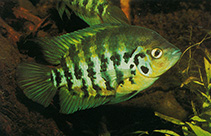
Flier cichlid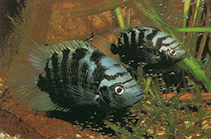
Classification / Noms Noms communs | Synonymes | Catalog of Fishes(Genre, Espèce) | ITIS | CoL | WoRMS | Cloffa
> Cichliformes (Cichlids, convict blennies) > Cichlidae (Cichlids) > Cichlasomatinae
Etymology: Archocentrus: Greek, archo = anus + Greek, kentron = sting (Ref. 45335).
More on author: Gill.
Etymology: Archocentrus: Greek, archo = anus + Greek, kentron = sting (Ref. 45335).
More on author: Gill.
Taxonomic Remarks
Reviewed by Bussing (1998: 336), with key, diagnosis, geographical distribution, and figures.
Environnement : milieu / zone climatique / profondeur / gamme de distribution Écologie
; eau douce benthopélagique. Tropical; 26°C - 36°C (Ref. 36880)
Distribution Territoires | Zones FAO | Écosystèmes | Occurrences | Carte par point | Introductions | Faunafri
Central America: Pacific slope, in tributaries of Fonseca Gulf in Honduras and Nicaragua; Atlantic slope in Río Chirripó (Río Matina) of Costa Rica to the Río San Juan and associated drainages of Nicaragua, including the Great Lakes.
Taille / Poids / Âge
Description synthétique Clés d'identification | Morphologie | Morphométrie
Épines dorsales (Total) : 15 - 17; Rayons mous dorsaux (Total) : 7 - 9; Épines anales: 9 - 11; Rayons mous anaux: 7 - 9. This species is distinguished by the following characters: 16- 19 total gill rakers on first arch, with rakers elongate and slender; 2 spots on opercle, vertically aligned; posterior end of maxilla not concave; circumpeduncular scales modally 18 or fewer; rows of secondary pored scales present on caudal fin; bars on side of body extending partially onto dorsal and anal fins, no medial intensification in bars on side of body, ocellus present on dorsal fin of mature females; in life abdomen predominantly yellow-green; caudal blotch ocellated (Ref. 74403).
Inhabits mainly shallow waters or swampy areas of lakes and rivers. Often found in many eutrophic oxbow lakes, ponds, roadside ditches and remnant pools of floodplains with thick vegetation. Prefers warm temperature and thrives in stagnant waters. An open water substrate spawner which lays eggs in extreme shallows. Fry feed on parents' dermal mucus for first few days (Ref. 7335). Feeds on detritus and insects (Ref. 36880).
Cycle de vie et comportement reproducteur Maturité | Reproduction | Frai | Œufs | Fécondité | Larves
Référence principale
Téléchargez vos références | Références | Coordinateur : Kullander, Sven O. | Collaborateurs
Conkel, D., 1993. Cichlids of North and Central America. T.F.H. Publications, Inc., USA. (Ref. 7335)
Statut dans la liste rouge de l'IUCN (Ref. 130435: Version 2025-2 (Global))
Préoccupation mineure (LC) ; Date assessed: 07 November 2019
CITES
Not Evaluated
Menace pour l'homme
Harmless
Utilisations par l'homme
FAO - Publication: search | FishSource |
Plus d'informations
Écologie trophique
Aliments (proies)
Composition du régime alimentaire
Consommation alimentaire
Rations alimentaires
Prédateurs
Aliments (proies)
Composition du régime alimentaire
Consommation alimentaire
Rations alimentaires
Prédateurs
Dynamique des populations
Paramètres de croissance
Âges / tailles maximales
Longueur-poids rel.
Rel. longueur-longueur.
Fréquences de longueurs
Conversion de masse
Recrutement
Abondance
Paramètres de croissance
Âges / tailles maximales
Longueur-poids rel.
Rel. longueur-longueur.
Fréquences de longueurs
Conversion de masse
Recrutement
Abondance
Cycle de vie
Reproduction
Maturité
Maturité/épines rel.
Fécondité
Frai
Agrégats de frai
Œufs
Développement de l'œuf
Larves
Dynamique des populations larvaires
Reproduction
Maturité
Maturité/épines rel.
Fécondité
Frai
Agrégats de frai
Œufs
Développement de l'œuf
Larves
Dynamique des populations larvaires
Anatomie
Surface branchiale
Cerveau
Otolithe
Surface branchiale
Cerveau
Otolithe
Physiologie
Composition corporelle
Nutriments
Consommation d'oxygène
Type de natation
Vitesse de nage
Pigments visuels
Son de poisson
Maladies et parasites
Toxicité (CL50)
Composition corporelle
Nutriments
Consommation d'oxygène
Type de natation
Vitesse de nage
Pigments visuels
Son de poisson
Maladies et parasites
Toxicité (CL50)
Liées à l'homme
Systèmes d'aquaculture
Profils d'aquaculture
Souches
Cas de ciguatera
Timbres, pièces de monnaie, divers
Systèmes d'aquaculture
Profils d'aquaculture
Souches
Cas de ciguatera
Timbres, pièces de monnaie, divers
Outils
Quiz bio | E-book | Guide de terrain | Clés d'identification | Générateur de fréquences de longueur | Outil de dynamique de population | Carte par point |
Capture-MSY |
Articles particuliers
Télécharger en XML
Sources Internet
AFORO (otoliths) | Aquatic Commons | BHL | Cloffa | Websites from users | FishWatcher | CISTI | Catalog of Fishes: Genre, Espèce | DiscoverLife | ECOTOX | FAO - Publication: search | Faunafri | Fishipedia | Fishtrace | GloBI | Google Books | Google Scholar | Google | IGFA World Record | OneZoom | Open Tree of Life | Otolith Atlas of Taiwan Fishes | PubMed | Reef Life Survey | Socotra Atlas | TreeBase | Arbre de Vie | Wikipedia: aller à, chercher | World Records Freshwater Fishing | Zoological Record
Estimations basées sur des modèles
Indice de diversité phylogénétique (Réf. 82804): PD50 = 1.0000 [Uniqueness, from 0.5 = low to 2.0 = high].
Bayesian length-weight: a=0.02188 (0.01025 - 0.04670), b=3.05 (2.87 - 3.23), in cm total length, based on LWR estimates for this (Sub)family-body shape (Ref. 93245).
Niveau trophique (Réf. 69278): 2.6 ±0.28 se; based on food items.
Résilience (Réf. 120179): Milieu, temps minimum de doublement de population : 1,4 à 4,4 années (Assuming Fec<1000).