This website uses cookies to enhance your browsing experience and ensure the functionality of our site. For more detailed information about the types of cookies we use and how we protect your privacy, please visit our Privacy Information page.
×
Cookie Settings
This website uses different types of cookies to enhance your experience. Please select your preferences below:
> Gobiiformes (Gobies) > Gobiidae (Gobies) > Sicydiinae
Etymology: Stiphodon:Greek, stiphos, -eos, -oys = mass + Greek, odous = teeth (Ref. 45335). Eponymy: Dr Richard Wolfgang Semon (1859–1918) was a German embryologist, evolutionary biologist and physiologist. [...] (Ref. 128868), visit book page. More on author: Weber.
Environnement : milieu / zone climatique / profondeur / gamme de distribution Écologie
Asia and Oceania: Indonesia, Philippines, New Guinea (Ref. 2847) and Solomon Islands (Ref. 26040). Reported from New Caledonia (Ref. 13235). Often referred to as Stiphodon elegans, which is apparently a different species from Polynesia.
Taille / Poids / Âge
Maturité: Lm? range ? - ? cm Max length : 4.6 cm SL mâle / non sexé; (Ref. 26040); 4.2 cm SL (female)
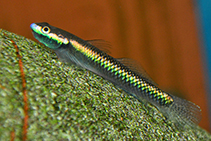
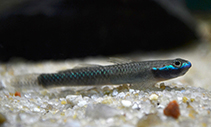
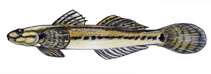
Épines dorsales (Total) : 7; Rayons mous dorsaux (Total) : 9; Épines anales: 1; Rayons mous anaux: 10. Second dorsal fin with segmented rays; pectoral fin usually with 15 rays; predorsal midline with cycloid scales, number sexually dimorphic with females having slightly more (usually 5-9) than males (usually 3-5); posterior half of belly with cycloid scales; in males first dorsal fin same height as second dorsal fin, without filamentous spines, patch of white fatty tissue posterior to pectoral base, bright green in life, bright blue immediately after death; brooding and dominant males may have a bright white lateral band; and females with a thin lateral band appearing zigzag like (Ref. 33064). Body shape (shape guide): elongated.
Occurs in small, moderately flowing to swift clear streams with rocky and boulder strewn bottom, usually in sunny areas and has been collected above waterfalls (Ref. 33064). Common in small rainforest creeks, often in hilly terrain, but usually within 30 km of the sea (Ref. 2847).
Cycle de vie et comportement reproducteur Maturité | Reproduction | Frai | Œufs | Fécondité | Larves
Watson, R.E., 1996. A review of Stiphodon from New Guinea and adjacent regions, with descriptions of five new species (Teleostei: Gobiidae: Sicydiinae). Rev. Fr. Aquariol. 23(3-4):113-132. (Ref. 26040)
Statut dans la liste rouge de l'IUCN (Ref. 130435: Version 2025-2 (Global))
Dynamique des populations Paramètres de croissance Âges / tailles maximales Longueur-poids rel. Rel. longueur-longueur. Fréquences de longueurs Conversion de masse Recrutement Abondance
Cycle de vie Reproduction Maturité Maturité/épines rel. Fécondité Frai Agrégats de frai Œufs Développement de l'œuf Larves Dynamique des populations larvaires
Physiologie Composition corporelle Nutriments Consommation d'oxygène Type de natation Vitesse de nage Pigments visuels Son de poisson Maladies et parasites Toxicité (CL50)
Indice de diversité phylogénétique (Réf. 82804): PD50 = 0.5000 [Uniqueness, from 0.5 = low to 2.0 = high].
Bayesian length-weight: a=0.00389 (0.00180 - 0.00842), b=3.12 (2.94 - 3.30), in cm total length, based on all LWR estimates for this body shape (Ref. 93245).
Résilience (Réf. 120179): Haut, temps minimum de doublement de population inférieur à 15 mois (Preliminary K or Fecundity.).
Vulnérabilité de la pêche (Ref. 59153): Low vulnerability (10 of 100). 🛈