



Probarbus labeamajor Roberts, 1992
Thicklip barb
Hochladen Photos und videos
Bilder | Google Bild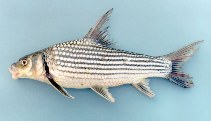 Probarbus labeamajor
Photo von Warren, T.
Bilder | Google Bild
Photo von Warren, T.
Klassifizierung / Names Namen | Synonyme | Catalog of Fishes(Gattung, Arten) | ITIS | CoL | WoRMS | Cloffa
> Cypriniformes (Carps) > Cyprinidae (Minnows or carps) > Probarbinae
Etymology: Probarbus: Greek, pro = first, in front of + Latin, barbus = barbel (Ref. 45335).
More on author: Roberts.
Etymology: Probarbus: Greek, pro = first, in front of + Latin, barbus = barbel (Ref. 45335).
More on author: Roberts.
Umwelt: Milieu / Klimazone / Tiefenbereich / Verbreitungsgebiet Ökologie
; süßwasser benthopelagisch; potamodrom (Ref. 51243). Tropical
Verbreitung Territorien | FAO Gebiete | Ökosysteme | Vorkommen | Punkt Karte | Einführungen | Faunafri
Asia: endemic to the Mekong.
Größe / Gewicht / Alter
Geschlechtsreife: Lm ? range ? - ? cm
Max length : 150 cm SL Männchen/unbestimmt; (Ref. 30857); max. veröff. Gewicht: 70.0 kg (Ref. 10431)
Max length : 150 cm SL Männchen/unbestimmt; (Ref. 30857); max. veröff. Gewicht: 70.0 kg (Ref. 10431)
Kurzbeschreibung Bestimmungsschlüssel | Morphologie | Morphometrie
Rückenflossenweichstrahlen (insgesamt) : 13; Afterflossenweichstrahlen: 8; Wirbelzahl: 40 - 41. Differs from the two other species of Probarbus in having slightly smaller (and more numerous) scales, scale row between dorsal fin origin and lateral line scale row 6; six instead of only five stripes on body above lateral line; lips greatly enlarged; barbels reduced in length, sometimes absent; and slightly more numerous vertebrae. Posterior margin of lower lip entirely free from side to side.
Body shape (shape guide): fusiform / normal.
Body shape (shape guide): fusiform / normal.
Occurs in large upland rivers. Feeds on benthic organisms and insect larvae (Ref. 58784). Undergoes upstream movement for spawning (Ref. 58784). Little is known about this species due to past confusion with P. jullieni. Apparently migrates together with P. jullieni and has been decimated by the intensive gillnet fishery directed at that species just above the Lee Pee Waterfalls in southern Laos (Ref. 10431). However, further investigation is needed to find out whether it shares the same spawning grounds and times (Ref. 10431).
Lebenszyklus und Paarungsverhalten Geschlechtsreife | Fortpflanzung | Ablaichen | Eier | Fruchtbarkeit | Larven
Hauptreferenz
Laden Sie Ihre Referenzen hoch | Referenzen | Koordinator | Partner
Rainboth, W.J., 1996. Fishes of the Cambodian Mekong. FAO species identification field guide for fishery purposes. FAO, Rome, 265 p. (Ref. 12693)
IUCN Rote Liste Status (Ref. 130435: Version 2025-2 (Global))
stark gefährdet (EN) (A2abcd); Date assessed: 25 February 2011
CITES
Not Evaluated
Bedrohung für Menschen
Harmless
Nutzung durch Menschen
Fischereien: weniger kommerziell
FAO - Publication: search | FishSource |
Mehr Information
Trophische Ökologie
Lebensmittel (Beutetiere)
Nahrungszusammensetzung
Nahrungsaufnahme
Lebensmittelrationen
Räuber
Lebensmittel (Beutetiere)
Nahrungszusammensetzung
Nahrungsaufnahme
Lebensmittelrationen
Räuber
Populationsdynamik
Wachstumsparameter
Max. Alter/Größen
Länge-Gewicht-Rel.
Länge-Länge-Verhältnis.
Längenhäufigkeiten
Massenkonvertierung
Rekrutierung
Dichte
Wachstumsparameter
Max. Alter/Größen
Länge-Gewicht-Rel.
Länge-Länge-Verhältnis.
Längenhäufigkeiten
Massenkonvertierung
Rekrutierung
Dichte
Lebenszyklus
Fortpflanzung
Geschlechtsreife
Reifung/Kiemen rel.
Fruchtbarkeit
Ablaichen
Laichaggregationen
Eier
Eientwicklung
Larven
Larven Pop.Dyn.
Fortpflanzung
Geschlechtsreife
Reifung/Kiemen rel.
Fruchtbarkeit
Ablaichen
Laichaggregationen
Eier
Eientwicklung
Larven
Larven Pop.Dyn.
Anatomie
Kiemenoberfläche
Gehirn
Otolith
Kiemenoberfläche
Gehirn
Otolith
Physiologie
Körperliche Zusammensetzung
Nährstoffe
Sauerstoffverbrauch
Schwimmart
Schwimmgeschwindigkeit
Visuelle Pigmente
Fischgeräusche
Krankheiten und Parasiten
Toxizität (LC50s)
Körperliche Zusammensetzung
Nährstoffe
Sauerstoffverbrauch
Schwimmart
Schwimmgeschwindigkeit
Visuelle Pigmente
Fischgeräusche
Krankheiten und Parasiten
Toxizität (LC50s)
Genetik
Genom
Genetik
Heterozygotie
Vererbbarkeit
Genetische Vielfalt
Genom
Genetik
Heterozygotie
Vererbbarkeit
Genetische Vielfalt
Menschenbezogen
Aquakultur-Systeme
Aquakultur Profile
Zuchtlinien
Ciguatera-Fälle
Briefmarken, Münzen, Verschiedenes.
Aquakultur-Systeme
Aquakultur Profile
Zuchtlinien
Ciguatera-Fälle
Briefmarken, Münzen, Verschiedenes.
Tools
Zusatzinformationen
Download XML
Zusammenfassung | Punktdaten | Namen | Photos
Internet Quellen
AFORO (otoliths) | Aquatic Commons | BHL | Cloffa | Websites from users | FishWatcher Einträge suchen | CISTI | Catalog of Fishes: Gattung, Arten | DiscoverLife | ECOTOX | FAO - Publication: search | Faunafri | Fishipedia | Fishtrace | GloBI | Google Books | Google Scholar | Google | IGFA World Record | OneZoom | Open Tree of Life | Otolith Atlas of Taiwan Fishes | PubMed | Reef Life Survey | Socotra Atlas | TreeBase | Tree of Life | Wikipedia: Gehe zu, Suchen | World Records Freshwater Fishing | Zoobank | Zoologischer Rekord
Schätzungen auf der Grundlage von Modellen
Phylogenetischer Diversitätsindex (Ref. 82804): PD50 = 0.6250 [Uniqueness, from 0.5 = low to 2.0 = high].
Bayesian length-weight: a=0.01122 (0.00514 - 0.02450), b=3.04 (2.87 - 3.21), in cm total length, based on all LWR estimates for this body shape (Ref. 93245).
Trophische Ebene (Ref. 69278): 3.1 ±0.4 se; based on size and trophs of closest relatives
Widerstandsfähigkeit (Ref. 120179): sehr niedrig, Verdopplung der Population dauert mehr als 14 Jahre. (Preliminary K or Fecundity.).