



Tetrapleurodon spadiceus (Bean, 1887)
Mexican lamprey
Hochladen Photos und videos
Bilder | Google Bild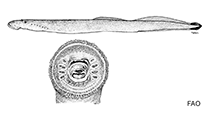 Tetrapleurodon spadiceus
Photo von FAO
Bilder | Google Bild
Photo von FAO
Klassifizierung / Names Namen | Synonyme | Catalog of Fishes(Gattung, Arten) | ITIS | CoL | WoRMS | Cloffa
> Petromyzontiformes (Lampreys) > Petromyzontidae (Northern lampreys) > Lampetrinae
Etymology: Tetrapleurodon: tetra (Gr.) four; pleura, (Gr.) side, odon (Gr.), tooth. i.e., lateral teeth, referring to four enlarged teeth on each side of mouth of T. spadiceus (See ETYFish); spadiceus: Latin for light- or nut-brown, referring to its color (See ETYFish).
More on author: Bean.
Etymology: Tetrapleurodon: tetra (Gr.) four; pleura, (Gr.) side, odon (Gr.), tooth. i.e., lateral teeth, referring to four enlarged teeth on each side of mouth of T. spadiceus (See ETYFish); spadiceus: Latin for light- or nut-brown, referring to its color (See ETYFish).
More on author: Bean.
Umwelt: Milieu / Klimazone / Tiefenbereich / Verbreitungsgebiet Ökologie
; süßwasser demersal; potamodrom (Ref. 126106). Tropical; 21°N - 19°N
Verbreitung Territorien | FAO Gebiete | Ökosysteme | Vorkommen | Punkt Karte | Einführungen | Faunafri
North America: Celio, Duero and Lerma rivers and Lake Chapala, Mexico.
Größe / Gewicht / Alter
Kurzbeschreibung Bestimmungsschlüssel | Morphologie | Morphometrie
Adults: 18-31 cm TL. Body wet weight of individuals measuring 18.7-22.5 cm TL, 21.3-26.3 g. Body proportions, as percentage of TL [based on 54 specimens, TL range inferred to be roughly 18-31 cm TL, Álvarez del Villar (1966)]: prebranchial length, 10.9-15.7; branchial length, 8.2-13.6; trunk length, 41.0-50.3; tail length, 27.2-34.3. Trunk myomeres, 60-65. Dentition: supraoral lamina, 2 unicuspid teeth, but 20% of individuals had 1-2 additional unicuspid teeth on the bridge; infraoral lamina, 5-9 unicuspid teeth, of which 4-5 are large and 0-4 are small (84% of specimens possess both large and small cusps); 4 endolaterals on each side, exceptionally 3 or 5; endolateral formula, typically 2-2-2-2, rarely, one of the teeth is tricuspid; 3 rows of anterials; first row of anterials, 6 unicuspid teeth; 1 row of exolaterals; 1 rows of posterials; first row of posterials, 21 unicuspid teeth; transverse lingual lamina weakly u-shaped, 17-22 unicuspid teeth, the median one or two unicuspid teeth slightly enlarged; longitudinal lingual laminae parentheses-shaped, each with 24-25 unicuspid teeth. Velar tentacles, 19-21, with tubercles; the dorsal wings are long, reaching the median tentacle. Lateral line neuromasts unpigmented. Caudal fin pigmentation, 75% or more. Caudal fin shape, spade-like. Oral fimbriae, 109-136. Oral papillae, 13-27.
Body shape (shape guide): eel-like.
Body shape (shape guide): eel-like.
Freshwater (Ref. 89241). Found in streams, rivers, and lakes over substrates of firm mud, silt, and rock (Ref. 57533). Spawning habitat is a fast-flowing, clear-water stream with a stony substrate. Eggs hatch between the months of November and January and ammocoetes undergo metamorphosis at the end of three years (Ref. 89241). Ammocoete larval stage duration also cited as four years (Ref. 57533). Ammocoetes live in the mud and feed on plankton (algae of the genera Rhizosolenia, Pleurosigma, Pinularia, Stauroneis, Amphora, and Cocconema, filamentous Chlorophyceae, rotifers, ciliates, and occasionally euglenoid flagellates). The mean total length reached at the end of the first year of larval life is 83 mm; at the end of two years, 135 mm; and at the end of three years, 146 mm. During the rainy season (July) of their first year, ammocoetes exhibit a shrinkage in their total length. Metamorphosis occurs in April-August (Ref. 89241). Parasitic (Ref. 57533). Following metamorphosis, adults migrate to Lake Chapala or the Duero River (Lerma River Basin) where they live as ectoparasites of fishes (carp and catfish) for two years. The diet appears to be predominantly blood. A large number of scales of Moxostoma austrinum and either of Algansea popoche, Yuriria alta, or Y. chapalae, as well as possibly Chirostoma sp. has been found mixed with blood in the intestine of adults. Attacks on the small cyprinids and the atherinopsid almost certainly resulted in their death. Around late June, early July they begin to migrate upstream to the spawning grounds in the upper reaches of the Celio River and die after spawning. Nine individuals in spawning readiness were collected on 19 November (water temperature was about 20°C). Fecundity, 6,617-9,095 eggs/female. Egg diameter, 0.7-0.8 mm. Is presumed to kill a certain number of commercial fish species (Algansea popoche and Chirostoma sp.) in Lake Chapala (Ref. 89241).
Lebenszyklus und Paarungsverhalten Geschlechtsreife | Fortpflanzung | Ablaichen | Eier | Fruchtbarkeit | Larven
Hauptreferenz
Laden Sie Ihre Referenzen hoch | Referenzen | Koordinator | Partner
Hardisty, M.W., 1986. A general introduction to lampreys. p. 19-84. In J. Holcík (ed.) The Freshwater fishes of Europe. Vol. 1, Part 1. Petromyzontiformes. AULA-Verlag GmbH, Wiesbaden. 313 p. (Ref. 12268)
IUCN Rote Liste Status (Ref. 130435: Version 2025-2 (Global))
vom Aussterben bedroht (CR) (D); Date assessed: 04 December 2018
CITES
Not Evaluated
Bedrohung für Menschen
Harmless
Nutzung durch Menschen
FAO - Publication: search | FishSource |
Mehr Information
Trophische Ökologie
Lebensmittel (Beutetiere)
Nahrungszusammensetzung
Nahrungsaufnahme
Lebensmittelrationen
Räuber
Lebensmittel (Beutetiere)
Nahrungszusammensetzung
Nahrungsaufnahme
Lebensmittelrationen
Räuber
Populationsdynamik
Wachstumsparameter
Max. Alter/Größen
Länge-Gewicht-Rel.
Länge-Länge-Verhältnis.
Längenhäufigkeiten
Massenkonvertierung
Rekrutierung
Dichte
Wachstumsparameter
Max. Alter/Größen
Länge-Gewicht-Rel.
Länge-Länge-Verhältnis.
Längenhäufigkeiten
Massenkonvertierung
Rekrutierung
Dichte
Lebenszyklus
Fortpflanzung
Geschlechtsreife
Reifung/Kiemen rel.
Fruchtbarkeit
Ablaichen
Laichaggregationen
Eier
Eientwicklung
Larven
Larven Pop.Dyn.
Fortpflanzung
Geschlechtsreife
Reifung/Kiemen rel.
Fruchtbarkeit
Ablaichen
Laichaggregationen
Eier
Eientwicklung
Larven
Larven Pop.Dyn.
Anatomie
Kiemenoberfläche
Gehirn
Otolith
Kiemenoberfläche
Gehirn
Otolith
Physiologie
Körperliche Zusammensetzung
Nährstoffe
Sauerstoffverbrauch
Schwimmart
Schwimmgeschwindigkeit
Visuelle Pigmente
Fischgeräusche
Krankheiten und Parasiten
Toxizität (LC50s)
Körperliche Zusammensetzung
Nährstoffe
Sauerstoffverbrauch
Schwimmart
Schwimmgeschwindigkeit
Visuelle Pigmente
Fischgeräusche
Krankheiten und Parasiten
Toxizität (LC50s)
Genetik
Genom
Genetik
Heterozygotie
Vererbbarkeit
Genetische Vielfalt
Genom
Genetik
Heterozygotie
Vererbbarkeit
Genetische Vielfalt
Menschenbezogen
Aquakultur-Systeme
Aquakultur Profile
Zuchtlinien
Ciguatera-Fälle
Briefmarken, Münzen, Verschiedenes.
Aquakultur-Systeme
Aquakultur Profile
Zuchtlinien
Ciguatera-Fälle
Briefmarken, Münzen, Verschiedenes.
Tools
E-Book | Feldführer | Bestimmungsschlüssel | Längenhäufigkeits Tool | Lebensdaten Tool | Punkt Karte |
Catch-MSY |
Zusatzinformationen
Download XML
Zusammenfassung | Punktdaten | Namen | Photos
Internet Quellen
AFORO (otoliths) | Aquatic Commons | BHL | Cloffa | Websites from users | FishWatcher Einträge suchen | CISTI | Catalog of Fishes: Gattung, Arten | DiscoverLife | ECOTOX | FAO - Publication: search | Faunafri | Fishipedia | Fishtrace | GloBI | Google Books | Google Scholar | Google | IGFA World Record | OneZoom | Open Tree of Life | Otolith Atlas of Taiwan Fishes | PubMed | Reef Life Survey | Socotra Atlas | TreeBase | Tree of Life | Wikipedia: Gehe zu, Suchen | World Records Freshwater Fishing | Zoologischer Rekord
Schätzungen auf der Grundlage von Modellen
Phylogenetischer Diversitätsindex (Ref. 82804): PD50 = 0.7500 [Uniqueness, from 0.5 = low to 2.0 = high].
Bayesian length-weight: a=0.00132 (0.00060 - 0.00290), b=2.99 (2.80 - 3.18), in cm total length, based on LWR estimates for this (Sub)family-body shape (Ref. 93245).
Trophische Ebene (Ref. 69278): 4.2 ±0.73 se; based on food items.
Widerstandsfähigkeit (Ref. 120179): niedrig, Verdopplung der Population dauert 4,5 - 14 Jahre. (Semelparous species, assuming tm (= tmax) > 4).