



Urobatis jamaicensis (Cuvier, 1816)
Yellow stingray
Masukkan pemerhatian anda di Fish Watcher
| Native range | All suitable habitat | Point map | Year 2050 |

|
| This map was computer-generated and has not yet been reviewed. |
| Urobatis jamaicensis AquaMaps Data sources: GBIF OBIS |
muatnaik fotos/gambar dan video
Gambar | video | imej Google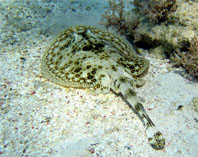 Urobatis jamaicensis
foto/gambar oleh Estrada Anaya, R.A.
Gambar | video | imej Google
foto/gambar oleh Estrada Anaya, R.A.
klasifikasi / Nama Nama-nama umum | Sinonim (persamaan) | Catalog of Fishes(Marga, Jenis) | ITIS | CoL | WoRMS | Cloffa
Ikan bertulang rawan (sharks and rays) > Myliobatiformes (Stingrays) > Urotrygonidae (American round stingrays)
Etymology: Urobatis: Greek,oura = tail + Greek, batis, batidos = a ray (Raja sp.) (Ref. 45335).
More on author: Cuvier.
Etymology: Urobatis: Greek,oura = tail + Greek, batis, batidos = a ray (Raja sp.) (Ref. 45335).
More on author: Cuvier.
Lingkungan: lingkungan / zona iklim / kisaran kedalaman / jangkauan distribusi Ekologi
laut berasosiasi dengan karang; kisaran kedalaman 1 - 25 m (Ref. 9710). Tropical; 37°N - 7°N, 100°W - 59°W (Ref. 55316)
Penyebaran Wilayah | Daerah-daerah FAO | Ekosistem | Kemunculan | peta titik | Introduksi | Faunafri
Western Atlantic: North Carolina, USA to northern South America. Also in Bahamas, Yucatan and throughout Caribbean (Ref. 26938).
Ukuran / Berat / umur
deskripsi pendek Kunci identifiaksi (pengenalan) | Morfologi | Morfometrik
Edge of disk no sharp angles, no dorsal fin. Well-developed caudal fin extends around tip of tail, doubly serrate spine near caudal fin base (Ref. 26938). Disk yellowish, with dark vermiculations and spots that form a variety of patterns on upper surface (Ref. 7251). Lower surface is yellowish, greenish or brownish white, tail with dark spots (Ref.6902).
Body shape (shape guide): other.
Body shape (shape guide): other.
Commonly found along sandy beaches to the water's edge, and especially in sandy areas in and around coral reefs (Ref. 7251). Raises front end of disc to attract prey seeking shelter (Ref. 7251). Feeds on shrimps, probably also on small fishes, clams, and worms (Ref. 12951). Known to be capable of inflicting dangerous wounds with its venomous spine. Easily approached (Ref. 9710). A live-bearing species, produces 3 to 4 young (Ref. 26938).
Siklus hidup dan perilaku kawin Kematangan | Reproduksi, perkembang biakan | Pemijahan | telur-telur | Fekunditas | Larva
Male grasps disc margin of female, swings under her and inserts a clasper. Mating pair is surrounded by other males that swim around and nudge them. Dugger (1987) (Ref. 51118) observed both male and female biting the pectoral fin of its mate (Ref. 49562).
rujukan utama
Unggah referensi Anda | Acuan | Koordinator | mitra
Compagno, L.J.V., 1999. Checklist of living elasmobranchs. p. 471-498. In W.C. Hamlett (ed.) Sharks, skates, and rays: the biology of elasmobranch fishes. Johns Hopkins University Press, Maryland. (Ref. 35766)
Status IUCN Red List (Ref. 130435: Version 2025-2 (Global))
kurang bimbang (LC) ; Date assessed: 21 June 2019
CITES
Not Evaluated
ancaman kepada manusia
Venomous
penggunaan manusia
Perikanan: komersial; Akuarium: Akuarium publik
FAO - Publication: search | FishSource |
informasi lanjut
Dinamika populasi
Parameter pertumbuhan
Maks. usia / ukuran
Panjang-berat rel.
Panjang-panjang rel.
ukuran frekuensi
Konversi massa
pemulihan
Kelimpahan
Parameter pertumbuhan
Maks. usia / ukuran
Panjang-berat rel.
Panjang-panjang rel.
ukuran frekuensi
Konversi massa
pemulihan
Kelimpahan
Siklus hidup
Reproduksi, perkembang biakan
Kematangan
Kedewasaan / insang rel.
Fekunditas
Pemijahan
Agregasi pemijahan
telur-telur
pekembangan telor
Larva
Dinamika larva
Reproduksi, perkembang biakan
Kematangan
Kedewasaan / insang rel.
Fekunditas
Pemijahan
Agregasi pemijahan
telur-telur
pekembangan telor
Larva
Dinamika larva
Anatomi
Area insang
Otak
Otolith
Area insang
Otak
Otolith
Fisiologi
Komposisi tubuh
Nutrisi
Konsumsi oksigen
Jenis renang
Kecepatan berenang
Pigmen visual
Suara ikan
Penyakit & Parasit
Toksisitas (LC50)
Komposisi tubuh
Nutrisi
Konsumsi oksigen
Jenis renang
Kecepatan berenang
Pigmen visual
Suara ikan
Penyakit & Parasit
Toksisitas (LC50)
Genetika
genom
Genetika
Heterozigositas
Diturunkan
Keanekaragaman Genetik
genom
Genetika
Heterozigositas
Diturunkan
Keanekaragaman Genetik
Yang berhubungan dengan manusia
Sistem akuakultur
profil budidaya air
Strain
Kasus Ciguatera
Perangko, koin, dll.
Sistem akuakultur
profil budidaya air
Strain
Kasus Ciguatera
Perangko, koin, dll.
Alat, peralatan
Kuis organik | E-book | Penuntun lapangan | Kunci identifiaksi (pengenalan) | tanda freqkuenci panjang | peringkat sejarah hidup | peta titik |
Tangkap-MSY |
laporan khas
muat turun XML
Sumber internet
AFORO (otoliths) | Aquatic Commons | BHL | Cloffa | Websites from users | semak peneliti ikan | CISTI | Catalog of Fishes: Marga, Jenis | DiscoverLife | DORIS | ECOTOX | FAO - Publication: search | Faunafri | Fishipedia | Fishtrace | GloBI | Google Books | Google Scholar | Google | IGFA World Record | OneZoom | Open Tree of Life | Otolith Atlas of Taiwan Fishes | Akuarium publik | PubMed | Reef Life Survey | Socotra Atlas | TreeBase | Tree of Life | Wikipedia: pergi, Cari | World Records Freshwater Fishing | Catatan Zoologi
Estimasi berdasarkan model
Suhu yang disukai (Acuan 123201): 25.8 - 28.1, mean 27.3 °C (based on 482 cells).
Indeks keanekaragaman filogenetik (Acuan 82804): PD50 = 0.5078 [Uniqueness, from 0.5 = low to 2.0 = high].
Bayesian length-weight: a=0.01072 (0.00572 - 0.02007), b=3.03 (2.86 - 3.20), in cm total length, based on LWR estimates for this species & (Sub)family-body (Ref. 93245).
Tingkat Trofik (Acuan 69278): 3.6 ±0.51 se; based on food items.
Daya lenting (Acuan 120179): sangat rendah, Waktu penggandaan populasi minimum lebih dari 14 tahun (Preliminary K or Fecundity.).
Nutrisi (Ref. 124155): Calcium = 7.17 [0.77, 112.55] mg/100g; Iron = 0.376 [0.030, 3.868] mg/100g; Protein = 20.4 [15.0, 25.6] %; Omega3 = 0.069 [0.021, 0.205] g/100g; Selenium = 24.1 [4.1, 110.7] μg/100g; VitaminA = 47.1 [3.2, 591.0] μg/100g; Zinc = 0.963 [0.062, 10.956] mg/100g (wet weight);