



Pteroplatytrygon violacea (Bonaparte, 1832)
Pelagic stingray
Beobachtung melden im Fish Watcher
| Native range | All suitable habitat | Point map | Year 2050 |

|
| This map was computer-generated and has not yet been reviewed. |
| Pteroplatytrygon violacea AquaMaps Data sources: GBIF OBIS |
Hochladen Photos und videos
Bilder | Google Bild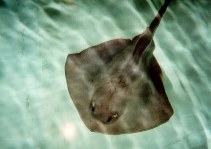 Pteroplatytrygon violacea
Male Photo von Mollet, H.F.
Bilder | Google Bild
Male Photo von Mollet, H.F.
Klassifizierung / Names Namen | Synonyme | Catalog of Fishes(Gattung, Arten) | ITIS | CoL | WoRMS | Cloffa
Elasmobranchii (Haie und Rochen) (sharks and rays) > Myliobatiformes (Stingrays) > Dasyatidae (Stingrays) > Dasyatinae
Etymology: Pteroplatytrygon: Greek, pteron = wing, fin + Greek,platys = flat + Greek, trygon = a sting ray (Ref. 45335); violacea: From the Latin 'viola' meaning violet.
More on author: Bonaparte.
Etymology: Pteroplatytrygon: Greek, pteron = wing, fin + Greek,platys = flat + Greek, trygon = a sting ray (Ref. 45335); violacea: From the Latin 'viola' meaning violet.
More on author: Bonaparte.
Umwelt: Milieu / Klimazone / Tiefenbereich / Verbreitungsgebiet Ökologie
seewasser pelagic-oceanic; tiefenbereich 1 - 381 m (Ref. 58302), usually 1 - 100 m (Ref. 55209). Subtropical; 52°N - 50°S, 180°W - 180°E (Ref. 55209)
Verbreitung Territorien | FAO Gebiete | Ökosysteme | Vorkommen | Punkt Karte | Einführungen | Faunafri
Probably cosmopolitan in tropical and subtropical seas. Eastern Pacific: Reported from Vancouver (Ref. 11980), from California (USA), Baja California (Mexico) to Chile, and the Galapagos Is. (Ref. 9068). Western Atlantic (Ref. 7251). Eastern Atlantic: Southeastern coasts of the Mediterranean and off Sicily; Reported from Cape Verde (Ref. 34514). Indian Ocean.
Länge bei der ersten Reifung / Größe / Gewicht / Alter
Geschlechtsreife: Lm 45.0, range 40 - 50 cm
Max length : 96.0 cm WD Männchen/unbestimmt; (Ref. 48844); common length : 80.0 cm WD Männchen/unbestimmt; (Ref. 9254)
Max length : 96.0 cm WD Männchen/unbestimmt; (Ref. 48844); common length : 80.0 cm WD Männchen/unbestimmt; (Ref. 9254)
Kurzbeschreibung Bestimmungsschlüssel | Morphologie | Morphometrie
A thick, dark stingray with a broadly rounded snout and an angular pectoral disc; tail less than twice body length with a long lower caudal finfold ending far in front of tail tip, but with no upper finfold; disc without thorns; usually 1 extremely long sting on tail; eyes do not protrude (Ref. 5578). Uniformly violet, purple, or dark blue-green dorsally and ventrally (Ref. 3263). No prominent markings (Ref. 3263).
Body shape (shape guide): other.
Body shape (shape guide): other.
Found in open, tropical and warm temperate waters usually in the first 100 m. Possibly the only totally pelagic member of the family (Ref. 6871). Feeds on coelenterates (including medusae), squid, decapod crustaceans, and fish. Ovoviviparous (Ref. 50449). Venomous spine on tail. Common catch of the pelagic tuna (and shark) longline and gillnet fisheries (drift, Ref. 75025) operating throughout the region (Ref. 58048); also by purse-seine and bottom trawls (Ref. 75025). Utilized for its meat and sometimes cartilage (Ref.58048). Total length 110 TL (80 cm WD) (Ref. 9254).
Lebenszyklus und Paarungsverhalten Geschlechtsreife | Fortpflanzung | Ablaichen | Eier | Fruchtbarkeit | Larven
Exhibit ovoviparity (aplacental viviparity), with embryos feeding initially on yolk, then receiving additional nourishment from the mother by indirect absorption of uterine fluid enriched with mucus, fat or protein through specialised structures (Ref. 50449). Distinct pairing with embrace (Ref. 205). With 2 (Ref.58048) to 9 young born at 15-25 cm WD (Ref. 26346); after a gestation period of 4 months (Ref.58048).
Hauptreferenz
Laden Sie Ihre Referenzen hoch | Referenzen | Koordinator : McEachran, John | Partner
Compagno, L.J.V., 1999. Checklist of living elasmobranchs. p. 471-498. In W.C. Hamlett (ed.) Sharks, skates, and rays: the biology of elasmobranch fishes. Johns Hopkins University Press, Maryland. (Ref. 35766)
IUCN Rote Liste Status (Ref. 130435: Version 2025-2 (Global))
nicht bedroht (LC) ; Date assessed: 09 November 2018
CITES
Not Evaluated
Bedrohung für Menschen
Venomous (Ref. 9254)
Nutzung durch Menschen
Fischereien: kommerziell; Sportfisch: ja
FAO - Publication: search | FishSource |
Mehr Information
Trophische Ökologie
Lebensmittel (Beutetiere)
Nahrungszusammensetzung
Nahrungsaufnahme
Lebensmittelrationen
Räuber
Lebensmittel (Beutetiere)
Nahrungszusammensetzung
Nahrungsaufnahme
Lebensmittelrationen
Räuber
Populationsdynamik
Wachstumsparameter
Max. Alter/Größen
Länge-Gewicht-Rel.
Länge-Länge-Verhältnis.
Längenhäufigkeiten
Massenkonvertierung
Rekrutierung
Dichte
Wachstumsparameter
Max. Alter/Größen
Länge-Gewicht-Rel.
Länge-Länge-Verhältnis.
Längenhäufigkeiten
Massenkonvertierung
Rekrutierung
Dichte
Lebenszyklus
Fortpflanzung
Geschlechtsreife
Reifung/Kiemen rel.
Fruchtbarkeit
Ablaichen
Laichaggregationen
Eier
Eientwicklung
Larven
Larven Pop.Dyn.
Fortpflanzung
Geschlechtsreife
Reifung/Kiemen rel.
Fruchtbarkeit
Ablaichen
Laichaggregationen
Eier
Eientwicklung
Larven
Larven Pop.Dyn.
Anatomie
Kiemenoberfläche
Gehirn
Otolith
Kiemenoberfläche
Gehirn
Otolith
Physiologie
Körperliche Zusammensetzung
Nährstoffe
Sauerstoffverbrauch
Schwimmart
Schwimmgeschwindigkeit
Visuelle Pigmente
Fischgeräusche
Krankheiten und Parasiten
Toxizität (LC50s)
Körperliche Zusammensetzung
Nährstoffe
Sauerstoffverbrauch
Schwimmart
Schwimmgeschwindigkeit
Visuelle Pigmente
Fischgeräusche
Krankheiten und Parasiten
Toxizität (LC50s)
Menschenbezogen
Aquakultur-Systeme
Aquakultur Profile
Zuchtlinien
Ciguatera-Fälle
Briefmarken, Münzen, Verschiedenes.
Aquakultur-Systeme
Aquakultur Profile
Zuchtlinien
Ciguatera-Fälle
Briefmarken, Münzen, Verschiedenes.
Tools
Bio-Quiz | E-Book | Feldführer | Bestimmungsschlüssel | Längenhäufigkeits Tool | Lebensdaten Tool | Punkt Karte |
Catch-MSY |
Zusatzinformationen
Download XML
Zusammenfassung | Punktdaten | Namen | Photos
Internet Quellen
AFORO (otoliths) | Aquatic Commons | BHL | Cloffa | Websites from users | FishWatcher Einträge suchen | CISTI | Catalog of Fishes: Gattung, Arten | DiscoverLife | ECOTOX | FAO - Publication: search | Faunafri | Fishipedia | Fishtrace | GloBI | Google Books | Google Scholar | Google | IGFA World Record | Nationale Datenbanken | OneZoom | Open Tree of Life | Otolith Atlas of Taiwan Fishes | Öffentliche Aquarien | PubMed | Reef Life Survey | Socotra Atlas | TreeBase | Tree of Life | Wikipedia: Gehe zu, Suchen | World Records Freshwater Fishing | Zoologischer Rekord
Schätzungen auf der Grundlage von Modellen
Bevorzugte Temperatur (Ref. 123201): 12 - 28.6, mean 24.8 °C (based on 5148 cells).
Phylogenetischer Diversitätsindex (Ref. 82804): PD50 = 1.0000 [Uniqueness, from 0.5 = low to 2.0 = high].
Bayesian length-weight: a=0.00447 (0.00189 - 0.01058), b=3.12 (2.92 - 3.32), in cm total length, based on LWR estimates for this (Sub)family-body shape (Ref. 93245).
Trophische Ebene (Ref. 69278): 4.4 ±0.54 se; based on food items.
Widerstandsfähigkeit (Ref. 120179): sehr niedrig, Verdopplung der Population dauert mehr als 14 Jahre. (K=0.18 (captivity); Fec=1-9 (could probably have 2 litters per year)).
Nährstoffe (Ref. 124155): Calcium = 19.5 [4.9, 91.5] mg/100g; Iron = 0.96 [0.25, 2.71] mg/100g; Protein = 22.8 [19.9, 25.8] %; Omega3 = 0.354 [0.107, 1.041] g/100g; Selenium = 20.5 [5.9, 52.0] μg/100g; VitaminA = 15.6 [5.9, 43.5] μg/100g; Zinc = 0.475 [0.235, 0.879] mg/100g (wet weight);