



Bathytoshia centroura (Mitchill, 1815)
Roughtail stingray
Beobachtung melden im Fish Watcher
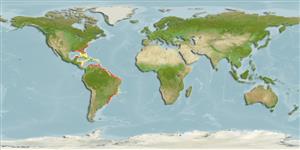
| Native range | All suitable habitat | Point map | Year 2050 |
|
| This map was computer-generated and has not yet been reviewed. |
| Bathytoshia centroura AquaMaps Data sources: GBIF OBIS |
Hochladen Photos und videos
Bilder | Laute | Google Bild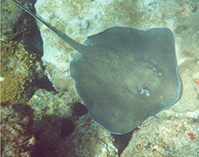 Bathytoshia centroura
Photo von Gasparini, J.L.
Bilder | Laute | Google Bild
Photo von Gasparini, J.L.
Klassifizierung / Names Namen | Synonyme | Catalog of Fishes(Gattung, Arten) | ITIS | CoL | WoRMS | Cloffa
Elasmobranchii (Haie und Rochen) (sharks and rays) > Myliobatiformes (Stingrays) > Dasyatidae (Stingrays) > Dasyatinae
More on author: Mitchill.
More on author: Mitchill.
Taxonomic Remarks
Eastern Atlantic populations of Bathytoshia centroura refer to Bathytoshia lata according to Last et al, 2016 (Ref. 114953). Species distribution will be corrected as soon as possible;
Umwelt: Milieu / Klimazone / Tiefenbereich / Verbreitungsgebiet Ökologie
seewasser; brackwasser demersal; tiefenbereich 3 - 270 m (Ref. 57911), usually 15 - 50 m (Ref. 4438). Subtropical; 45°N - 35°S, 90°W - 36°E
Verbreitung Territorien | FAO Gebiete | Ökosysteme | Vorkommen | Punkt Karte | Einführungen | Faunafri
Western Atlantic: antitropical; from western and southern USA, including the Gulf of Mexico, and Brazil to Argentina (Ref. 114953). Eastern Atlantic populations refer to Bathytoshia lata (Ref. 109651, 114953).
Länge bei der ersten Reifung / Größe / Gewicht / Alter
Geschlechtsreife: Lm 116.5, range 66 - 160 cm
Max length : 300 cm TL Männchen/unbestimmt; (Ref. 27549); common length : 125 cm WD Männchen/unbestimmt; (Ref. 26999); max. veröff. Gewicht: 300.0 kg (Ref. 57911)
Max length : 300 cm TL Männchen/unbestimmt; (Ref. 27549); common length : 125 cm WD Männchen/unbestimmt; (Ref. 26999); max. veröff. Gewicht: 300.0 kg (Ref. 57911)
Kurzbeschreibung Bestimmungsschlüssel | Morphologie | Morphometrie
Diagnosis: Large specimens of Dasyatis centroura are recognizable by their thorny tails, by the large size and wide spacing spacing of their mid-dorsal bucklers, and by the conspicuous tubercles or bucklers on the outer parts of their discs; in smaller specimens the large tubercles have not yet developed on the tail (Ref. 6902). It differs from Dasyatis sabina, D. guttata and Himantura schmardae in the shape of disc; it resembles Dasyatis say and D. americana in shape of disc, but it can be distinguished from D. say by the fact that the tail lacks any trace of a cutaneous fold above, and from D. americana by its much narrower ventral tailfold (Ref. 6902).
Body shape (shape guide): other; Cross section: flattened.
Body shape (shape guide): other; Cross section: flattened.
Dasyatis centroura is a coastal species (Ref. 81259), found over sandy and muddy bottoms (Ref. 3169). It feeds on bottom-living invertebrates and fishes (Ref. 3169). Ovoviviparous (Ref. 6901). Wings marketed fresh, smoked, dried-salted; used for fishmeal and oil. Harmful to shellfish banks; dangerous to bathers and fishers due to its poisonous spine. May attain well over 100 cm TL. Warm season visitor to coastal waters (Ref. 6902).
Lebenszyklus und Paarungsverhalten Geschlechtsreife | Fortpflanzung | Ablaichen | Eier | Fruchtbarkeit | Larven
Exhibit ovoviparity (aplacental viviparity), with embryos feeding initially on yolk, then receiving additional nourishment from the mother by indirect absorption of uterine fluid enriched with mucus, fat or protein through specialised structures (Ref. 50449). Gestation about 4 months with 2 to 4 young produced in autumn and early winter (Ref. 6901). Distinct pairing with embrace (Ref. 205).
Hauptreferenz
Laden Sie Ihre Referenzen hoch | Referenzen | Koordinator : McEachran, John | Partner
Last, P.R., W.T. White, M.R. de Carvalho, B. Séret, M.F.W. Stehmann and G.J.P. Naylor, 2016. Rays of the world. CSIRO Publishing, Comstock Publishing Associates. i-ix + 1-790. (Ref. 114953)
IUCN Rote Liste Status (Ref. 130435: Version 2025-2 (Global))
Verwundbar (VU) (A2d); Date assessed: 21 June 2019
CITES
Not Evaluated
Bedrohung für Menschen
Venomous
Nutzung durch Menschen
Fischereien: weniger kommerziell; Sportfisch: ja
FAO - Publication: search | FishSource | Das Meer um uns herum
Mehr Information
Trophische Ökologie
Lebensmittel (Beutetiere)
Nahrungszusammensetzung
Nahrungsaufnahme
Lebensmittelrationen
Räuber
Lebensmittel (Beutetiere)
Nahrungszusammensetzung
Nahrungsaufnahme
Lebensmittelrationen
Räuber
Populationsdynamik
Wachstumsparameter
Max. Alter/Größen
Länge-Gewicht-Rel.
Länge-Länge-Verhältnis.
Längenhäufigkeiten
Massenkonvertierung
Rekrutierung
Dichte
Wachstumsparameter
Max. Alter/Größen
Länge-Gewicht-Rel.
Länge-Länge-Verhältnis.
Längenhäufigkeiten
Massenkonvertierung
Rekrutierung
Dichte
Lebenszyklus
Fortpflanzung
Geschlechtsreife
Reifung/Kiemen rel.
Fruchtbarkeit
Ablaichen
Laichaggregationen
Eier
Eientwicklung
Larven
Larven Pop.Dyn.
Fortpflanzung
Geschlechtsreife
Reifung/Kiemen rel.
Fruchtbarkeit
Ablaichen
Laichaggregationen
Eier
Eientwicklung
Larven
Larven Pop.Dyn.
Physiologie
Körperliche Zusammensetzung
Nährstoffe
Sauerstoffverbrauch
Schwimmart
Schwimmgeschwindigkeit
Visuelle Pigmente
Fischgeräusche
Krankheiten und Parasiten
Toxizität (LC50s)
Körperliche Zusammensetzung
Nährstoffe
Sauerstoffverbrauch
Schwimmart
Schwimmgeschwindigkeit
Visuelle Pigmente
Fischgeräusche
Krankheiten und Parasiten
Toxizität (LC50s)
Menschenbezogen
Aquakultur-Systeme
Aquakultur Profile
Zuchtlinien
Ciguatera-Fälle
Briefmarken, Münzen, Verschiedenes.
Aquakultur-Systeme
Aquakultur Profile
Zuchtlinien
Ciguatera-Fälle
Briefmarken, Münzen, Verschiedenes.
Tools
E-Book | Feldführer | Bestimmungsschlüssel | Längenhäufigkeits Tool | Lebensdaten Tool | Punkt Karte |
Catch-MSY |
Zusatzinformationen
Download XML
Zusammenfassung | Punktdaten | Namen | Photos
Internet Quellen
AFORO (otoliths) | Aquatic Commons | BHL | Cloffa | Websites from users | FishWatcher Einträge suchen | CISTI | Catalog of Fishes: Gattung, Arten | DiscoverLife | DORIS | ECOTOX | FAO - Publication: search | Faunafri | Fishipedia | Fishtrace | GloBI | Google Books | Google Scholar | Google | IGFA World Record | Nationale Datenbanken | OceanAdapt | OneZoom | Open Tree of Life | Otolith Atlas of Taiwan Fishes | Öffentliche Aquarien | PubMed | Reef Life Survey | Socotra Atlas | TreeBase | Tree of Life | Wikipedia: Gehe zu, Suchen | World Records Freshwater Fishing | Zoologischer Rekord
Schätzungen auf der Grundlage von Modellen
Bevorzugte Temperatur (Ref. 123201): 14.6 - 27.7, mean 23.1 °C (based on 772 cells).
Phylogenetischer Diversitätsindex (Ref. 82804): PD50 = 0.6250 [Uniqueness, from 0.5 = low to 2.0 = high].
Bayesian length-weight: a=0.00447 (0.00189 - 0.01058), b=3.12 (2.92 - 3.32), in cm total length, based on LWR estimates for this (Sub)family-body shape (Ref. 93245).
Trophische Ebene (Ref. 69278): 3.8 ±0.0 se; based on diet studies.
Widerstandsfähigkeit (Ref. 120179): sehr niedrig, Verdopplung der Population dauert mehr als 14 Jahre. (Fec=2-6).
Nährstoffe (Ref. 124155): Calcium = 12 [2, 54] mg/100g; Iron = 0.627 [0.158, 1.732] mg/100g; Protein = 23 [20, 26] %; Omega3 = 0.272 [0.080, 0.798] g/100g; Selenium = 34.5 [9.9, 96.0] μg/100g; VitaminA = 3.84 [1.53, 9.51] μg/100g; Zinc = 0.47 [0.24, 0.84] mg/100g (wet weight); based on nutrient studies.