



Beobachtung melden im Fish Watcher
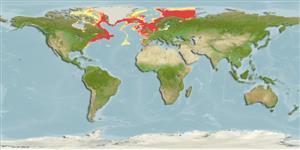
| Native range | All suitable habitat | Point map | Year 2050 |
|
| This map was computer-generated and has not yet been reviewed. |
| Amblyraja radiata AquaMaps Data sources: GBIF OBIS |
Hochladen Photos und videos
Bilder | Google Bild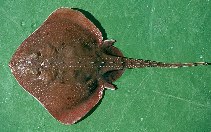 Amblyraja radiata
Photo von Ueberschär, B.
Bilder | Google Bild
Photo von Ueberschär, B.
Klassifizierung / Names Namen | Synonyme | Catalog of Fishes(Gattung, Arten) | ITIS | CoL | WoRMS | Cloffa
Elasmobranchii (Haie und Rochen) (sharks and rays) > Rajiformes (Skates and rays) > Rajidae (Skates)
Etymology: Amblyraja: Greek, amblys = darkness + Latin, raja, -ae = ray (Raja sp.) (Ref. 45335).
Etymology: Amblyraja: Greek, amblys = darkness + Latin, raja, -ae = ray (Raja sp.) (Ref. 45335).
Umwelt: Milieu / Klimazone / Tiefenbereich / Verbreitungsgebiet Ökologie
seewasser; brackwasser demersal; ozeanodrom (Ref. 51243); tiefenbereich 5 - 1540 m (Ref. 117245), usually 25 - 440 m (Ref. 114953). Boreal; -1°C - 14°C (Ref. 49751); 79°N - 38°N, 95°W - 54°E (Ref. 55275)
Verbreitung Territorien | FAO Gebiete | Ökosysteme | Vorkommen | Punkt Karte | Einführungen | Faunafri
North Atlantic and adjacent Arctic.
Länge bei der ersten Reifung / Größe / Gewicht / Alter
Geschlechtsreife: Lm 87.5 range ? - ? cm
Max length : 105 cm TL Männchen/unbestimmt; (Ref. 53748); max. veröff. Gewicht: 11.4 kg (Ref. 53748); max. veröff. Alter: 28 Jahre (Ref. 88929)
Max length : 105 cm TL Männchen/unbestimmt; (Ref. 53748); max. veröff. Gewicht: 11.4 kg (Ref. 53748); max. veröff. Alter: 28 Jahre (Ref. 88929)
Kurzbeschreibung Bestimmungsschlüssel | Morphologie | Morphometrie
Rückenflossenstacheln (insgesamt) : 0; Afterflossenstacheln: 0. Adults are rhomboid in shape, young are rounder (Ref. 7251). Short, stiff, bluntly triangular snout; tail shorter than body (Ref. 5578). Upper surface very rough, with solid thornlets scattered all over disc and tail, underside smooth, except for some prickles on snout; a constant pattern of separate orbital thorns, a regular row of 13-17 large thorns from nape to first dorsal fin (Ref. 3167); large, close-set thorns with star-shaped bases at upper disc (Ref. 5578). Coloration highly variable; brownish grey with scattered irregular black blotches dorsally; white ventrally; with darker spots and blotches on tail and pelvic fins; black spot on tip of tail (Ref. 2708).
Body shape (shape guide): other.
Body shape (shape guide): other.
Eurybathic, eurythermic (Ref. 4426) and benthic (Ref. 58426). Cold temperate species found in offshore waters (Ref. 88171) on all kinds of bottoms (Ref. 3167), mainly sandy and muddy (Ref. 82311). In the northeast Atlantic most common between 50-100 m depth (Ref. 88187) at temperatures of 2-5 °C (Ref. 89120). Some seasonal migrations have been reported from the western Atlantic (Ref. 52109, 89121). Migration experiments showed that 85 % of tagged individuals remained within 93 km of the release site, with longest distance travelled at 180 km (Ref. 82319). Feed mainly on fish, crustaceans (Ref. 5951) and polychaete worms (Ref. 5578), but also on hydroids, molluscs, cephalopods and echinoderms (Ref. 49751); known to be a scavenger (Ref. 89122). Diet changes with increasing body size (Ref. 82311). Different populations of starry rays mature at different ages and sizes (Ref. 88171). Oviparous (Ref. 3167). Maturity size varies from 44-90 cm TL. Young hatch at ca. 8-12 cm TL (Ref. 114953). Young may tend to follow large objects, such as their mother (Ref. 205). Rarely reaches 60 cm in the North Sea (Ref. 88187). Able to detect weak electric fields generated by potential prey organisms and may also generate its own weak electric fields (Ref. 10311). Probably taken by hake trawlers (Ref. 5578). Few are dried and salted in Iceland (Ref. 6902). It is a common Skate whose landings are converted to fish-meal (Ref. 117245). It has been mentioned that North American specimens grow to a larger size than East-Atlantic specimens (Arve Lynghammar, pers.comm., 11/09).
Lebenszyklus und Paarungsverhalten Geschlechtsreife | Fortpflanzung | Ablaichen | Eier | Fruchtbarkeit | Larven
Distinct pairing with embrace. Oviparous, laying 10-45 egg cases each year (Ref. 44869, 41305). Eggs are oblong capsules with stiff pointed horns at the corners deposited in sandy or muddy flats (Ref. 205). Egg capsules are 3.4-8.9 cm long and 2.3-6.8 cm wide (Ref. 41250). Paired eggs are laid. Embryos feed solely on yolk (Ref. 50449). In the North Sea, fully formed individuals hatch after 4 months and pups are about 8-11 cm in length (Ref. 44869, 37969). In the Barents Sea, low water temperature may lengthen embryonic development time to 2.5-3 years (Ref. 44869).
Hauptreferenz
Laden Sie Ihre Referenzen hoch | Referenzen | Koordinator : McEachran, John | Partner
McEachran, J.D. and K.A. Dunn, 1998. Phylogenetic analysis of skates, a morphologically conservative clade of elasmobranchs (Chondrichthyes: Rajidae). Copeia 1998(2):271-290. (Ref. 27314)
IUCN Rote Liste Status (Ref. 130435: Version 2025-2 (Global))
Verwundbar (VU) (A2bcd); Date assessed: 01 July 2019
CITES
Not Evaluated
Bedrohung für Menschen
Harmless
Nutzung durch Menschen
Fischereien: weniger kommerziell; Sportfisch: ja
FAO - Fischereien: landungen; Publication: search | FIRMS - Stock assessments | FishSource |
Mehr Information
Trophische Ökologie
Lebensmittel (Beutetiere)
Nahrungszusammensetzung
Nahrungsaufnahme
Lebensmittelrationen
Räuber
Lebensmittel (Beutetiere)
Nahrungszusammensetzung
Nahrungsaufnahme
Lebensmittelrationen
Räuber
Populationsdynamik
Wachstumsparameter
Max. Alter/Größen
Länge-Gewicht-Rel.
Länge-Länge-Verhältnis.
Längenhäufigkeiten
Massenkonvertierung
Rekrutierung
Dichte
Wachstumsparameter
Max. Alter/Größen
Länge-Gewicht-Rel.
Länge-Länge-Verhältnis.
Längenhäufigkeiten
Massenkonvertierung
Rekrutierung
Dichte
Lebenszyklus
Fortpflanzung
Geschlechtsreife
Reifung/Kiemen rel.
Fruchtbarkeit
Ablaichen
Laichaggregationen
Eier
Eientwicklung
Larven
Larven Pop.Dyn.
Fortpflanzung
Geschlechtsreife
Reifung/Kiemen rel.
Fruchtbarkeit
Ablaichen
Laichaggregationen
Eier
Eientwicklung
Larven
Larven Pop.Dyn.
Physiologie
Körperliche Zusammensetzung
Nährstoffe
Sauerstoffverbrauch
Schwimmart
Schwimmgeschwindigkeit
Visuelle Pigmente
Fischgeräusche
Krankheiten und Parasiten
Toxizität (LC50s)
Körperliche Zusammensetzung
Nährstoffe
Sauerstoffverbrauch
Schwimmart
Schwimmgeschwindigkeit
Visuelle Pigmente
Fischgeräusche
Krankheiten und Parasiten
Toxizität (LC50s)
Menschenbezogen
Aquakultur-Systeme
Aquakultur Profile
Zuchtlinien
Ciguatera-Fälle
Briefmarken, Münzen, Verschiedenes.
Aquakultur-Systeme
Aquakultur Profile
Zuchtlinien
Ciguatera-Fälle
Briefmarken, Münzen, Verschiedenes.
Tools
E-Book | Feldführer | Bestimmungsschlüssel | Längenhäufigkeits Tool | Lebensdaten Tool | Punkt Karte |
Catch-MSY |
Zusatzinformationen
Download XML
Zusammenfassung | Punktdaten | Namen | Photos
Internet Quellen
AFORO (otoliths) | Aquatic Commons | BHL | Cloffa | Websites from users | FishWatcher Einträge suchen | CISTI | Catalog of Fishes: Gattung, Arten | DiscoverLife | ECOTOX | FAO - Fischereien: landungen; Publication: search | Faunafri | Fishipedia | Fishtrace | GloBI | Google Books | Google Scholar | Google | IGFA World Record | Nationale Datenbanken | OceanAdapt | OneZoom | Open Tree of Life | Otolith Atlas of Taiwan Fishes | Öffentliche Aquarien | PubMed | Reef Life Survey | Socotra Atlas | TreeBase | Tree of Life | Wikipedia: Gehe zu, Suchen | World Records Freshwater Fishing | Zoologischer Rekord
Schätzungen auf der Grundlage von Modellen
Bevorzugte Temperatur (Ref. 123201): -0.8 - 5, mean 1 °C (based on 340 cells).
Phylogenetischer Diversitätsindex (Ref. 82804): PD50 = 0.5039 [Uniqueness, from 0.5 = low to 2.0 = high].
Bayesian length-weight: a=0.00324 (0.00279 - 0.00375), b=3.24 (3.20 - 3.28), in cm total length, based on LWR estimates for this species (Ref. 93245).
Trophische Ebene (Ref. 69278): 4.2 ±0.3 se; based on diet studies.
Widerstandsfähigkeit (Ref. 120179): niedrig, Verdopplung der Population dauert 4,5 - 14 Jahre. (K=0.17; tm=4; Fec=13-20).
Prior r = 0.09, 95% CL = 0.06 - 0.13, Based on 1 full stock assessment.
Nährstoffe (Ref. 124155): Calcium = 7.77 [1.30, 39.92] mg/100g; Iron = 0.366 [0.079, 1.119] mg/100g; Protein = 17 [14, 20] %; Omega3 = 0.661 [0.208, 2.577] g/100g; Selenium = 14.9 [3.6, 47.2] μg/100g; VitaminA = 9.24 [1.90, 45.37] μg/100g; Zinc = 0.284 [0.141, 0.547] mg/100g (wet weight);