



Tetronarce californica (Ayres, 1855)
Pacific electric ray
Beobachtung melden im Fish Watcher
| Native range | All suitable habitat | Point map | Year 2050 |

|
| This map was computer-generated and has not yet been reviewed. |
| Tetronarce californica AquaMaps Data sources: GBIF OBIS |
Hochladen Photos und videos
Bilder | videos | Google Bild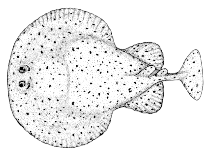 Tetronarce californica
Photo von Canadian Museum of Nature, Ottawa, Canada
Bilder | videos | Google Bild
Photo von Canadian Museum of Nature, Ottawa, Canada
Klassifizierung / Names Namen | Synonyme | Catalog of Fishes(Gattung, Arten) | ITIS | CoL | WoRMS | Cloffa
Elasmobranchii (Haie und Rochen) (sharks and rays) > Torpediniformes (Electric rays) > Torpedinidae (Electric rays)
Etymology: californica: Named after the state of California (Ref. 6885).
More on author: Ayres.
Etymology: californica: Named after the state of California (Ref. 6885).
More on author: Ayres.
Umwelt: Milieu / Klimazone / Tiefenbereich / Verbreitungsgebiet Ökologie
seewasser demersal; tiefenbereich 0 - 906 m (Ref. 96339), usually 3 - 200 m (Ref. 55307). Temperate; 48°N - 23°N, 126°W - 110°W (Ref. 55307)
Verbreitung Territorien | FAO Gebiete | Ökosysteme | Vorkommen | Punkt Karte | Einführungen | Faunafri
Eastern Pacific: Dixon Entrance, British Columbia, Canada to Sebastian Vizcaino Bay, Baja California, Mexico. Electric rays off Peru, Chile, and Japan may belong to this species (Ref. 2850).
Länge bei der ersten Reifung / Größe / Gewicht / Alter
Geschlechtsreife: Lm ?, range 73 - ? cm
Max length : 140 cm TL Männchen/unbestimmt; (Ref. 12951); 137.0 cm TL (female); common length : 91.0 cm TL Männchen/unbestimmt; (Ref. 43939); common length :137 cm TL (female); max. veröff. Gewicht: 0.00 g; max. veröff. Alter: 16 Jahre (Ref. 48844)
Max length : 140 cm TL Männchen/unbestimmt; (Ref. 12951); 137.0 cm TL (female); common length : 91.0 cm TL Männchen/unbestimmt; (Ref. 43939); common length :137 cm TL (female); max. veröff. Gewicht: 0.00 g; max. veröff. Alter: 16 Jahre (Ref. 48844)
Kurzbeschreibung Bestimmungsschlüssel | Morphologie | Morphometrie
Gray with scattered black spots dorsally, no ocelli. 1st dorsal fin much larger than 2nd. Spiracle margin smooth and without papillae.
Body shape (shape guide): other.
Body shape (shape guide): other.
Found on the outer continental shelf, around rocks, in kelp beds, over fine sand bottoms or buried in sand. Solitary, nomadic, and can remain suspended in the water with minimal swimming (Ref. 12951). Feeds on bony fishes, mainly herrings and halibuts. Ovoviviparous (Ref. 50449). Produces litters of up to 17 pups. Males reaches maturity at ca. 65 cm TL, females at ca. 73 cm TL (Ref. 114953). Attacks their prey from the substratum by day and actively forage at night with the aid of its electric organ discharge or EOD (Ref. 10011). The EOD of a large individual was measured at 50 V; with a low internal organ resistance the power output exceeded 1 kW (Ref. 10480). Aggressive when provoked but no human has yet been injured by the electric shock (Ref. 2850). Does not do well in aquariums (Ref. 12951).
Lebenszyklus und Paarungsverhalten Geschlechtsreife | Fortpflanzung | Ablaichen | Eier | Fruchtbarkeit | Larven
Exhibit ovoviparity (aplacental viviparity), with embryos feeding initially on yolk, then receiving additional nourishment from the mother by indirect absorption of uterine fluid enriched with mucus, fat or protein through specialised structures (Ref. 50449).
Reproductive cycle appears to be annual in males and biannual in females (Ref. 48844). No defined birthing season (Ref. 48844).
Hauptreferenz
Laden Sie Ihre Referenzen hoch | Referenzen | Koordinator : Carvalho, Marcelo | Partner
Allen, M.J. and G.B. Smith, 1988. Atlas and zoogeography of common fishes in the Bering Sea and northeastern Pacific. NOAA Tech. Rep. NMFS 66, 151 p. (Ref. 6793)
IUCN Rote Liste Status (Ref. 130435: Version 2025-2 (Global))
nicht bedroht (LC) ; Date assessed: 08 September 2024
CITES
Not Evaluated
Bedrohung für Menschen
Other (Ref. 13513)
Nutzung durch Menschen
FAO - Publication: search | FishSource |
Mehr Information
Trophische Ökologie
Lebensmittel (Beutetiere)
Nahrungszusammensetzung
Nahrungsaufnahme
Lebensmittelrationen
Räuber
Lebensmittel (Beutetiere)
Nahrungszusammensetzung
Nahrungsaufnahme
Lebensmittelrationen
Räuber
Populationsdynamik
Wachstumsparameter
Max. Alter/Größen
Länge-Gewicht-Rel.
Länge-Länge-Verhältnis.
Längenhäufigkeiten
Massenkonvertierung
Rekrutierung
Dichte
Wachstumsparameter
Max. Alter/Größen
Länge-Gewicht-Rel.
Länge-Länge-Verhältnis.
Längenhäufigkeiten
Massenkonvertierung
Rekrutierung
Dichte
Lebenszyklus
Fortpflanzung
Geschlechtsreife
Reifung/Kiemen rel.
Fruchtbarkeit
Ablaichen
Laichaggregationen
Eier
Eientwicklung
Larven
Larven Pop.Dyn.
Fortpflanzung
Geschlechtsreife
Reifung/Kiemen rel.
Fruchtbarkeit
Ablaichen
Laichaggregationen
Eier
Eientwicklung
Larven
Larven Pop.Dyn.
Anatomie
Kiemenoberfläche
Gehirn
Otolith
Kiemenoberfläche
Gehirn
Otolith
Physiologie
Körperliche Zusammensetzung
Nährstoffe
Sauerstoffverbrauch
Schwimmart
Schwimmgeschwindigkeit
Visuelle Pigmente
Fischgeräusche
Krankheiten und Parasiten
Toxizität (LC50s)
Körperliche Zusammensetzung
Nährstoffe
Sauerstoffverbrauch
Schwimmart
Schwimmgeschwindigkeit
Visuelle Pigmente
Fischgeräusche
Krankheiten und Parasiten
Toxizität (LC50s)
Menschenbezogen
Aquakultur-Systeme
Aquakultur Profile
Zuchtlinien
Ciguatera-Fälle
Briefmarken, Münzen, Verschiedenes.
Aquakultur-Systeme
Aquakultur Profile
Zuchtlinien
Ciguatera-Fälle
Briefmarken, Münzen, Verschiedenes.
Tools
Zusatzinformationen
Download XML
Zusammenfassung | Punktdaten | Namen | Photos
Internet Quellen
AFORO (otoliths) | Aquatic Commons | BHL | Cloffa | Websites from users | FishWatcher Einträge suchen | CISTI | Catalog of Fishes: Gattung, Arten | DiscoverLife | ECOTOX | FAO - Publication: search | Faunafri | Fishipedia | Fishtrace | GloBI | Google Books | Google Scholar | Google | IGFA World Record | OceanAdapt | OneZoom | Open Tree of Life | Otolith Atlas of Taiwan Fishes | PubMed | Reef Life Survey | Socotra Atlas | TreeBase | Tree of Life | Wikipedia: Gehe zu, Suchen | World Records Freshwater Fishing | Zoologischer Rekord
Schätzungen auf der Grundlage von Modellen
Bevorzugte Temperatur (Ref. 123201): 8.6 - 22.3, mean 12.8 °C (based on 100 cells).
Phylogenetischer Diversitätsindex (Ref. 82804): PD50 = 0.5001 [Uniqueness, from 0.5 = low to 2.0 = high].
Bayesian length-weight: a=0.01479 (0.00678 - 0.03229), b=2.97 (2.78 - 3.16), in cm total length, based on LWR estimates for this (Sub)family-body shape (Ref. 93245).
Trophische Ebene (Ref. 69278): 4.5 ±0.80 se; based on food items.
Widerstandsfähigkeit (Ref. 120179): niedrig, Verdopplung der Population dauert 4,5 - 14 Jahre. (Fec = 17; tm=9; tmax=16).