



Zapteryx exasperata (Jordan & Gilbert, 1880)
Banded guitarfish
เพิ่มการสังเกตของคุณใน Fish Watcher
| Native range | All suitable habitat | Point map | Year 2050 |

|
| This map was computer-generated and has not yet been reviewed. |
| Zapteryx exasperata AquaMaps Data sources: GBIF OBIS |
อัพโหลดของคุณ ภาพถ่าย และ วิดีโอ
รูปภาพหลายรูป | Google image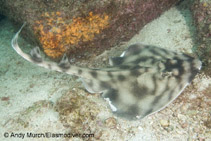 Zapteryx exasperata
ภาพโดย Murch, A.
รูปภาพหลายรูป | Google image
ภาพโดย Murch, A.
การจำแนกประเภท / ชื่อ ชื่อสามัญ | ชื่อพ้อง | Catalog of Fishes(สกุล, ชนิด) | ITIS | CoL | WoRMS | Cloffa
sub class Elasmobranchii (ฉลามและกระเบน) (sharks and rays) > Rhinopristiformes (Shovelnose rays) > Trygonorrhinidae (Banjo rays, Fiddler rays)
Etymology: Zapteryx: Greek, za = an augmentative particle + Greek, pteryx, wing, fin (Ref. 45335).
More on authors: Jordan & Gilbert.
Etymology: Zapteryx: Greek, za = an augmentative particle + Greek, pteryx, wing, fin (Ref. 45335).
More on authors: Jordan & Gilbert.
สิ่งแวดล้อม : สิ่งแวดล้อม / เขตภูมิอากาศ / ระดับความลึก / ระยะการกระจายสินค้า นิเวศวิทยา
เกี่ยวกับทะเล,น้ำเค็ม เกี่ยวกับหินโสโครก; ระดับความลึก 1 - 200 m (Ref. 37955), usually 1 - 22 m (Ref. 12951). Subtropical; 37°N - 20°N, 125°W - 108°W (Ref. 114953)
การแพร่กระจาย อาณาเขต | พื้นที่จำแนกตาม FAO | ระบบนิเวศหลายระบบ | การปรากฏขึ้น,การเกิดขึ้น,พบ | ตำแหน่งบนแผนที่ | การแนะนำ | Faunafri
Eastern Pacific: California, USA to Mexico, records to Peru probably misidentifications.
ความยาวเมื่อครบกำหนดครั้งแรก / ขนาด / น้ำหนัก / อายุ
วัยเจริญพันธุ์: Lm 68.0, range 57 - 77 cm
Max length : 83.0 cm เพศผู้/กระเทย; (Ref. 48844); 97.0 cm (female)
Max length : 83.0 cm เพศผู้/กระเทย; (Ref. 48844); 97.0 cm (female)
คำอธิบายสั้นๆ เครื่องมือที่ใช้ในการแยกชนิดสัตว์,สิ่งมีชีวิตออกจากกัน | สัณฐานวิทยา | ความยาวต่างๆ
สัตว์มีกระดูกสันหลัง: 149 - 150. Spiral valve count: 8-10. Broad disc is about as wide as it is long; dorsal surface covered with numerous, small to large, scattered, stellate prickles; a single median row of enlarged thorns running along the mid-back; a broad, short snout; small, blunt, pebble like teeth; a dorsal fin that originates closer to the pelvic fin bases than to the caudal fin origin; a thick tail and a moderately large, rounded caudal fin without a distinct lower lobe. Tooth count: 60-75/60-75.
Coloration: The dorsal surface is sandy brown to dark gray, with several prominent black bars, and lighter below with dark spots on the posterior edge of the pectoral fins.
Body shape (shape guide): other.
Body shape (shape guide): other.
Generally in rocky areas mainly shallower than 10 m, moves offshore onto soft bottoms in autumn and winter; but may also be found on sandy bottoms (Ref. 37955, Ref. 114953). Reported from tide pools (Ref. 12951). Relatively docile, harmless rays that are easily approached by divers (Ref. 48844). Feeds mainly on mollusks and crustaceans (Ref. 37955). Ovoviviparous (Ref. 50449), with 4 to 11 pups in a litter (Ref. 51576). Maturity size of males at 64-70 cm TL, females at 57-77 cm TL; birth size at 15-18 cm TL (Ref. 114953). Seldom buries itself in sand. This species is a commercially important part of artisanal fisheries (Ref. 114953).
Etymology: The genus name comes from the Greek za, meaning intensive, and pteryx, meaning fin, in reference to the vertical fins being larger than those of skates. The species name comes from Latin, meaning made rough, in reference to the numerous stellate prickles on its back. (Ref. 48844).
วงจรชีวิตและพฤติกรรมการผสมพันธุ์ วัยเจริญพันธุ์ | การสืบพันธุ์ | การวางไข่ | เซลสืบพันธ์ของเพศเมีย(ไข่) | ความดกของไข่ | ตัวอ่อน
Exhibit ovoviparity (aplacental viviparity), with embryos feeding initially on yolk, then receiving additional nourishment from the mother by indirect absorption of uterine fluid enriched with mucus, fat or protein through specialised structures (Ref. 50449).
During breeding season, male and female adult schools congregate in shallow areas of bays and lagoons (Ref. 51576). Parturition takes place three to four months after mating, with litters of 4 to 11 pups (Ref. 48844).
อ้างอิงหลัก
อัพโหลดข้อมูลอ้างอิงของคุณ | อ้างอิง | ผู้ประสานงาน | ผู้ร่วมมือ
Compagno, L.J.V., 1999. Checklist of living elasmobranchs. p. 471-498. In W.C. Hamlett (ed.) Sharks, skates, and rays: the biology of elasmobranch fishes. Johns Hopkins University Press, Maryland. (Ref. 35766)
สถานะบัญชีแดงของ IUCN (Ref. 130435: Version 2025-2 (Global))
เปราะบาง (VU) (A2cd); Date assessed: 04 March 2025
CITES
Not Evaluated
ภัยคุกคามต่อมนุษย์
Harmless
การใช้ของมนุษย์
การประมง: มีการค้าเพียงเล็กน้อย
FAO - Publication: search | FishSource |
ข้อมูลเพิ่มเติม
พลวัตของประชากร
พารามิเตอร์การเจริญเติบโต
อายุสูงสุด / ขนาด
ความยาว-น้ำหนักสัมพันธ์
ความยาว-ความยาวสัมพันธ์
ความยาว-ความถี่
การแปลงมวล
การทดแทนที่
อุดมสมบรูณ์
พารามิเตอร์การเจริญเติบโต
อายุสูงสุด / ขนาด
ความยาว-น้ำหนักสัมพันธ์
ความยาว-ความยาวสัมพันธ์
ความยาว-ความถี่
การแปลงมวล
การทดแทนที่
อุดมสมบรูณ์
วงจรชีวิต
การสืบพันธุ์
วัยเจริญพันธุ์
ความสมบูรณ์พันธุ์/เหงือกที่เกี่ยวข้อง
ความดกของไข่
การวางไข่
การรวมตัวของสปอน
เซลสืบพันธ์ของเพศเมีย(ไข่)
การพัฒนาไข่
ตัวอ่อน
พลวัตของสัตว์น้ำวัยอ่อน
การสืบพันธุ์
วัยเจริญพันธุ์
ความสมบูรณ์พันธุ์/เหงือกที่เกี่ยวข้อง
ความดกของไข่
การวางไข่
การรวมตัวของสปอน
เซลสืบพันธ์ของเพศเมีย(ไข่)
การพัฒนาไข่
ตัวอ่อน
พลวัตของสัตว์น้ำวัยอ่อน
การแพร่กระจาย
อาณาเขต
พื้นที่จำแนกตาม FAO
ระบบนิเวศหลายระบบ
การปรากฏขึ้น,การเกิดขึ้น,พบ
การแนะนำ
BRUVS - วิดีโอ
อาณาเขต
พื้นที่จำแนกตาม FAO
ระบบนิเวศหลายระบบ
การปรากฏขึ้น,การเกิดขึ้น,พบ
การแนะนำ
BRUVS - วิดีโอ
กายวิภาคศาสตร์
พื้นที่เหงือก
สมอง
หินโสต
พื้นที่เหงือก
สมอง
หินโสต
สรีรวิทยา
องค์ประกอบของร่างกาย
สารอาหาร
การใช้ออกซิเจน
ประเภทการว่ายน้ำ
ระดับความเร็วในการว่ายน้ำ
เม็ดสีที่มองเห็นได้
เสียงปลา
โรคและปรสิต
ความเป็นพิษ (LC50s)
องค์ประกอบของร่างกาย
สารอาหาร
การใช้ออกซิเจน
ประเภทการว่ายน้ำ
ระดับความเร็วในการว่ายน้ำ
เม็ดสีที่มองเห็นได้
เสียงปลา
โรคและปรสิต
ความเป็นพิษ (LC50s)
พันธุศาสตร์
จีโนม
พันธุศาสตร์
ความไม่สมดุลทางเชื้อชาติ
อัตราพันธุกรรม
ความหลากหลายทางพันธุกรรม
จีโนม
พันธุศาสตร์
ความไม่สมดุลทางเชื้อชาติ
อัตราพันธุกรรม
ความหลากหลายทางพันธุกรรม
เกี่ยวข้องกับมนุษย์
ระบบการเพาะเลี้ยงสัตว์น้ำ
ประวัติการเพาะเลี้ยงสัตว์น้ำ
สายพันธุ์
กรณีซิเกวเทอรา
แสตมป์ เหรียญ อื่นๆ
ระบบการเพาะเลี้ยงสัตว์น้ำ
ประวัติการเพาะเลี้ยงสัตว์น้ำ
สายพันธุ์
กรณีซิเกวเทอรา
แสตมป์ เหรียญ อื่นๆ
เครื่องมือ
แบบทดสอบชีววิทยา | หนังสืออิเล็กทรอนิกส์ | คู่มือภาคสนาม | ผู้มีความชำนาญในเรื่องความถี่ของความยาว | เครื่องมือในการศึกษาชีวประวัติ | ตำแหน่งบนแผนที่ |
จับ-MSY |
รายงานพิเศษ
ตรวจสอบการบำรุงรักษาตู้ปลา | ตรวจสอบเอกสารข้อเท็จจริงเกี่ยวกับสายพันธุ์ | ตรวจสอบเอกสารข้อเท็จจริงเกี่ยวกับการเพาะเลี้ยงสัตว์น้ำ
ดาวน์โหลด XML
หน้าสรุป | ข้อมูลสำคัญ | ชื่อสามัญ | ภาพถ่าย
แหล่งที่มาจากอินเตอร์เน็ต
AFORO (otoliths) | Aquatic Commons | BHL | Cloffa | Websites from users | Check FishWatcher | CISTI | Catalog of Fishes: สกุล, ชนิด | DiscoverLife | ECOTOX | FAO - Publication: search | Faunafri | Fishipedia | Fishtrace | GloBI | Google Books | Google Scholar | Google | IGFA World Record | OneZoom | Open Tree of Life | Otolith Atlas of Taiwan Fishes | PubMed | Reef Life Survey | Socotra Atlas | TreeBase | แผนภูมิชีวิตแบบต้นไม้ | Wikipedia: Go, ค้นหา | World Records Freshwater Fishing | บันทึกทางด้านสัตววิทยา
การประมาณค่าตามแบบจำลอง
อุณหภูมิที่ต้องการ (อ้างอิง 123201): 18.1 - 28.5, mean 23.1 °C (based on 64 cells).
ดัชนีความหลากหลายทางวิวัฒนาการ (อ้างอิง 82804): PD50 = 0.6289 [Uniqueness, from 0.5 = low to 2.0 = high].
Bayesian length-weight: a=0.00724 (0.00264 - 0.01991), b=3.00 (2.77 - 3.23), in cm total length, based on LWR estimates for this (Sub)family-body shape (Ref. 93245).
ระดับชั้นอาหาร (อ้างอิง 69278): 3.6 ±0.53 se; based on food items.
Generation time: 7.8 ( na - na) years. Estimated as median ln(3)/K based on 2 growth studies.
ความสามารถในการกลับคืนสู่ปกติ (อ้างอิง 120179): ต่ำมาก, เวลาต่ำสุดที่จะทำให้ประชากรเพิ่มขึ้นเป็น 2 เท่าใช้เวลามากกว่า 14 ปี (Fec = 4).
สารอาหาร (Ref. 124155): Calcium = 9.41 [1.30, 36.16] mg/100g; Iron = 0.385 [0.093, 1.046] mg/100g; Protein = 19.9 [17.7, 21.9] %; Omega3 = 0.146 [0.062, 0.340] g/100g; Selenium = 16.5 [4.8, 49.0] μg/100g; VitaminA = 34.4 [11.2, 110.6] μg/100g; Zinc = 0.605 [0.292, 1.289] mg/100g (wet weight);