This website uses cookies to enhance your browsing experience and ensure the functionality of our site. For more detailed information about the types of cookies we use and how we protect your privacy, please visit our Privacy Information page.
×
Cookie Settings
This website uses different types of cookies to enhance your experience. Please select your preferences below:
(كوسه ها و سپرماهيان) (sharks and rays) > Orectolobiformes (Carpet sharks) > Ginglymostomatidae (Nurse sharks)
Etymology: Ginglymostoma:ginglymus (Gr.), hinge; stoma (Gr.), mouth, presumably referring to how corner of mouth has a hinged appearance (See ETYFish); cirratum:Latin for having tendrils, referring to elongated nasal barbels (See ETYFish). More on author: Bonnaterre.
محیط زیست: محیط زیست / منطقه آب و هوایی / تغييرات عمق / محدوده توزیع بوم شناسي
دريايي; لب شور وابسته به آب سنگ; تغييرات عمق 0 - 130 m (Ref. 43278), usually 1 - 35 m (Ref. 40849). Subtropical; 44°N - 35°S, 122°W - 10°E (Ref. 43278)
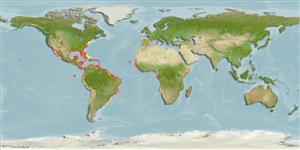
Western Central Atlantic: Rhode Island to southern Brazil (south to Rio de Janeiro), including Gulf of Mexico and Caribbean coasts, although (exceptionally from Rhode Island to Texas), Bermuda; Eastern Central Atlantic: Cape Verde Islands, Senegal, Cameroon to Gabon, and rarely north to Bay of Biscaye, France (ref. 43278). Populations in eastern Pacific refer to Ginglymostoma unami Del Moral-Flores et al., 2015 (Ref. 113902).
طول در اولین بلوغ / اندازه / وزن / سن
بلوغ: Lm235.0, range 230 - 240 cm Max length : 430 cm TL جنس نر / بدون خواص جنسي; (Ref. 96339); common length : 304 cm TL جنس نر / بدون خواص جنسي; (Ref. 247); بيشينه وزن گزارش شده: 109.6 kg (Ref. 40637); بيشينه سن گزارش شده: 25 سال ها (Ref. 72467)
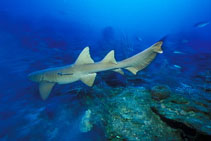
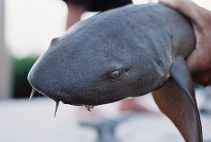
خارهاي باله پشتي (کل) : 0. Moderately long barbels, nasoral grooves present but no perinasal grooves, mouth well in front of eyes, spiracles minute, precaudal tail shorter than head and body, dorsal fins broadly rounded (the first much larger than the second and anal fins), caudal fin moderately long, over 1/4 of total length, yellow-brown to grey-brown in color, with or without small dark spots and obscure dorsal saddle markings (Ref. 247). Head blunt, mouth inferior, pair of conspicuous barbels between nostrils (Ref. 26938). Body shape (shape guide): elongated.
Found on continental and insular shelves. Solitary (Ref. 26340) and sluggish fish, often encountered lying on the bottom (Ref. 9987). Nocturnal, feeding on bottom invertebrates such as spiny lobsters, shrimps, crabs, sea urchins, squids, octopi, snails and bivalves, and fishes like catfishes, mullets, puffers and stingrays. Ovoviviparous with 21 to 28 young in a litter (Ref. 9987, 43278). Kept in captivity for researches. May attack humans if they are molested or stepped upon accidentally. Edible, but mainly valued for its hide, which makes extremely tough and durable leather (Ref. 9987). Common over shallow sand flats, in channels, and around coral reefs; young may be found among prop roots of red mangroves (Ref. 26938).
Ovoviviparous, with 21 to 28 young in a litter. Development of young in the uterus being sustained by a large supply of yolk. Females give birth in late spring and summer in waters off Florida. During courtship, a pair sometimes a triplet of adults engaged in synchronized parallel swimming. While on it, the male may grab one of the female's pectoral fins with his mouth which induces the female to pivot 90° and roll on her back on the bottom. Then the male inserts a clasper in her vent, and then roll on his back beside the female. Pair may break apart and depart rapidly after copulation or the male may remain motionless on the subtrate as if recovering from the mating bout (Ref. 49562). Not all attempts of males to copulate with a female nurse shark result in successful fertilization, females may employ avoidance by 'pivotting and rolling' to escape from male attention (Ref. 49562). Or females may 'lie on back' and rest motionless and rigidly on the substrate (Ref. 51113, 49562). On the contrary, females send signals of readiness to copulate with males by arching their body toward their male partner and cupping the pelvic fin (Ref. 51126, 49562). Male nurse sharks may mate with many females over several weeks (polygyny) and vice versa (polyandry) (Ref. 49562). Also Ref. 205.
Compagno, L.J.V., 1984. FAO Species Catalogue. Vol. 4. Sharks of the world. An annotated and illustrated catalogue of shark species known to date. Part 1 - Hexanchiformes to Lamniformes. FAO Fish. Synop. 125(4/1):1-249. Rome, FAO. (Ref. 247)
وضعيت در فهرست قرمز IUCN (Ref. 130435: Version 2025-2 (Global))
دمای ترجیحی (مرجع 123201): 22.3 - 28, mean 25.5 °C (based on 798 cells).
شاخص تنوع فیلوژنتیکی (مرجع 82804): PD50 = 0.8125 [Uniqueness, from 0.5 = low to 2.0 = high].
Bayesian length-weight: a=0.00417 (0.00158 - 0.01100), b=3.08 (2.85 - 3.31), in cm total length, based on LWR estimates for this (Sub)family-body shape (Ref. 93245).
سطح تروفیک (مرجع 69278): 4.2 ±0.2 se; based on diet studies.
جهندگی (مرجع 120179): پايين ، كم, كمينه زمان لازم براي دو برابر شدن جمعيت 5/4 – 14 سال (K=0.14; tmax=25; Fec=21-28).
آسیبپذیری ماهیگیری (Ref. 59153): Very high vulnerability (90 of 100). 🛈
آسیبپذیری اقلیمی (Ref. 125649): High vulnerability (65 of 100). 🛈